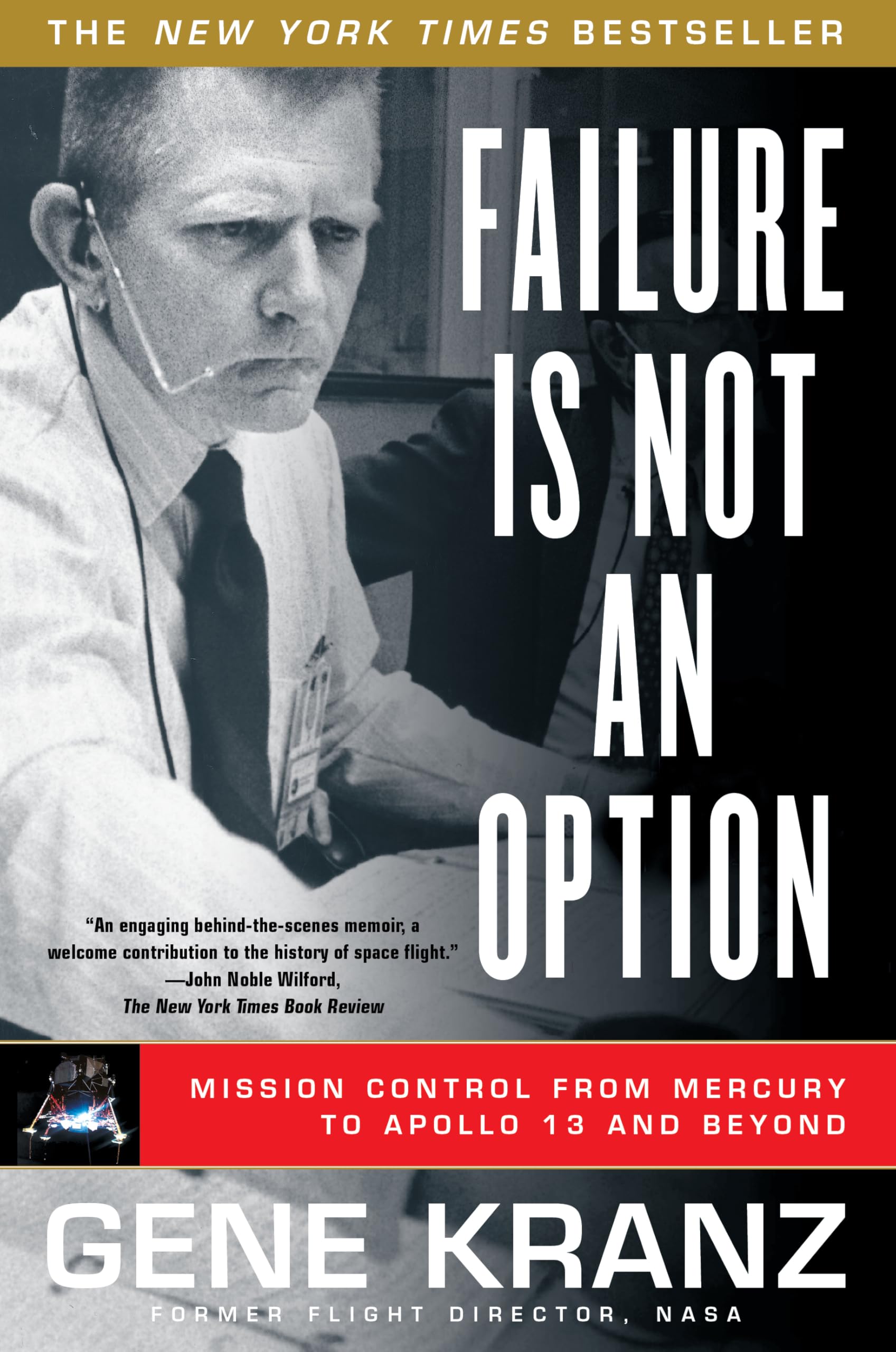
Failure Is Not an Option: Mission Control From Mercury to Apollo 13 and Beyond
$9.99
by Gene Kranz



This New York Times bestselling memoir of a veteran NASA flight director tells riveting stories from the early days of the Mercury program through Apollo 11 (the moon landing) and Apollo 13, for both of which Kranz was flight director. Gene Kranz was present at the creation of America’s manned space program and was a key player in it for three decades. As a flight director in NASA’s Mission Control, Kranz witnessed firsthand the making of history. He participated in the space program from the early days of the Mercury program to the last Apollo mission, and beyond. He endured the disastrous first years when rockets blew up and the United States seemed to fall further behind the Soviet Union in the space race. He helped to launch Alan Shepard and John Glenn, then assumed the flight director’s role in the Gemini program, which he guided to fruition. With his teammates, he accepted the challenge to carry out President John F. Kennedy’s commitment to land a man on the Moon before the end of the 1960s. Kranz recounts these thrilling historic events and offers new information about the famous flights. What appeared as nearly flawless missions to the Moon were, in fact, a series of hair-raising near misses. When the space technology failed, as it sometimes did, the controllers’ only recourse was to rely on their skills and those of their teammates. He reveals behind-the-scenes details to demonstrate the leadership, discipline, trust, and teamwork that made the space program a success. A fascinating firsthand account by a veteran mission controller of one of America’s greatest achievements, Failure Is Not an Option reflects on what has happened to the space program and offers his own bold suggestions about what we ought to be doing in space now. "An engaging behind-the-scenes memoir, a welcome contribution to the history of space flight." -- John Noble Wilford, The New York Times Book Review "A blow-by-blow account of heroic teams overcoming adversity...No matter how many times you read the story of the Apollo 11 landing, with computer alarms going off and only seconds of fuel left, it is a heartstopper. Here, Kranz recalls it vividly." -- Alex Roland, The Washington Post "A rich, behind-the-scenes account of the experts who held the lives of America's first space explorers in their hands." -- Mark Carreau, Houston Chronicle Eugene F. Kranz joined the NASA Space Task Group in 1960 and was Assistant Flight Director for Project Mercury (the original manned space missions). He continued as Flight Director for the Apollo 11 lunar landing. He is a co-recipient of the Presidential Medal of Freedom for his work leading the Apollo 13 teams. Failure Is Not an Option is his first book. He lives with his family near Houston, Texas. Chapter One: The Four-Inch Flight "Houston, we have a problem." At some time in the hours that followed that terse announcement from Apollo 13, many of us in NASA's Mission Control Center wondered if we were going to lose the crew. Each of us had indelible memories of that awful day three years before when three other astronauts sat in an Apollo spacecraft firmly anchored to the ground. Running a systems test. Routine. In terms of the distances involved in spaceflight, we could almost reach out and touch them. Moments after the first intimation that something had gone terribly wrong, technicians were up in the gantry, desperately trying to open the hatch. It took only seconds for an electrical glitch to ignite the oxygen-rich atmosphere of the cabin, creating a fire that was virtually a contained explosion. In those few seconds, the men inside the capsule knew what was happening -- and they must have realized, at the last moment, that there was no escape. We simply could not reach them in time. Now, three equally brave men were far beyond us in distance, far out in the vast absolute zero world of space, the most deadly and unforgiving environment ever experienced by man. We could measure the distances in miles. But with so many miles, the number was an abstraction, albeit one we had become used to dealing with in matter-of-fact fashion. We could reach them only with our voices, and they could speak to us only through the tenuous link of radio signals from precisely directional radio antennas. This time they were truly beyond our reach. Time and distance. So close were we in the Apollo fire that claimed the first three Americans to be killed in a spacecraft. Now we were so far, so very far, away. Once again, technology had failed us. We had not anticipated what happened back then, on Earth. We had not anticipated what had happened this time. In fact, it would be hours before we really understood what had happened. There was one big difference in this case. We could buy time. What we could not accomplish through technology, or procedures and operating manuals, we might be able to manage by drawing on a priceless fund of experience, accumulated over almost a decade of send