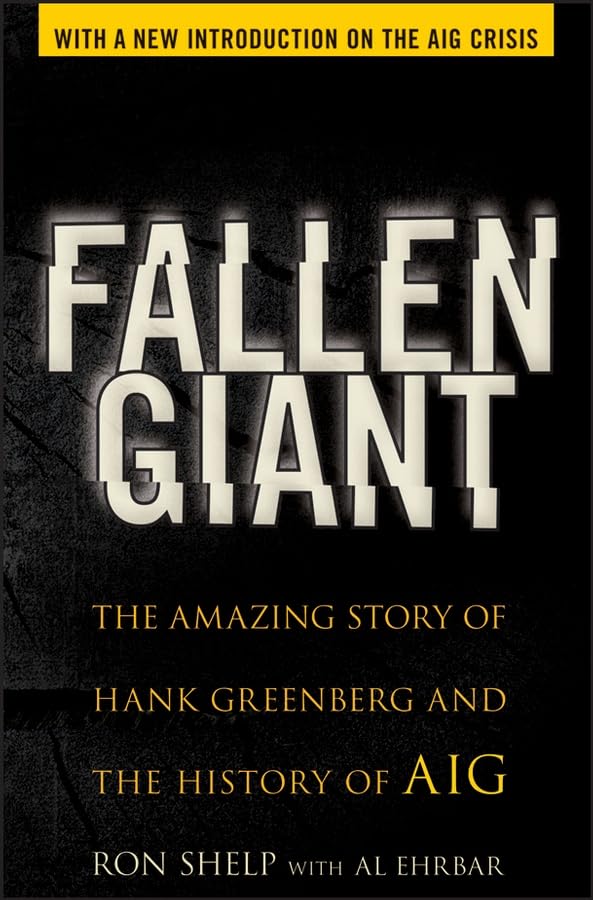



In Fallen Giant, author Ron Shelp—who worked within the AIG organization for more than a decade—sheds light on AIG, the company, and Hank Greenberg, the man. Through in-depth research, candid interviews, and firsthand experiences, Shelp provides a detailed look at how AIG was originally created and reveals how Greenberg’s unrelenting drive to be the best may have led to his untimely departure from AIG. "All Hank Greenberg ever wanted was "an unfair advantage." That is the phrase that Ron Shelp chooses to sum up Maurice R. Greenberg, the deposed chairman of the American International Group and the subject of his “Fallen Giant: The Amazing Story of Hank Greenberg and the History of A.I.G.,” and it would be hard to improve on. Insurance, Mr. Greenberg realized early, is the game of playing only when the odds are in one’s favor. For instance, if a far-flung customer wants insurance against a kidnapping — a risk that few others will touch — chances are that you can charge a lot for the policy. As Mr. Greenberg did not fail to notice, plenty of overseas executives are kidnapped, but many more are not — and they pay premiums, too. Throw in a few other “unfair” advantages, like lobbying, cajoling or otherwise persuading governments to do one’s bidding as well as, quite possibly, obscuring some of the truth about one’s operations, and you have the secret of a great insurance fortune. Accusations of cooking the books more or less forced Mr. Greenberg to resign last year. Mr. Shelp, a former Greenberg lieutenant and troubleshooter at A.I.G., wrote the book ostensibly to explain his old boss’s fall from grace. He asks some very good questions. One is why Mr. Greenberg would risk his $3 billion fortune on some “fairly modest fiddling.” Another is this: What did Eliot Spitzer, New York’s attorney general and now its governor-elect, have against Mr. Greenberg, whom he all but accused of criminality on Sunday morning television? Then, after the A.I.G. board forced Mr. Greenberg to resign, Mr. Spitzer neglected to charge him after all. Well, never mind. (Mr. Spitzer did file civil charges, which Mr. Greenberg is contesting.) Mr. Shelp leaves no doubt that A.I.G. was a master at shaping and, at times, bending the rules, but he argues that the offenses that got Mr. Greenberg canned were pretty modest, and notes that reversing the deals in question resulted in a write-down of only 3 percent of A.I.G.’s equity. The author does not probe deeply enough to resolve the legal issues, nor does he have much fresh news, but that is not his point. Mr. Shelp is more interested in another question: How did A.I.G.’s “unique corporate culture” contribute to its autocratic chairman’s success and — after 37 years at the helm — his undoing? This gives Mr. Shelp license for telling one of the great unsung stories in American business, namely the origins of A.I.G. The company was founded by Cornelius Vander Starr, a gadabout soda-fountain operator in Fort Bragg, Calif., who switched to real estate, then insurance. For no particular reason, he hopped a boat to the Far East and in 1919 began to sell policies in Shanghai. Somehow, he talked American insurance companies into giving him their “pen” — that is, letting him act as their agent. Starr had a wonderful idea, which was that the Chinese were not such a bad risk. (Other Western insurance companies in China preferred to sell policies only to Occidentals.) As you can imagine, this broadened his client base considerably. Mr. Shelp says Starr proved his affection for the natives by selling to them, but this is patronizing. What he proved was his good business sense. Starr branched into other countries, bought newspapers in China, became friendly with American intelligence operatives. The author, who aims to be fair but does not pretend to be neutral, relates quite a few tales from those swashbuckling days, some of which are relevant to his narrative and many of which are interesting. His style is conversational, as if he were telling the story from an adjacent barstool. When Starr marries, the author says his wife “would have been in her 20s” — as if the author were only dimly recalling an unverifiable detail. We will allow Mr. Shelp his penchant for certain colonial mannerisms — for instance, referring to this or that character as a “Dutchman” or a “Chinese gentleman.” But a few of his sentences ought not to have slipped past his editor, nor his co-writer, Al Ehrbar. Here is one: “I persuaded friends at A.I.G. that an outsider writer but former employee who is basically friendly to A.I.G. would be read more widely than a corporate book, which might be read by some of those they give it to.” Here is another: “Apparently, they did well, for none withdrew because they were losing money.” This is perfectly good writing if you have just swallowed your fifth highball. The pity is that Mr. Shelp, in his quirky fashion, arrives at a truth about A.I.G. that writers who focused on the insurance deals