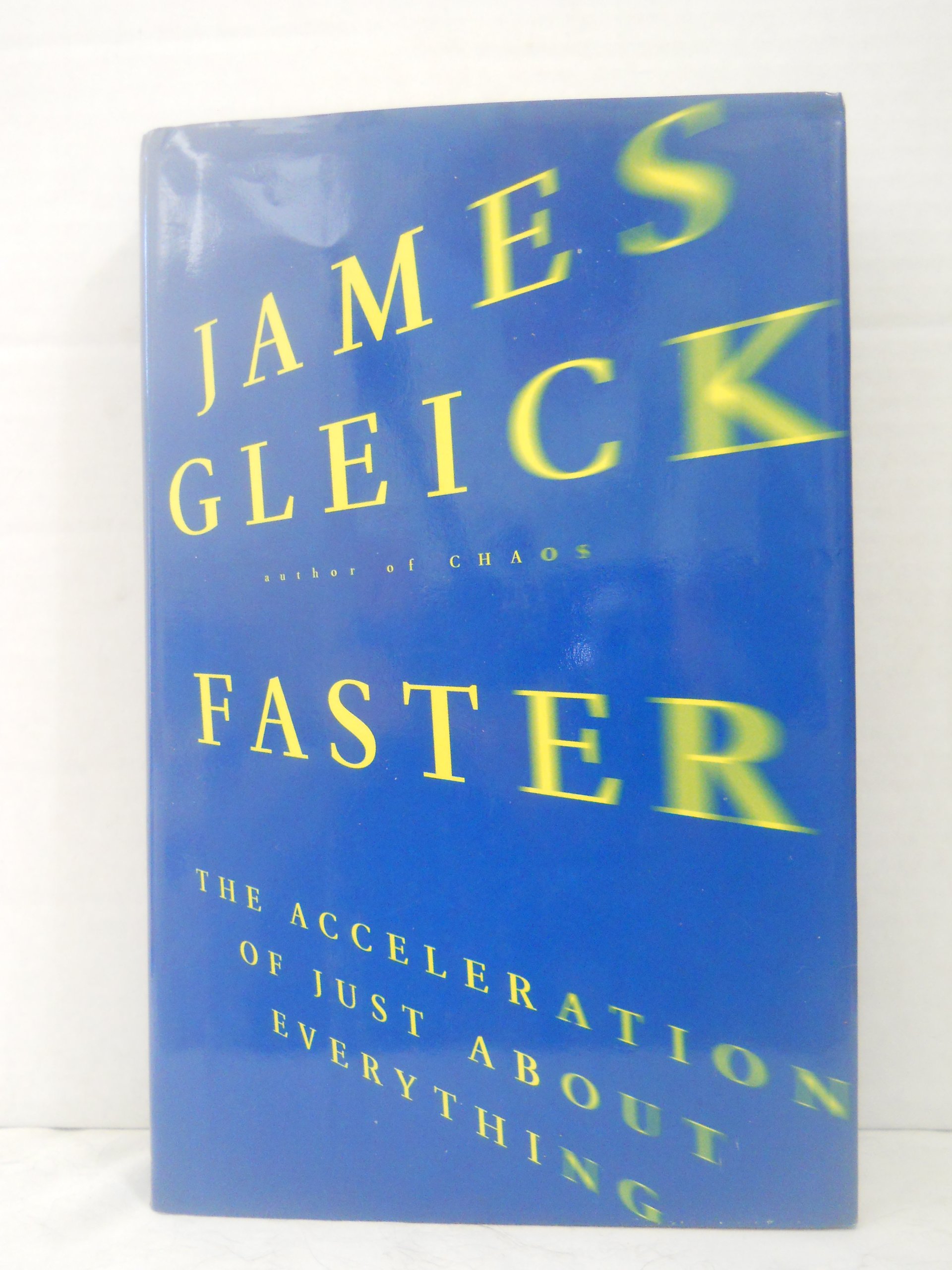



Synchronize your watches. We have reached the epoch of the nanosecond. This is the heyday of speed. If one quality defines our modern, technocratic age, it is acceleration. We are making haste. Our computers, our movies, our sex lives, our prayers -- they all run faster now than ever before. And the more we fill our lives with time-saving devices and time-saving strategies, the more rushed we feel. In Faster , James Gleick explores nothing less than the human condition at the turn of the millennium. He shines a light of enterprising and analytical reporting -- as well as sly wit -- on the newest paradoxes of time. His journey takes us through the bunkers and trenches of a war we barely knew we were fighting: to the atomic clocks of the Directorate of Time, to the waiting rooms that focus our impatience, to the film production studios that test the high-speed limits of our perception, to the air-traffic command centers that give time pressure new meaning. We have become a quick-reflexed, multitasking, channel-flipping, fast-forwarding species. We don't completely understand it, and we're not altogether happy about it. Faster is a mirror held up to our times -- and a mordant reminder of why some things take time. Never in the history of the human race have so many had so much to do in so little time. That, anyway, is the impression most of us have of civilized life at the end of the millennium, and Faster: The Acceleration of Just About Everything only sharpens it. Elegantly composed and insightfully researched, Faster delivers a brisk volley of observations on how microchips, media, and economics, among other things, have accelerated the pace of everyday experience over the course of the manic 20th century. Author of the pop-science triumph, Chaos , James Gleick brings his formidable writing skills to bear here, creating an almost poetic flow of ideas from what in other hands might have been just a mass of interesting facts and anecdotes. Whether tracing the modern history of chronometry (from Louis-François Cartier's invention of the wristwatch to the staggeringly precise atomic clocks of today's standards bureaus) or revealing the ways the camera has sped up our subjective sense of pace (from the freeze frames of Eadweard Muybridge's early photographic experiments to the jump cuts of MTV's latest videos), Gleick manages to weave in slyly perceptive or occasionally profound points about our increasingly hopped-up relationship to time. The result is the kind of thing only an accelerated culture like ours could have come up with: an instant classic. --Julian Dibbell Fax me, beep me, send me an e-mail, call me on my cell phone, or at worst send me an overnight delivery...just don't waste my time. "Real time" is what people perceive, but many machines are capable of working much, much faster. Technology has pushed the psychology of speed near human limits, so that "race conditions" and "hurry sickness" often prevail. In his other books (Chaos: The Making of a New Science and Genius: The Life and Science of Richard Feynmann), Gleick took his time to capture the complexities of his subjects, but here his pace is appropriately breathless, and his short chapters will be easily digested by busy people. Has the frantic pace of electronic society made us slaves of our own machines? Do they really make us more productive or even save our time? These are questions that many people are asking, so this book will attract a large readership. Read the book quickly, thoughAor else you'll fall behind everybody else. -AGregg Sapp, Univ. of Miami Lib., Coral Gables, FL Copyright 1999 Reed Business Information, Inc. Travel, communication, technology and most other things keep speeding up. "We are in a rush. We are making haste. A compression of time characterizes the life of the century now closing." That is science writer Gleick's snapshot of today's hurried citizens. He gives many examples: the door close button on elevators, routinely pushed by type A people; the Rush Hour Concerts offered by the New York Philharmonic; the remote control devices that have led to a frenzy of channel surfing. But is the incessant hurry gaining us anything? Gleick cites several common time-consuming irritants, suggesting that the answer is "Not much." Tollbooths, he says, "are monuments of civic ineptitude--along with the telephone lotteries at city agencies and queues at unemployment and passport offices." The telephone, supposedly a saver of time, is the source of some spectacular delays, notably for callers put on hold. "And before you get on hold, you must get past the busy signal." The Texas Transportation Institute's Urban Mobility Study found that in Los Angeles alone, more than 2.3 million person-hours were lost to traffic delay in 1994. What can the hurried and harried soul do about all this? At least, Gleick says, "recognize that neither technology nor efficiency can acquire more time for you, because time is not a thing