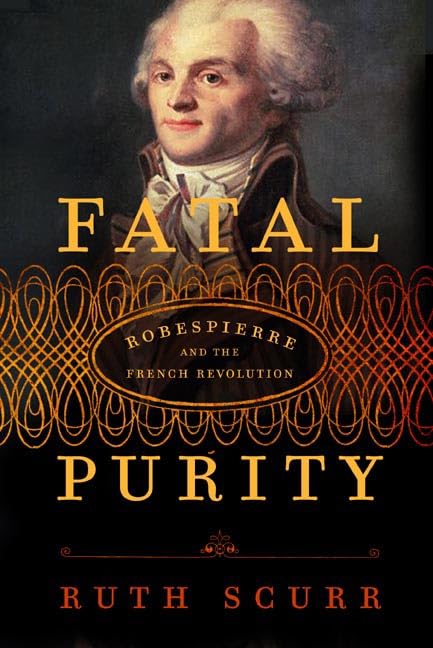



A riveting biography of the French Revolution's most enigmatic figure that restores him to his pivotal historic place Since his execution by guillotine in July 1794, Maximilien Robespierre has been contested terrain for historians, at once the most notorious leader of the French Revolution and the least comprehensible. Was he a bloodthirsty charlatan or the only true defender of revolutionary ideals? Was his extreme moralism--he was known as "The Incorruptible"--a heroic virtue or a ruinous flaw? Was he the first modern dictator or the earliest democrat? Against the dramatic backdrop of the French Revolution, historian Ruth Scurr follows the trajectory of Robespierre's paradoxical life, from his unprepossessing beginnings as a provincial lawyer opposed to repressive authority and the death penalty, to his meteoric rise in Paris politics as a devastatingly efficient revolutionary leader, righteous and paranoid in equal measure. She explores his reformist zeal, his role in the trial of the king and the fall of the monarchy, his passionate attempt to design a modern republic, even his extraordinary effort to found a perfect religion. And she follows him into the depths of the Terror, as he makes summary execution the order of the day, himself falling victim to the violence at the age of thirty-six. Written with epic sweep, full of nuance and insight, Fatal Purity is a fascinating portrait of a man who identified with the Revolution to the point of madness, and in so doing changed the course of history. The name Maximilien Robespierre seems to embody the excesses that contributed to the deterioration of the French Revolution; his name is synonymous with the expression "Reign of Terror." Born in the provincial city of Arras, the lawyer Robespierre carved a significant place for himself in the destruction of the ancien regime, but in 1794 he fell under the machine of terror he had greatly contributed to creating and was himself guillotined. Scurr is to be applauded--and read, of course--for bringing the intricacies of the revolutionary philosophies and actions to a readily comprehensible level; as this author maintains, "To understand [Robespierre] is to begin to understand the French Revolution." Robespierre was a peculiar personality, distinctive in ways that were not all positive, and here he is as accurately assessed as hindsight permits. For the general reader, then, this is not simply a well-balanced, evenly shaded portrait of the man and his motivations, mistakes, and achievements but also a helpful explanation of an event that makes our American Revolution seem straightforward and of undeniable good sense. Brad Hooper Copyright © American Library Association. All rights reserved "Ruth Scurr does for Robespierre and the French Revolution what Quentin Bell did for Virginia Woolf and Bloomsbury: she apprehends the complete personality of the man, the moment, and the movement. A work of genuine scholarship and political literature, Fatal Purity is an electrifying biography of an epoch's vaulting ambitions and wounded pride, radical vision and terrifying uncertainty, bracing heroism and decimating energies." -- Corey Robin, author of Fear: The History of a Political Idea Born in 1971, Ruth Scurr studied at Oxford and Cambridge, where she currently teaches politics and history. A prominent literary critic, she has written for The New York Review of Books and The Times Literary Supplement . Fatal Purity is her first book. Preface My dear Croker, I wish you would think seriously of the History of the Reign of Terror. I do not mean a pompous, philosophical history, but a mixture of biography, facts and gossip: a diary of what really took place with the best authenticated likenesses of the actors. Ever yours, Robert Peel1 Soon after he received this letter from his friend Sir Robert Peel, the once and future Tory prime minister, John Wilson Croker packed his bags for a seaside holiday. Although he was a prominent literary and political journalist and was hoping to work as he sat on the beach, Croker packed none of his collection of rare and fascinating books about the French Revolution that are now one of the glories of the British Library. He took with him only the list of those condemned to death during the Reign of Terror.2 He perused it against the rhythmic sound of waves breaking on the shore. Twenty-two impoverished women, many of them widows, convicted of forwarding "the designs of the fanatics, aristocrats, priests and other agents of England," guillotined. Nine private soldiers convicted of "pricking their own eyes with pins, and becoming by this cowardly artifice unable to bear arms," guillotined. Jean Baptiste Henry, aged eighteen, journeyman tailor, convicted of sawing down a tree of liberty, guillotined. Henrietta Frances de Marbœuf, aged fifty-five, convicted of hoping for the arrival in Paris of the Austrian and Prussian armies and of hoarding provisions fo