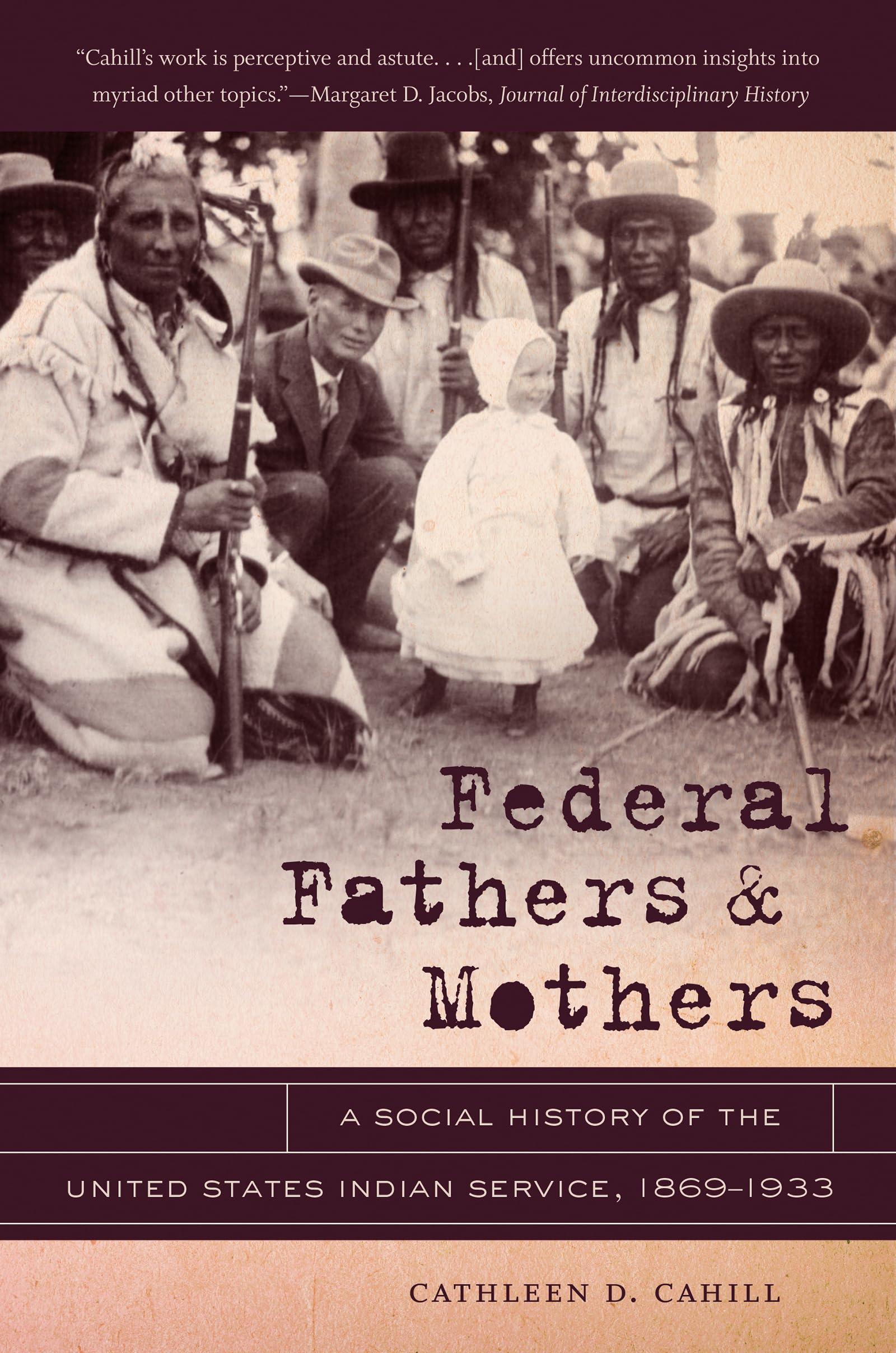
Federal Fathers and Mothers: A Social History of the United States Indian Service, 1869-1933 (First Peoples: New Directions in Indigenous Studies)
$39.95
by Cathleen D. Cahill



Established in 1824, the United States Indian Service (USIS), now known as the Bureau of Indian Affairs, was the agency responsible for carrying out U.S. treaty and trust obligations to American Indians, but it also sought to “civilize” and assimilate them. In Federal Fathers and Mothers , Cathleen Cahill offers the first in-depth social history of the agency during the height of its assimilation efforts in the late nineteenth and early twentieth centuries. Cahill shows how the USIS pursued a strategy of intimate colonialism, using employees as surrogate parents and model families in order to shift Native Americans' allegiances from tribal kinship networks to Euro-American familial structures and, ultimately, the U.S. government. “A major contribution to our understanding of how gender and ethnicity shaped Indian affairs in this era. The book is well written and deeply researched, and it gives readers a sophisticated and informed account of an era that remains understudied.” — North Carolina Historical Review “A new perspective on Indian-U.S. relations during the nineteenth and twentieth centuries. . . . An essential library addition for all scholars of federal policy and colonialism.” — Western Historical Quarterly “A groundbreaking account.” — Ethnohistory “An in-depth social history of the United States Indian Service. . . . Well-researched, interesting, even inspirational, Cathleen Cahill’s Federal Fathers and Mothers highlights Indian history and the American historical context and brings the term ‘intimate colonialism’ solidly into the lexicon.” — Southwestern American Literature “An outstanding investigation of the Indian Service and its employees. Cahill’s work bolsters scholarship, challenging the unidirectional impact of empire and colonialism by demonstrating the domestic consequences of imperialism.” — Journal of the Gilded Age and Progressive Era “Innovative and compelling reading by a promising young scholar. . . . Cahill writes beautifully. . . [and] her research and significant interventions into historiographic trends make this an important book.” — Journal of Social History “Cahill’s work is perceptive and astute . . .[and] offers uncommon insights into myriad other topics.” — Journal of Interdisciplinary History “A valuable contribution to Indian history.” — Western Legal History “This work is essential in understanding the history of the Bureau of Indian Affairs.” — Journal of the North Carolina Association of Historians “Will appeal to scholars interested in colonialism and Native American studies, especially students of the assimilation era in the United States. Beyond North America, Cahill’s work will be of use to scholars interested in the social history of large governmental agencies and the employees who implement the broad directives of policymakers.” — H-Florida With fresh, insightful analysis, Cathleen Cahill reveals how ideas about gender, masculinity, and the family influenced and defined nineteenth-century policies about assimilation. Federal Fathers and Mothers is a major and valuable contribution to our knowledge of the Indian Service, its workforce, and their influence on tribes, communities, and individual Native lives in the United States.--Brenda Child, University of Minnesota, author of Boarding School Seasons: American Indian Families, 1900-1940 A social history of the agency and its Indigenous employees Cahill offers the first in-depth social history of the United States Indian Service (now the Bureau of Indian Affairs) during the height of its assimilation efforts in the late nineteenth and early twentieth centuries. The USIS pursued a strategy of intimate colonialism, using employees as surrogate parents and model families in order to shift Native Americans' allegiances from tribal kinship networks to Euro-American familial structures and, ultimately, the U.S. government. Cahill offers the first in-depth social history of the United States Indian Service (now the Bureau of Indian Affairs) during the height of its assimilation efforts in the late nineteenth and early twentieth centuries. The USIS pursued a strategy of intimate colonialism, using employees as surrogate parents and model families in order to shift Native Americans' allegiances from tribal kinship networks to Euro-American familial structures and, ultimately, the U.S. government. Cathleen D. Cahill is associate professor of history at Penn State University. Used Book in Good Condition