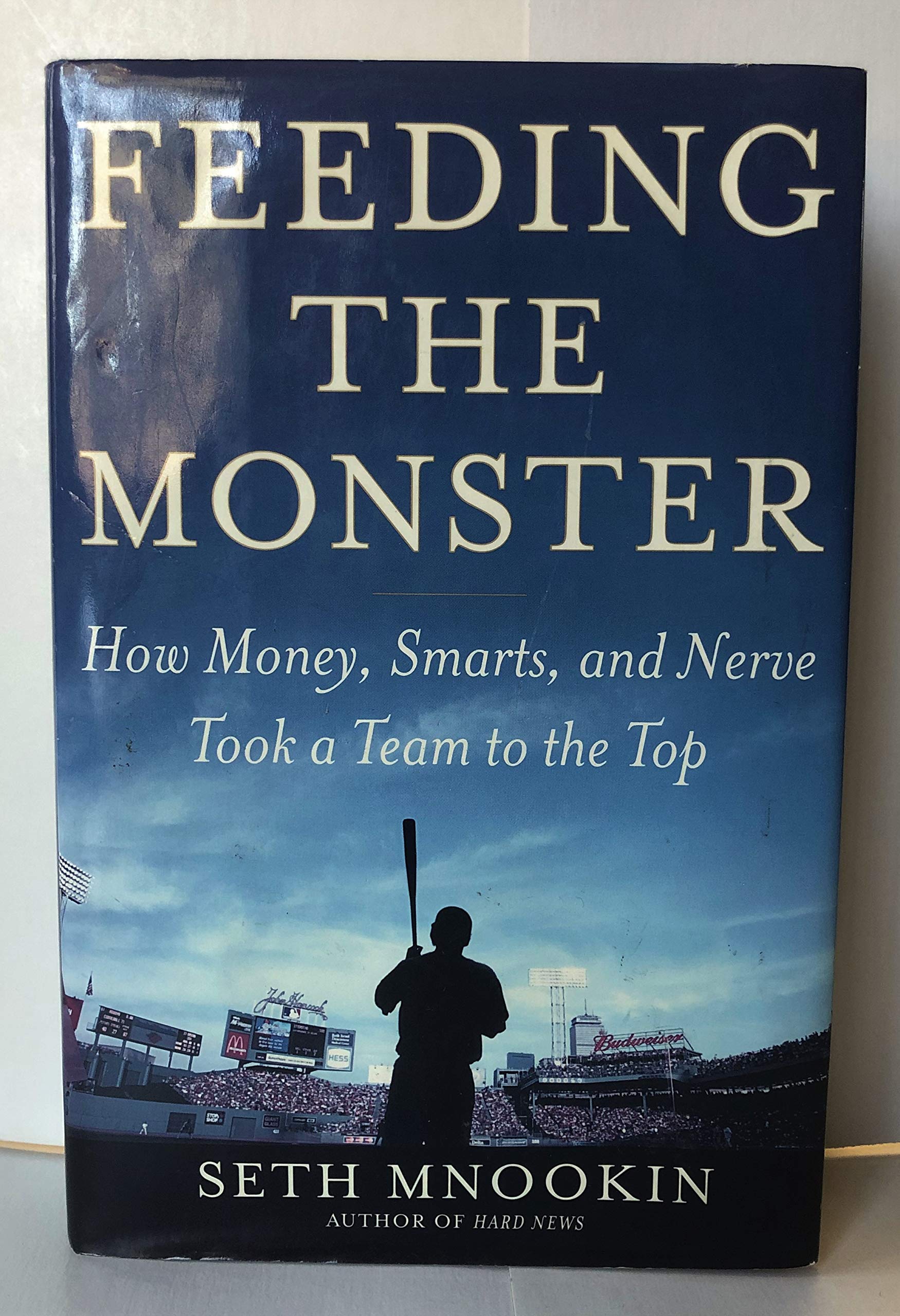
Feeding the Monster: How Money, Smarts, and Nerve Took a Team to the Top
$14.32
by Seth Mnookin



An inside account about how the Boston Red Sox rose from a reputedly "cursed" team to World Series champions documents such topics as the 2001 sale of the team, recent player trades and acquisitions, and plans for the next decade. By the author of Hard News. 250,000 first printing. Not so many years ago Boston was, or liked to think of itself as, the Athens of America. The people it most venerated, or claimed to venerate, were the likes of Ralph Waldo Emerson, William Dean Howells and Isabella Stewart Gardner: men and women of cultural distinction and accomplishment. Across the Charles River from the center city stood two of America's greatest universities, Harvard and the Massachusetts Institute of Technology, and on Beacon Hill lived the city's great aristocrats, who so loomed above the common folk that an otherwise deservedly unknown poet named John Collins Bossidy was inspired to declaim these immortal lines at a dinner in 1910: And this is good old Boston, The home of the bean and the cod, Where the Lowells talk to the Cabots And the Cabots talk only to God. That was then. Now, nearly a century later, Boston is a very different place. Its standing in the galaxy of great American cities, once beyond dispute, has changed dramatically. Not merely is it lost in the shadows of New York, Washington and Los Angeles, as Seth Mnookin points out in Feeding the Monster, but other cities to which it once condescended -- Atlanta, Houston, Dallas, Seattle, Miami, Tampa -- now wield far greater economic and political influence. Boston remains, as always, a place of great beauty and charm with which it is very easy to fall in love, but its importance is largely limited to New England. Except, that is, in the world of sport. However improbable it may be, this comparatively small city, which for much of the year has absolutely appalling weather and which occupies a relatively remote location, is the sports capital of the United States, or so at least it can be argued. No doubt this is appalling to those superannuated Beacon Hill aristos who retreat behind the walls of their clubs so as to look down on the rest of the world, but that world now knows Boston not for the high-powered eggheads of Harvard and MIT but for Tom Brady of the New England Patriots and David Ortiz of the Boston Red Sox. Nowhere in the country -- not even in Texas -- does the passion for spectator sports run so irrationally high as in Boston and its environs. America's Athens is now its Rome, with coliseums to which the multitudes flock. The most famous of those coliseums is Fenway Park. Four and a half decades ago a young writer named John Updike described it to perfection: "Fenway Park, in Boston, is a lyric little bandbox of a park. Everything is painted green and is in curiously sharp focus, like the inside of an old-fashioned peeping-type Easter egg." That too was then, and this is now: Fenway Park still retains its lyric essence, but it has become a big, booming business, every single game a sellout, every crowd raucous and explosive and hyperventilated. The tiny crowd that saw Ted Williams play his last game there in 1960 -- the occasion that inspired Updike's great essay "Hub Fans Bid Kid Adieu" -- and the tiny ones of which I was occasionally a member in the late 1960s, are distant memories now. Fenway Park is hotter than hot, and so too are the Red Sox, known universally in New England simply as "the Sawx." How this came to pass is the subject of Feeding the Monster. Mnookin, previously the author of a book about the various difficulties experienced by the New York Times in the early years of this decade, wrote an article for Vanity Fair about the Red Sox' incredible postseason run to the 2004 World Championship and apparently impressed the powers that be at the team, for they granted him "access to all levels of the organization" during the 2005 season and neither demanded nor received any editorial control over this book. The result is a detailed, knowledgeable account of how a successful sports franchise operates, how it deals with failure and success, how hard it is to turn a profit in a business that seems, at least from the outside, to be swimming in money. Feeding the Monster is scarcely as surprising or revelatory as its author and publisher believe it to be, and Mnookin's prose infrequently rises above cliché, but no doubt residents of Red Sox Nation will gobble it up, as may others who are interested in the inner workings of professional sports. Hardly a man or woman is now alive who doesn't know that in October 2004 the Red Sox ended more than eight decades of highly publicized frustration and won their first World Series since 1918. They did so in astonishing fashion, losing the first three games of the American League championship to the New York Yankees, roaring back to win the next four, then polishing off the St. Louis Cardinals -- by most accounts the best team in baseball that year -- in four games that bordered