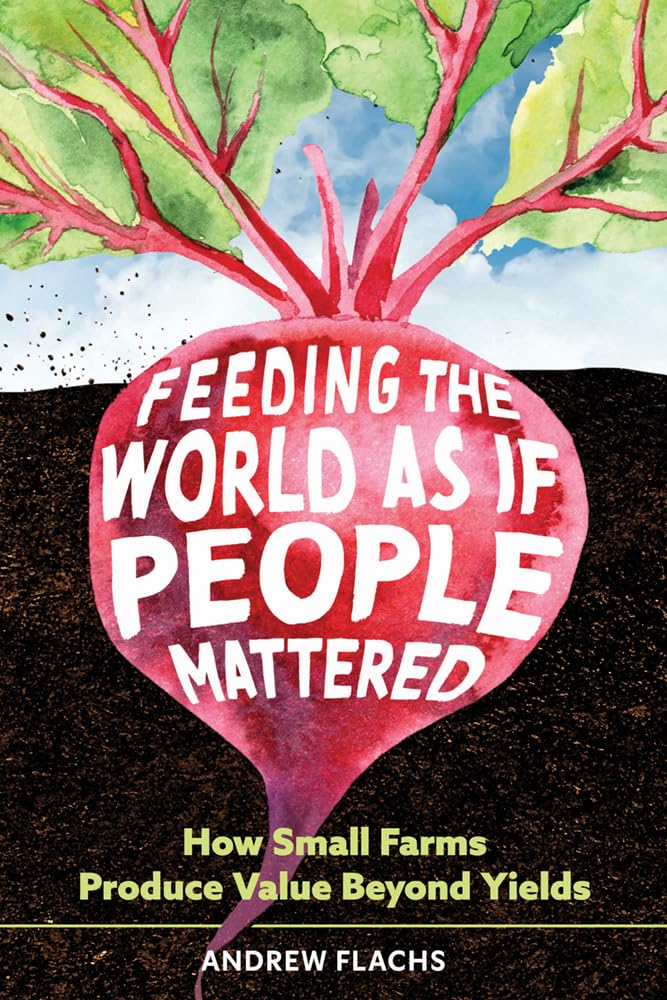
Feeding the World as if People Mattered: How Small Farms Produce Value Beyond Yields
$32.00
by Andrew Flachs



Backyard gardens flush with cucumbers, tomatoes, and peppers where bees buzz and chickens scratch. Beyond, a forest filled with blackberries and jewelweed. Inspired by childhood memories of his grandmother’s overflowing backyard garden, author Andrew Flachs has embarked on a multi-continent, decades-long look at agriculture and its value. The dominant view of agriculture has focused only on what we produce. It sees value in terms of capital gains or yield efficiency, masking how our global food system produces tremendous amounts of food commodities while failing to feed people, support rural communities, or enhance ecological well-being. Feeding the World as if People Mattered asks us to look more deeply and more humanely at what we perceive to be most valuable in our agricultural systems. This book draws on fifteen years of anthropological research, taking readers to fields in South India, Eastern Europe, and North America, where people are already feeding the future amid global change. From these fields, Flachs shows us how a radical rethinking of the value of small farms and farmers is already happening. Bringing together conversations in agriculture, economics, anthropology, and the environmental humanities, Flachs deftly shows how small farms reproduce social and ecological relationships that are the only sustainable path forward. For anyone who is curious about the food on their plate and the people who helped to get it there, Feeding the World as if People Mattered will offer a new way to find value in the food we grow and the people who grow it. “In Feeding the World as if People Mattered , Andrew Flachs reminds us that the measure of a farm is not only what it yields but what it preserves―soil, skill, fellowship, and the possibility of a lived, local economy. Through careful attention to small farms in India, Bosnia, and the Midwest, he shows how people hold together the practices that make a place habitable. This is a clear-sighted book, rooted in the lives of working people, and it offers the quiet but necessary truth that to care for the land is to care for one another.”―Raj Patel, author of Stuffed and Starved: The Hidden Battle for the World Food System “With its engaged ethnography, sensitive portrayals, and sharp critique, Flachs’s book can be considered the twenty-first century's transnational sequel to Walter Goldschmidt’s work that celebrated America’s small farms. Highlighting the limitations of industrial, capitalist agriculture, this book flags the potential that small farms in various parts of the world hold for ushering in new agrarian and social orders. If to ‘grow is to grow together’ in the spirit of community solidarity and cooperation, then this book enables us to question the tropes of productivity and unlimited growth.”―A. R. Vasavi, author of Shadow Space: Suicides and the Predicament of Rural India “Around the world, the most common livelihood that people have is small-scale farming, even though it is becoming increasingly marginalized by the corporations and states that shape people's lives. This wonderful new book, based on extensive work with small-scale farmers around the world, demonstrates that how the costs and benefits of small-scale farming are counted is a gross misrepresentation of its value. Small-scale farmers produce a greater diversity of life by building strong, meaningful relationships between people, plants, and landscapes. Rather than being the face of the past, this book shows that small-scale farming is critical to the face of a sustainable future. It will be essential reading for everyone who recognizes the peril facing our planet.”―A. Haroon Akram-Lodhi, author of Hungry for Change: Farmers, Food Justice and the Agrarian Question “This book is an exciting exploration of contemporary agriculture’s entangled webs of life, labor, and power. Flachs unveils how gardens and farms―whether in the Midwest, Bosnia, or Telangana―are not mere sites of production but vibrant places of creativity and resistance, where new configurations of human and nonhuman work point to a world beyond capitalism. This book is crucial for everyone seeking to understand how capitalism’s agrarian orders are remade and contested through everyday acts of resistance and reciprocity, offering a hopeful reimagining of agrarian life―and human possibility―in these turbulent times.”―Jason W. Moore, author of Capitalism in the Web of Life: Ecology and the Accumulation of Capital “What might a degrowth approach to global agriculture look like? Flachs argues that farming must be unmoored from the logics of productivism that have led to stark inequalities in the global food system. Reimagining farming as reproduction, the book makes a forceful argument for a return to agriculture’s roots as a social relation, rather than an economic one.”―Sarah Besky, author of Tasting Qualities: The Past and Future of Tea “Andrew Flachs is a genius! This is the book we have needed