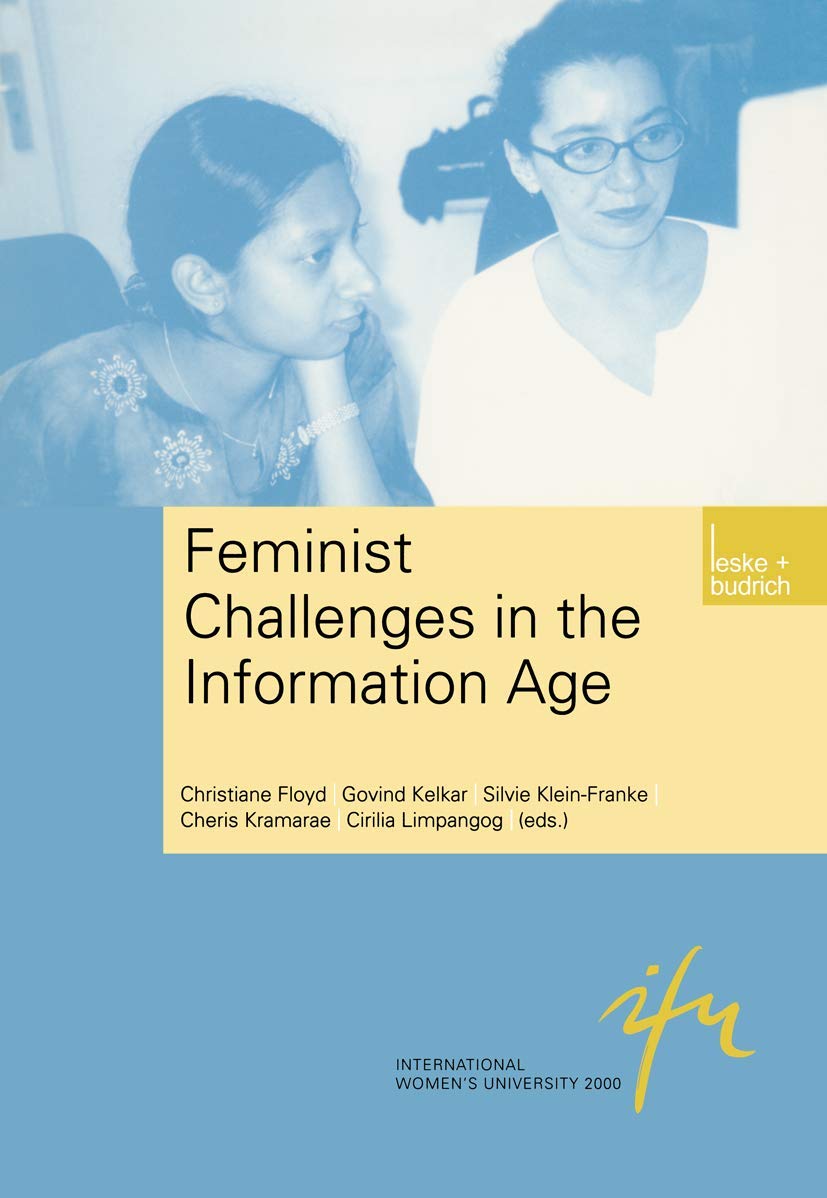
Feminist Challenges in the Information Age: Information as a Social Resource (Schriftenreihe der internationalen Frauenuniversität "Technik und Kultur
$54.99
by Christiane Floyd



In the last three decades, women's intervention in the social and natural sci ences, in medicine and technology has introduced new paradigms. We have to admit that it takes time and energy to influence these fields in a feministic way. Women do not only work for the growth of knowledge, but also for the trans formation of knowledge systems. This book is about using knowledge for action in an interdisciplinary effort focussing on information as a social resource. Women's approach to the information age is different, as becomes visible in this book: Women's scholarly explorations include not only developing technol ogy, but also improving communication and networking, as well as supporting democratic processes by taking advantage of the tremendous technological op tions. I am convinced that this approach is vital for living the information soci ety, and that it will also make fields relating to information technology more at tractive to women. This book is the outcome of the Project Area INFORMATION of the Interna tional Women's University (ifo) held at the University of Hamburg in the sum mer 2000. As the Deputy Minister for Science and Research of the Free and Hanseatic City of Hamburg I was responsible for promoting this study program. The international gathering of 150 participants was a most exciting event. The experience of ifo has enriched me as a scientist, as a feminist and as a politician. In summer 2000, about 160 women students, scientists and professionals from all over the world gathered at the University of Hamburg to join in the International Women´s University, Project Area Information. The articles in this book report on the ongoing work and the results obtained in this unique setting, which allowed for creativity and for a world-wide cooperation and exchange of views amongst women. The program was oriented mainly towards the idea of information as a social resource. It aimed to bring out women´s perspectives on understanding information and on exploring how to develop information for human needs. The focus was on how modern information and communication technologies interact with and radically change traditional ways of dealing with information, thus giving rise to information societies rooted in different cultures. Information societies come with new challenges and opportunities for women. Engaging actively and taking advantage of the technology, therefore, can be seen as a way of empowerment. The book brings out how building international learning communities opens the way to meet the challenges ahead: gendering information technology; enhancing communication; supporting cooperative, interactive learning; networking for community development; and fostering democracy. Christiane Floyd, Professor and Head of the Software Engineering Group at the Informatics Department, University of Hamburg; Govind Kelkar, Ph.D. in Political Economy, Professor of History and Gender and Development Studies, Consultant for the International Fund for Agricultural Development (IFAD) and the Food and Agriculture Organization (FAO); Silvie Klein-Franke, Ph.D. Immunobiology/Biochemistry; further education in affirmative action; Cheris Kramarae, Professor, Center for the Study of Women in Society, University of Oregon; Cirilia P. Limpangog, B.Sc. Mass Communication, Master in Public Administration, post graduate fellow in Germany on 'Gender and Corruption'.