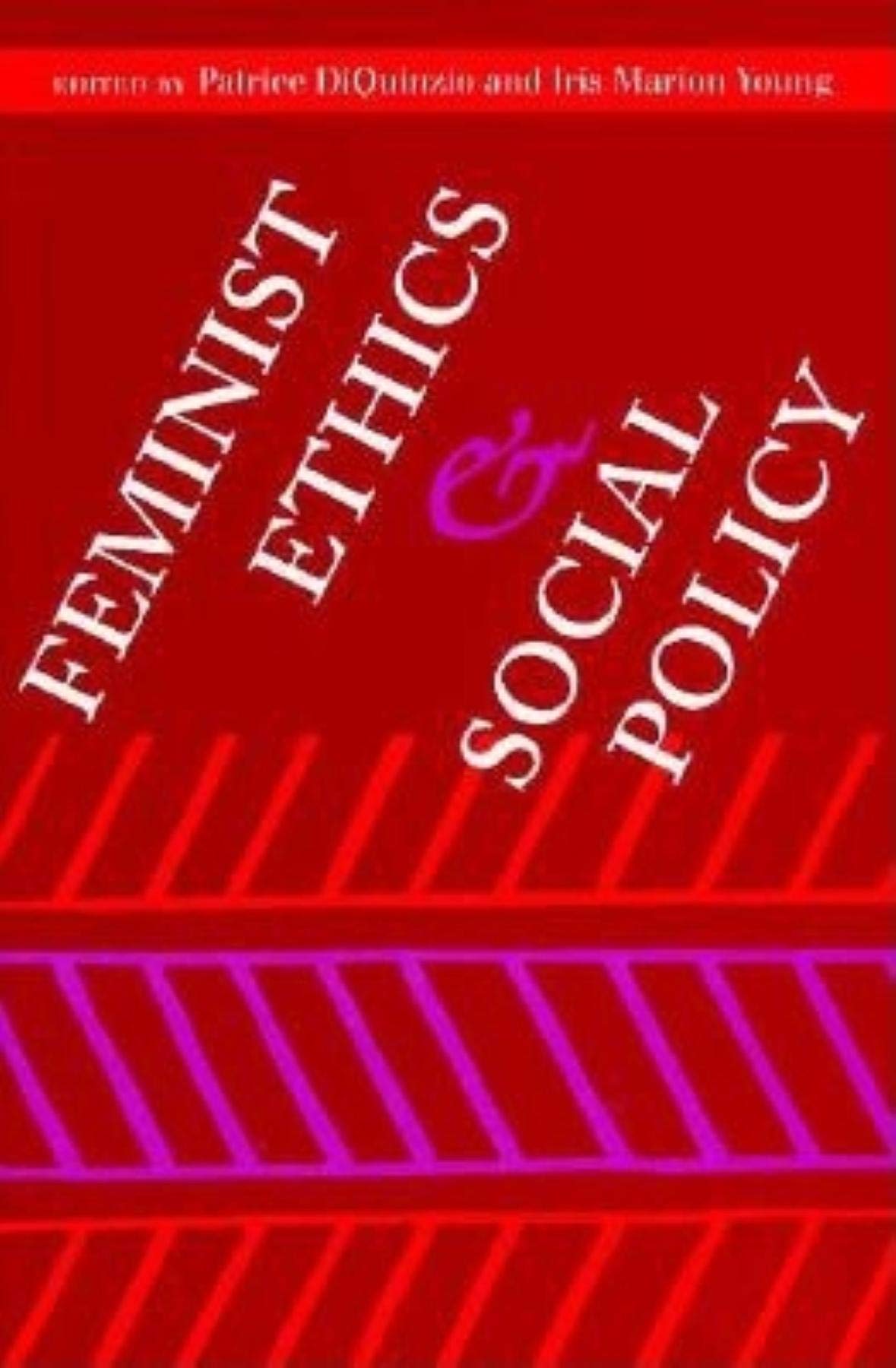



Much work in feminist ethics has been rather abstract. The editors of this work believe that the time has come to assess the potential contribution of feminist ethical theory to the evaluation of specific social policies. If feminist ethics has indeed mobilized important paradigm shifts in normative analysis, then this should enable creative ways of reflection on social policy. Feminist ethics criticizes the gender blindness and biases in much traditional ethical theory, and develops new theories and concepts that are more gender sensitive. Feminist ethics also works to conceptualize issues of right action, social justice, and the human good from out of the specifically gendered experience of diverse groups of women. Feminist ethics has no single set of questions or propositions, but includes a variety of approaches as demonstrated by these essays―some operate within a liberal framework of equality, freedom, justice, and rights, while others are more critical of mainstream liberal versions of these concepts. Patrice DiQuinzio, Assistant Professor of Philosophy and Director of Women's Studies at Muhlenberg College, has published articles in Hypatia and Women and Politics. Iris Marion Young, Professor of Public and International Affairs at the University of Pittsburgh, is the author of Throwing Like a Girl and Justice and the Politics of Difference. Feminist Ethics and Social Policy By Patrice DiQuinzio, Iris Marion Young Indiana University Press Copyright © 1997 Hypatia, Inc. All rights reserved. ISBN: 978-0-253-21125-5 Contents Introduction PATRICE DiQUINZIO AND IRIS MARION YOUNG, vii, 1. Taking Dependency Seriously: The Family and Medical Leave Act Considered in Light of the Social Organization of Dependency Work and Gender Equality EVA FEDER KITTAY, 1, 2. Reconciling Equality to Difference: Caring (F)or Justice for People with Disabilities ANITA SILVERS, 23, 3. Feminist Ethics and Public Health Care Policies: A Case Study on the Netherlands SELMA SEVENHUIJSEN, 49, 4. The Combat Exclusion and the Role of Women in the Military JUDITH WAGNER DECEW, 77, 5. Fathers' Rights, Mothers' Wrongs? Reflections on Unwed Fathers' Rights and Sex Equality MARY L. SHANLEY, 95, 6. Does Comparable Worth Have Radical Potential? CAROLYN H. MAGID, 125, 7. "Male-Order" Brides: Immigrant Women, Domestic Violence, and Immigration Law UMA NARAYAN, 143, 8. Intimate Danger: The Case for Preemptive Self-Defense SHARON E. HARTLINE, 159, 9. Mixed Black and White Race and Public Policy NAOMI ZACK, 173, 10. Agency and Alliance in Public Discourses about Sexualities JANET R. JAKOBSEN, 186, 11. "Undemocratic Afflictions": A Feminist Response to the AIDS Epidemic KATE MEHURON, 208, 12. Pornography: An Uncivil Liberty? ALISA L. CARSE, 226, 13. Beauty and Breast Implantation: How Candidate Selection Affects Autonomy and Informed Consent LISA S. PARKER, 255, 14. Sex-Selective Abortion: A Relational Approach GAIL WEISS, 274, Contributors, 291, Index, 295, CHAPTER 1 Taking Dependency Seriously The Family and Medical Leave Act Considered in Light of the Social Organization of Dependency Work and Gender Equality EVA FEDER KITTAY Dependents require care. They are unable either to survive or to thrive without attention to basic needs. Dependency needs range from the utter helplessness of a newborn infant to the incapacity of illness or frail old age. Dependency can be protracted (e.g., the extended dependency of early childhood) or brief (e.g., a temporary illness). An individual who is dependent may be able to function otherwise independently if only she is given needed assistance in limited areas, or she may be dependent in every aspect of her being, that is, utterly dependent. At some stage in the lives of each of us we face at least one period of utter dependency; and, with accident and disease forever a danger to the most independent of us, we are all, at least potentially, dependents. In our dependency, we not only require care, but require a sustaining relation with a care-giver who provides this care — for who does the caring is often as important as the care itself. These dependencies may be alleviated or aggravated by cultural practices and prejudices, but given the immutable facts of human development, disease, and decline, no culture that endures beyond one generation can secure itself against the claims of human dependency. While we are all dependent on some form of care or support, at least minimally, and although dependencies vary in degree, those that involve the survival or thriving of a person cut most deeply through the fiction of a social order presumably constituted by independent equal persons. For the past two decades, feminists have argued that this fiction is parasitic on a tradition in which women attend to those dependencies. The labor has been seen as part of their familial obligations, obligations that trump all other obligations. Women who have been sufficiently wealthy