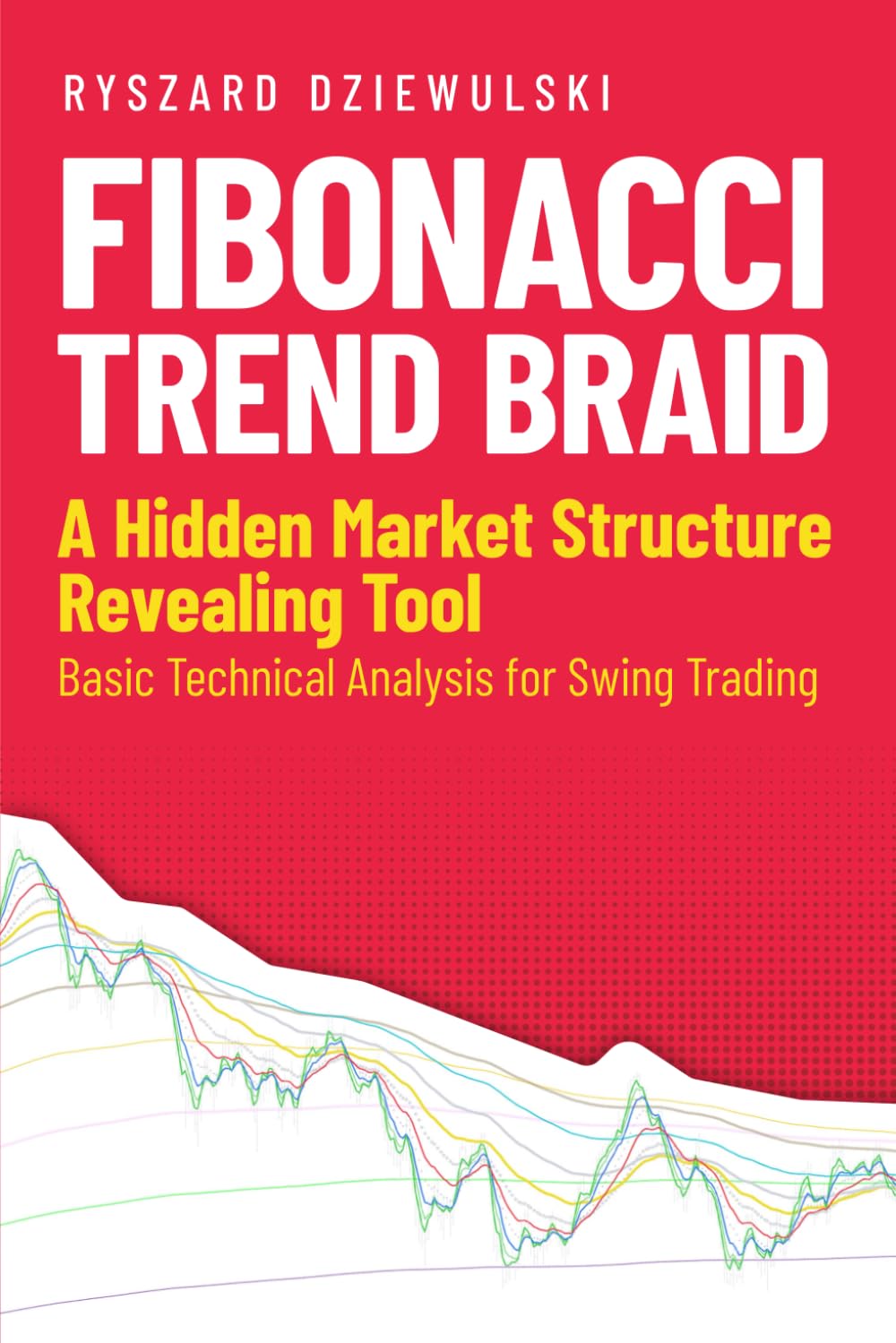
Fibonacci Trend Braid: A Hidden Market Structure Revealing Tool. Basic Technical Analysis for Swing Trading - Predictive Indicator Visualizing Price
$24.90
by Ryszard Dziewulski



"You'll never be a trader!" Tell me how many times you've heard that sentence – coming from somewhere deep inside you. And I'll tell you why: You can determine support/resistance zones, pivots, trendlines, Fibonacci retracements and extensions - You know basic candlestick patterns, indicators, and market oscillators - You can recognize divergences, Elliott waves, and moving averages ...and YOU'RE STILL LOSING CAPITAL. Your problem is that you're using a standard trading strategy that does not take into account two elements: THE POWER OF CAPITAL , which is currently playing with price, and - THE TIME it takes for the market to either succumb to this capital or overcome it. The Fibonacci trend braid is actually a braid of capital trends and – simultaneously - a braid of time trends . It is – DIFFERSIVE from all others – a technical analysis tool that, in my opinion, meets the criteria of genius. These criteria are: logical simplicity and - the power stemming from this simplicity. A braid of multiple moving averages, built on the relationships embedded in Fibonacci numbers, is drawn on the price chart in real time. This allows you to see not only retracements unfolding before your eyes, but also trendlines – true trendlines, not those (artificially) drawn with a ruler and (artificially) as straight as broomsticks. Using the Fibonacci trend braid, you'll quickly understand the deepest essence of a trend. By observing multiple trends simultaneously, you'll notice that each has a different market pulse (a different Elliott wave frequency) – dependent on the different capital forces that govern it. You'll also notice the constant struggle between different capital trends, as well as how they intertwine (forming alliances) or unravel (upon encountering a stronger opponent). Winning capital trends impose their own pulse on the market (their own wave frequency); defeated trends join stronger ones, losing their autonomy. A new understanding of the definition of a trend will inevitably lead to a new understanding of the consolidation phenomenon. We no longer treat a trend in a conventional way (as an upward or downward price movement), but see it as an emanation of a specific capital strength. Therefore, consolidation doesn't have to be exclusively lateral (i.e., limited by fixed price levels). It can also be oblique, as its boundaries can also be the lines of various capital trends. And we see these lines because they are drawn before our eyes in real time – in the form of a Fibonacci trend braid. Some Fibonacci trend lines (those with shorter periods) run more diagonally, while others run more horizontally (those with longer periods). Diagonal trends are most often the "ceilings" of diagonal consolidations, while horizontal ones act like levels – stairs on which the price walks. These ceilings and Fibonacci stairs – which only we, the Fibonacci trend braid users, can see – are often precisely those price rebounds where there are no support/resistance levels. Speaking of which – most often, when price bounces off the same support/resistance level, it bounces off completely different trend braid lines (either increasingly stronger or weaker), giving us an idea of what to expect. Fibonacci trend braid lines are also more refined than so-called ‘ trend lines’ (drawn from a ruler), because for each market you can find a Leading Trend (or a Medium Braid), the breakout (or rebound) of which marks the beginning of a major price movement. ** The Fibonacci trend braid is a truly reliable multi-indicator that confirms market signals and can work as a standalone method for managing positions during swing trading. Try it. You won't regret it.