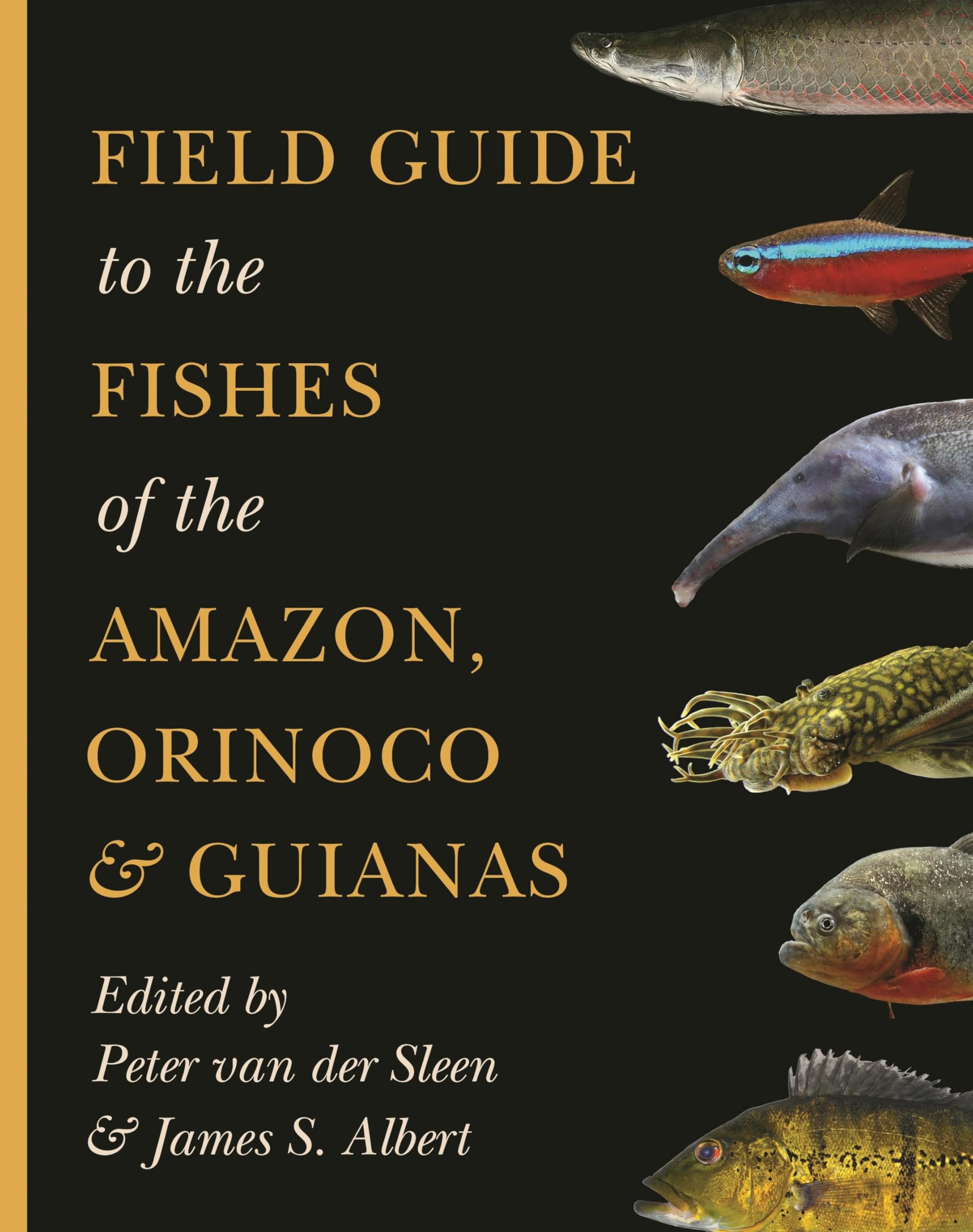
Field Guide to the Fishes of the Amazon, Orinoco, and Guianas (Princeton Field Guides)
$39.99
by Peter Van Der Sleen



The Amazon and Orinoco basins in northern South America are home to the highest concentration of freshwater fish species on earth, with more than 3,000 species allotted to 564 genera. Amazonian fishes include piranhas, electric eels, freshwater stingrays, a myriad of beautiful small-bodied tetras and catfishes, and the largest scaled freshwater fish in the world, the pirarucu. Field Guide to the Fishes of the Amazon, Orinoco, and Guianas provides descriptions and identification keys for all the known genera of fishes that inhabit Greater Amazonia, a vast and still mostly remote region of tropical rainforests, seasonally flooded savannas, and meandering lowland rivers. The guide’s contributors include more than fifty expert scientists. They summarize the current state of knowledge on the taxonomy, species richness, and ecology of these fish groups, and provide references to relevant literature for species-level identifications. This richly illustrated guide contains 700 detailed drawings, 190 color photos, and 500 distribution maps, which cover all genera. An extensive and illustrated glossary helps readers with the identification keys. The first complete overview of the fish diversity in the Amazon, Orinoco, and Guianas, this comprehensive guide is essential for anyone interested in the freshwater life inhabiting this part of the world. First complete overview of the fish diversity in the Amazon and Orinoco basins - Contributors include more than fifty experts - Identification keys and distribution maps for all genera - 190 stunning color photos - 700 detailed line drawings - Extensive and illustrated glossary "This book is a really great source not only for all ichthyologists working with fish from the AOG, but also for all interested in the AOG fish fauna. The authors did a big hit while including all genera and giving keys to all of them. It’s worth much more than the price asked for." ---Harro Hieronimus, Bulletin of Fish Biology "This is an extremely valuable guide to the genera of fishes in the Amazon. Contributors include every prominent ichthyologist working on Amazonian fishes today, making this an essential guide to the field." ―Luiz A. Rocha, California Academy of Sciences " Field Guide to the Fishes of the Amazon, Orinoco, and Guianas is an outstanding contribution to the field of neotropical ichthyology. There are no similar books on the market." ―Jansen Zuanon, National Institute for Amazonian Research "This is an extremely valuable guide to the genera of fishes in the Amazon. Contributors include every prominent ichthyologist working on Amazonian fishes today, making this an essential guide to the field." --Luiz A. Rocha, California Academy of Sciences " Field Guide to the Fishes of the Amazon, Orinoco, and Guianas is an outstanding contribution to the field of neotropical ichthyology. There are no similar books on the market." --Jansen Zuanon, National Institute for Amazonian Research Peter van der Sleen is a postdoctoral fellow at the Marine Science Institute of the University of Texas, Austin. James S. Albert is professor of biology at the University of Louisiana, Lafayette. He is the coeditor of Historical Biogeography of Neotropical Freshwater Fishes . Field Guide to the Fishers of the Amazon, Orinoco & Guianas By Peter van der Sleen, James S. Albert PRINCETON UNIVERSITY PRESS Copyright © 2018 Princeton University Press All rights reserved. ISBN: 978-0-691-17074-9 Contents Foreword by Michael J. Goulding, 7, Preface by Luiz R. Malabarba, 8, Acknowledgments, 9, Contributors, 11, General Introduction, 13, How to Use This Book, 23, Identification Key to Fish Families, 26, Photographic Guide to Fish Families, 35, The Fish Families, 69, Glossary of Technical Terms, 403, Literature Cited, 413, Photo Credits, 459, Index, 460, CHAPTER 1 GENERAL INTRODUCTION Amazonia is a vast and complex landscape, with a biodiversity unrivaled on the surface of the Earth. The Amazon River is the largest in the world by any measure, including maximum length from mouth to most distant headwater tributary (6,712 km or 4,195 mi), total catchment area (7.05 million km2 or 2.72 million mi2), area of seasonally flooded wetlands (250,000 km2 or 96,530 mi2), average annual water discharge (219,000 m3 second-1), and proportion of global river surface area (25-28%) (Goulding et al. 2003). Near its mouth as it approaches the Atlantic Ocean, the Amazon is so wide that one cannot see across it from one bank to the other. Here the Amazon flows inexorably like an inland freshwater sea, discharging a volume of water into the Atlantic so immense that it accounts for about one-sixth to one-fifth of all the Earth's river water, depending on the year. Many Amazonian headwaters arise as glacier and snow melt high in the Andes (>5,000 m or >16,400 ft), eroding the steep mountain slopes as they fall, and carrying with them a high sediment load. Other headwaters arise from cla