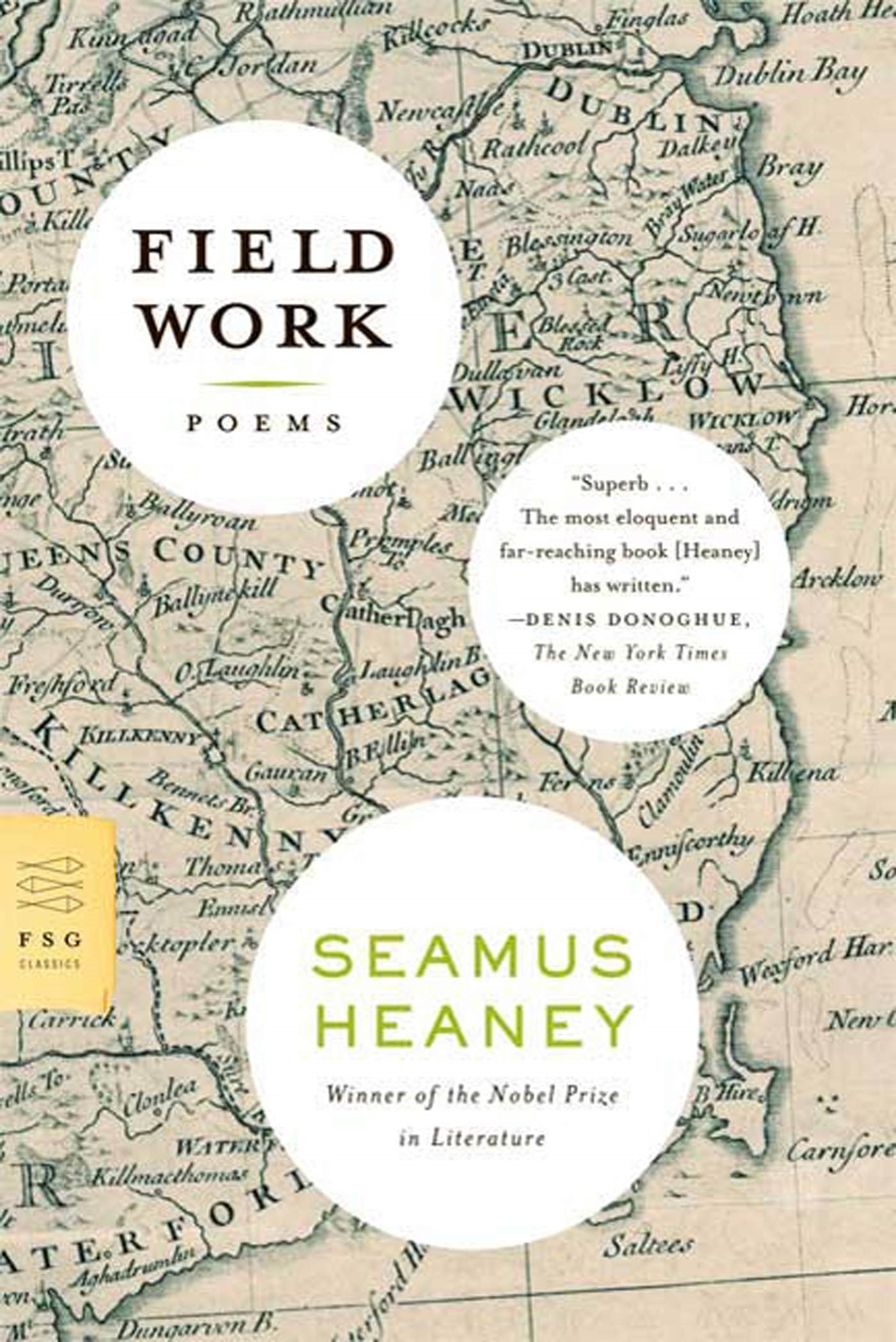



Field Work is the record of four years during which Seamus Heaney left the violence of Belfast to settle in a country cottage with his family in Glanmore, County Wicklow. Heeding "an early warning system to get back inside my own head," Heaney wrote poems with a new strength and maturity, moving from the political concerns of his landmark volume North to a more personal, contemplative approach to the world and to his own writing. In Field Work he "brings a meditative music to bear upon fundamental themes of person and place, the mutuality of ourselves and the world" (Denis Donoghue, The New York Times Book Review). “A superb book, the most eloquent and far-reaching book [Heaney] has written, a perennial poetry offered at a time when many of us have despaired of seeing such a thing.” ― The New York Times Seamus Heaney (1939–2013) received the Nobel Prize in Literature in 1995. His poems, plays, translations, and essays include Opened Ground , Electric Light , Beowulf , The Spirit Level , District and Circle , and Finders Keepers . Robert Lowell praised Heaney as the "most important Irish poet since Yeats." Field Work By Seamus Heaney Farrar, Straus and Giroux Copyright © 1979 Seamus Heaney All rights reserved. ISBN: 978-0-374-53139-3 Contents Title Page, Copyright Notice, Dedication, Acknowledgements, Oysters, Triptych, I. After a Killing, II. Sibyl, III. At the Water's Edge, The Toome Road, A Drink of Water, The Strand at Lough Beg, A Postcard from North Antrim, Casualty, The Badgers, The Singer's House, The Guttural Muse, In Memoriam Sean O'Riada, Elegy, Glanmore Sonnets, September Song, An Afterwards, High Summer, The Otter, The Skunk, Homecomings, A Dream of Jealousy, Polder, Field Work, Song, Leavings, The Harvest Bow, In Memoriam Francis Ledwidge, Ugolino, Notes, FSG Classics, Books by Seamus Heaney, Copyright, CHAPTER 1 Oysters Our shells clacked on the plates. My tongue was a filling estuary, My palate hung with starlight: As I tasted the salty Pleiades Orion dipped his foot into the water. Alive and violated They lay on their beds of ice: Bivalves: the split bulb And philandering sigh of ocean. Millions of them ripped and shucked and scattered. We had driven to that coast Through flowers and limestone And there we were, toasting friendship, Laying down a perfect memory In the cool of thatch and crockery. Over the Alps, packed deep in hay and snow, The Romans hauled their oysters south to Rome: I saw damp panniers disgorge The frond-lipped, brine-stung Glut of privilege And was angry that my trust could not repose In the clear light, like poetry or freedom Leaning in from sea. I ate the day Deliberately, that its tang Might quicken me all into verb, pure verb. Triptych I After a Killing There they were, as if our memory hatched them, As if the unquiet founders walked again: Two young men with rifles on the hill, Profane and bracing as their instruments. Who's sorry for our trouble? Who dreamt that we might dwell among ourselves In rain and scoured light and wind-dried stones? Basalt, blood, water, headstones, leeches. In that neuter original loneliness From Brandon to Dunseverick I think of small-eyed survivor flowers, The pined-for, unmolested orchid. I see a stone house by a pier. Elbow room. Broad window light. The heart lifts. You walk twenty yards To the boats and buy mackerel. And to-day a girl walks in home to us Carrying a basket full of new potatoes, Three tight green cabbages, and carrots With the tops and mould still fresh on them. II Sibyl My tongue moved, a swung relaxing hinge. I said to her, 'What will become of us?' And as forgotten water in a well might shake At an explosion under morning Or a crack run up a gable, She began to speak. 'I think our very form is bound to change. Dogs in a siege. Saurian relapses. Pismires. Unless forgiveness finds its nerve and voice, Unless the helmeted and bleeding tree Can green and open buds like infants' fists And the fouled magma incubate Bright nymphs. ... My people think money And talk weather. Oil-rigs lull their future On single acquisitive stems. Silence Has shoaled into the trawlers' echo-sounders. The ground we kept our ear to for so long Is flayed or calloused, and its entrails Tented by an impious augury. Our island is full of comfortless noises.' III At the Water's Edge On Devenish I heard a snipe And the keeper's recital of elegies Under the tower. Carved monastic heads Were crumbling like bread on water. On Boa the god-eyed, sex-mouthed stone