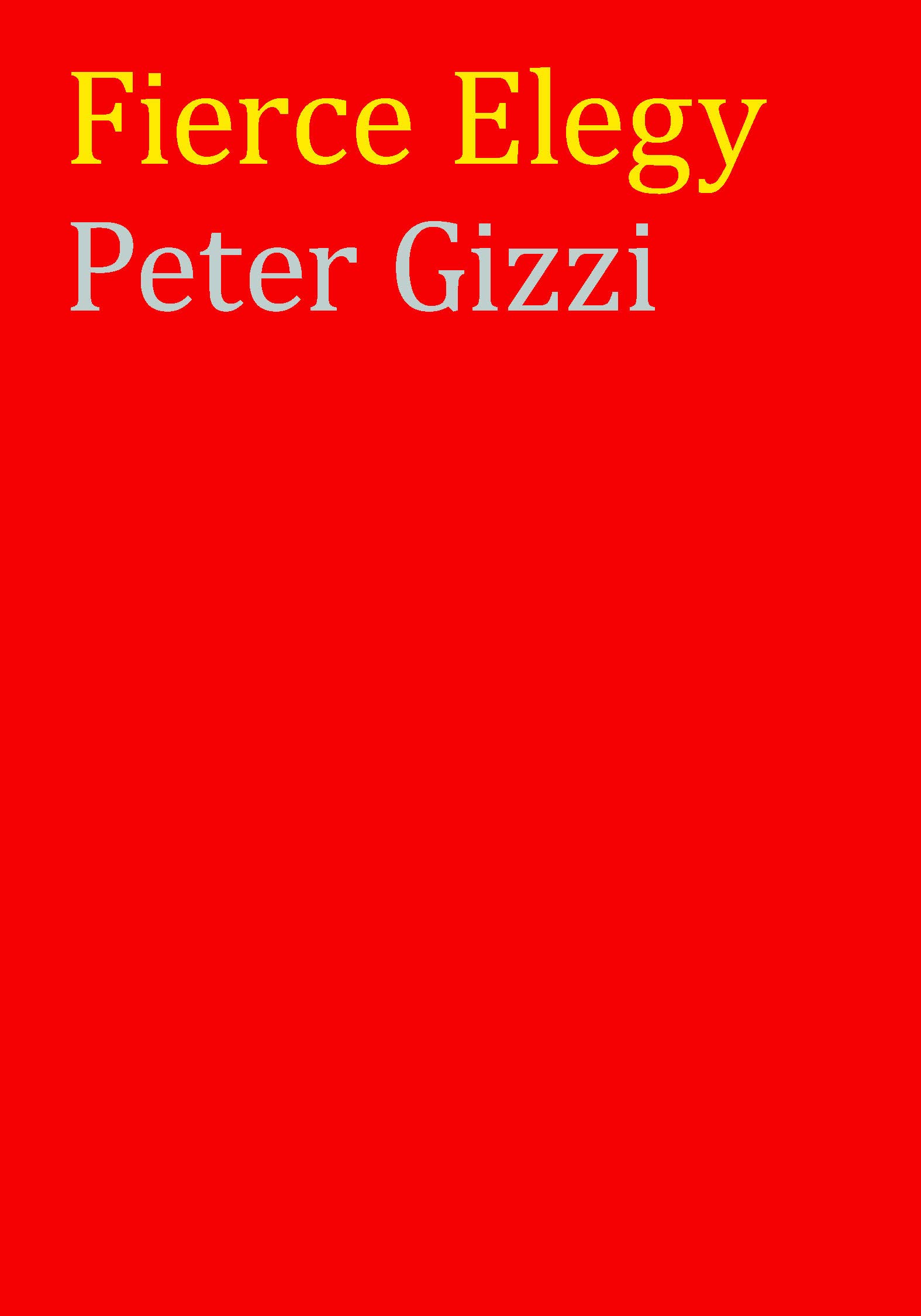



Peter Gizzi's powerful new collection reminds us that the elegy is lament but also―as it has been for centuries―a work of love Winner of the T.S. Eliot Prize Winner of the Massachusetts Book Award Peter Gizzi has said that "the elegy is a mode that can transform a broken heart in a fierce world into a fierce heart in a broken world." For Gizzi, ferocity can be reimagined as vulnerability, bravery and discovery, a braiding of emotional and otherworldly depth, "a holding open." In Gizzi's voice joy and sorrow make a complex ecosystem. In their quest for a lyric reality, these poems remind us that elegy is lament but also―as it has been for centuries―a work of love. "This new poetry," Kamau Brathwaite has written about Gizzi, "taking such care of temperature―the time & details of the world―meaning the space(s) in which we live―defining love in this way. Writing along the edge. A way of writing about hope." [sample poem] Creely Song all that is lovely in words, even if gone to pieces all that is lovely gone, all of it for love and autobiography as if I were writing this hello, listen the plan is the body and all of it for love now in pieces all that is lovely echoes still in life & death still memory gardens open onto windows lovely, the charm that mirrors all that was, all that is, lovely in a song "In Peter Gizzi's Fierce Elegy, poems on ferocious heartbrokenness also attest to joy."― Library Journal "I know of no better companion to word our common lament for us, with us, than Gizzi's new Fierce Elegy . For those of us devoted already to his work, we'll find here the fullest condensation of his powers I know ― poems of fearless questioning, muse-bruised, words with "a hunger / for real things," and the real things that hunger right back. For those who don't know his work, you'll discover one of this nation's foremost practitioners of lyric art, refusing that the poem should do anything less than posit one human life in actual relation with the world entire. His life, your life, mine ― such are the fierce demands of love in a world where all one loves also leaves."―Dan Beachy-Quick, Westword "Gizzi is a master of the elegiac mode His subject isn't loss alone, but loss interwoven with afterlife. Shadows, reflections, mirrors, and migrating birds populate his poems, and he weaves one state of consciousness into another, like gossamer Fierce Elegy is lyrical and transcendent. It is also fierce in the sense that overcoming the broken world is the ultimate act of defiance."―Amanda Holmes Duffy, Washington Independent Review "With his last several collections, Peter Gizzi has distinguished himself as one of America's finest living poets. In his latest book, Fierce Elegy, we find the poet writing at the height of his powers."―James O'Connor, Harvard Review "Lyrics of resignation are juxtaposed with ecstatic lines that reimagine silence as 'conversations with the dead.' Spare and raked of impurities, these poems reside in an airy purgatory of the soul... In its beautiful, fiery insistence this collection redeclares the elegy as the undying practice of the living."―Oluwaseun Olayiwola, The Guardian "In his latest book, we recognize Gizzi's distinctive voice, but its melancholy is even more intensified, now almost black as ink. We might call it lyric after catastrophe: the world has suffered blows, shocks, accidents, and destructions and things are no better for things, which are often as not broken, undone, burned, or ruined, 'language marching into empire / starving the words.' What remains now are no more than 'the ruins of anything.' And yet the book is a necessary reminder to continue to live, perhaps to love, and certainly to die."―Stéphane Bouquet, Chicago Review "For Gizzi, silence lives inside the poems, its words charged by it just as, for Gerard Manley Hopkins, 'the world is charged with the grandeur of God.' Fierce Elegy anneals its phrases to the clotted silences that surround them, so that rather than a continuous utterance, Gizzi's rhythms are those of words teased, wrested, chiseled, and siphoned out of the darkness, with all of the nuances of sound those operations imply. Fierce Elegy differs equally from elegies that establish strong ties to a tradition (e.g., Milton) and from those that imagine themselves as wholly anti-elegy (e.g., Plath and Ginsberg). It omits not only proper names but dead addressees altogether, and the affect set in most salient contrast to sadness is actually ecstasy."―John Steen, The Poetry Project Newsletter "These poems are assertions of a spiritual excess that won't die."―Fanny Howe, author of Love and I "Having read Peter Gizzi's work through the immense and singular wingspan his books make, I am still awestruck and dumbfounded as to how these poems are made. This book believes in language. It also offers it the utmost reverence: by lowering it to human height, where the living are. What a masterwork of def