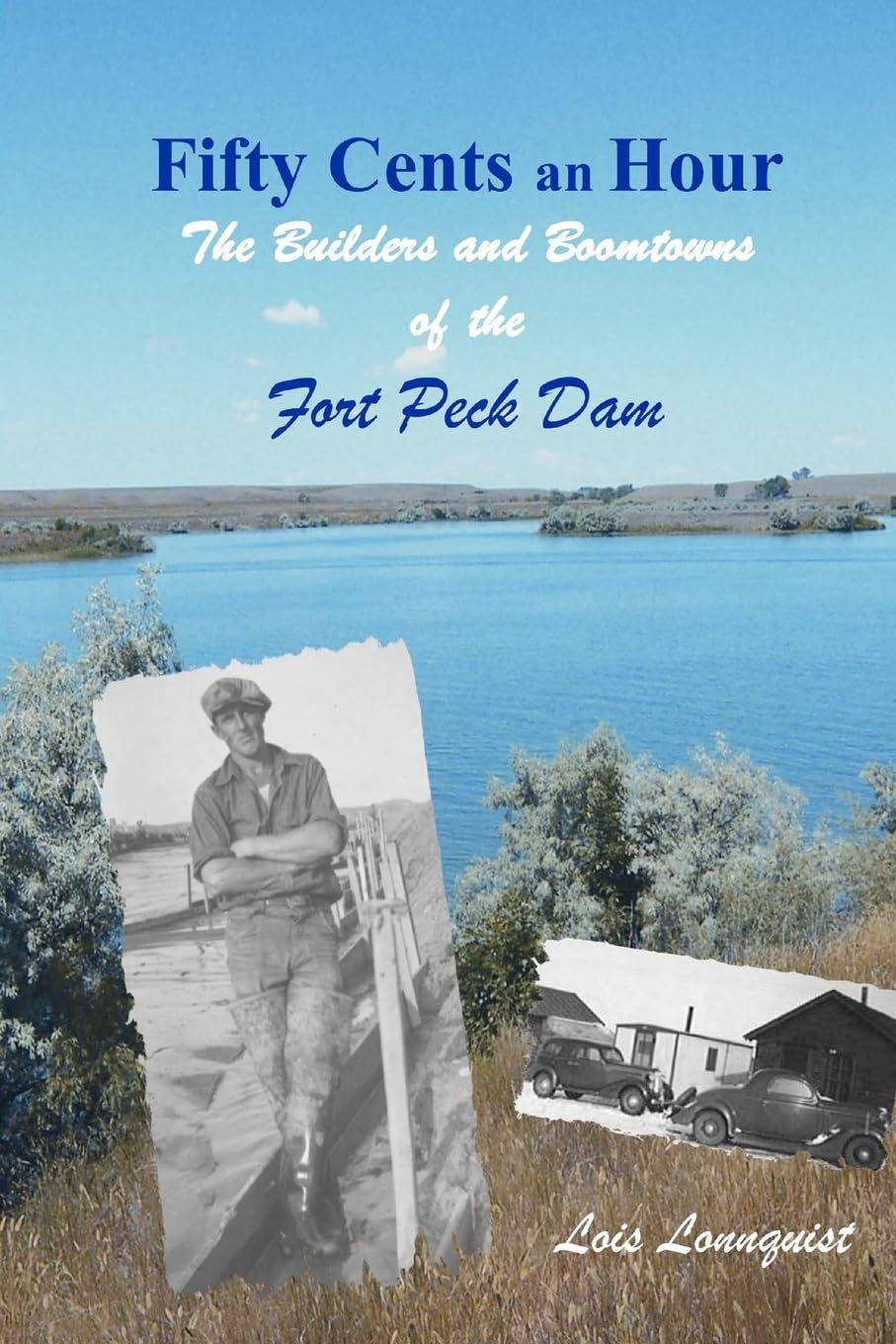
Fifty Cents an Hour: The Builders and Boomtowns of the Fort Peck Dam (Volume 1)
$16.00
by Lois Lonnquist



Fifty Cents An Hour: The Builders and Boomtowns of the Fort Peck Dam One of the most fascinating chapters in Montana history is the building of the Fort Peck Dam across the Missouri River in northeast Montana. The story of the people who built it, is another. Project Number 30, the Fort Peck Dam, was authorized by President Franklin D. Roosevelt during the Great Depression of the 1930s, and built by the U.S. Army Corps of Engineers. It provided jobs and hope for the thousands of unemployed Montana workers, and others across the country. It left a legacy of flood control, electric power, and recreation on Fort Peck Lake enjoyed by thousands today. My family's four year involvement with "the dam" project led me to write a book: Revisiting Project No. 30 Time has changed almost everything. The dust has long since settled on the project worksites. Nature has healed the scarred land. The construction workers have moved on, and the care of their dam and spillway has been handed down. Prairie grass grows over the boomtown sites where shantys and false-front stores once stood. A few old business buildings, remodeled or boarded up, remain. Since 1940 many of the former project people have come back to reminisce about old times at the work and town sites. Their children and grandchildren come and try to imagine what life at the dam was like in the 1930s. They drive through the town of Fort Peck looking for the updated Administration Building, the Recreation Hall, and the Fort Peck Hotel. They visit the Fort Peck Theater, and hope to see its ghost. They move on to the empty lot where the Lutheran Church was a long time landmark, and over to where the service station still is. There is so much history here! Remarkable growth and change have taken place since the dam was built, starting with the first of the two power houses in 1941. The engineering techniques have changed they don t build dams like the Fort Peck dam anymore. The 1930s Corpsmen and workers agree: They don t build dams like the Fort Peck Dam anymore. Thousands of tourists still come to see the dam and spillway, to visit the old powerhouse museum, the new Fort Peck Interpretive Center (2005), and the warm water Fish Hatchery (2006). Thousands more come for the sport of fishing for walleye, trout, bass, and the multitude of species in the Fort Peck Lake and Missouri River. They watch the deer, elk, and other wildlife in the Charles M. Russell Wildlife Refuge. They participate in boating, hiking, and many other land and water sports in refined or rustic settings. Sight-seeing is still popular. From the observation site on the hill at the east end of the dam, there is a panoramic view of the lake, dam, river, badlands, and much of the wildlife refuge around them. It is a beautiful four mile drive on Highway 24 across the berm of the dam from the west to the east end. From the two mile main dam section in the middle you can see for miles in all directions: To the south, Fort Peck Lake stretches out to touch a chain of rugged badlands. To the north the Missouri River runs out of the four tunnels under the dam, next to the two huge powerhouses, and into the winding river valley, sending streams through a channel on the west side into the dredge cuts. Off to the northwest is the former government town of Fort Peck, and beyond it, in the cottonwood between a dredge cut and the river, west of Highway 117, is Park Grove the last of the boomtowns. Highway 24 runs east up the hill to where the Spillway Building stands guard over the mile-long spillway below, running to the north. The huge concrete and steel structure is often mistaken for the dam because the dam in its outward earth-friendly simplicity looks more like an enormous lake-side hill with a highway across. From the tops of the dam, spillway, and observation point the panoramic view is stunning in its vastness. Seen through the eyes of the 50-cent an hour workers it s an awesome sight. --MtSky Press At the end of 1939 my family moved from Wheeler to my great-grandmother s deserted homestead south of the Missouri River in northeastern Montana. There I got first hand experience as a dryland farmer/rancher living in a little prairie house with ice on the inside of the windows in winter and wild roses around the door in summer. I was destined to leave at seventeen and a year or so later marry a Midwesterner who shared my love of music. We added six children to our duo and formed a family band playing music for shows and radio. While my husband Del managed and owned radio stations and our children grew up, I freelanced news and features for several Midwest newspapers, and television and radio stations, earned a BA in English from the University of Wisconsin, and saw my short stories in print. Once more a duo, Del and I moved to Helena in 1989. He stayed with radio, I spent thirteen years at the Helena Independent Record. All the while, especially after Mom and Dad were gone, this book kept tugging at my heart, s