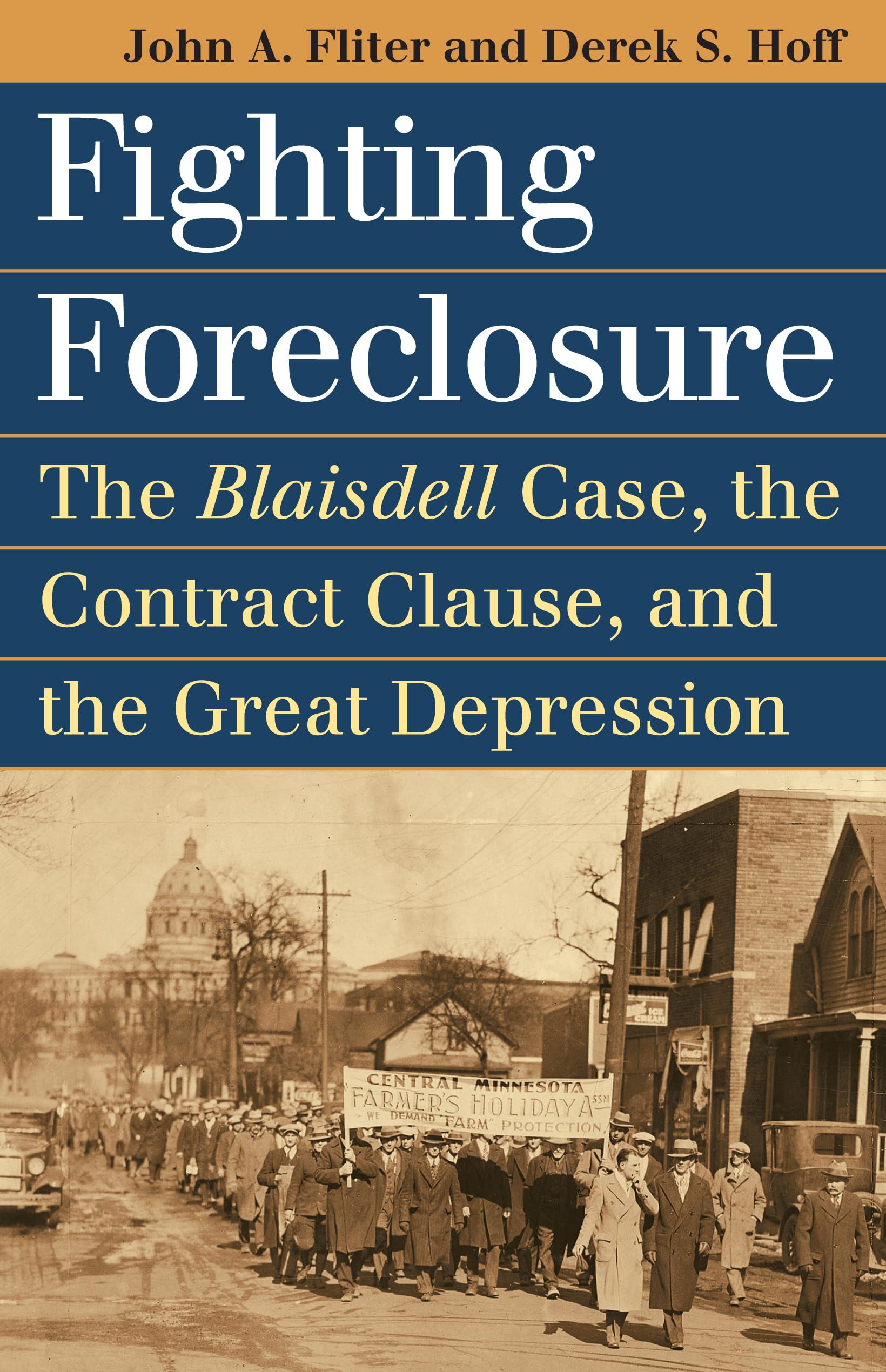
Fighting Foreclosure: The Blaisdell Case, the Contract Clause, and the Great Depression (Landmark Law Cases and American Society)
$20.83
by John A. Fliter



In the depths of the Great Depression, when foreclosure rates skyrocketed across the United States, more than two dozen states passed mortgage-extension or -adjustment laws to help farmers and homeowners keep their properties. One such statute in Minnesota led to the most important property law case of its time and still casts a long shadow upon constitutional debates and our own era's severe economic downturn. Fighting Foreclosure marks the first book-length study of the landmark 1934 Supreme Court decision in Home Building and Loan Association v. Blaisdell, which, by a 5-4 vote, upheld the Minnesota Mortgage Moratorium Act. On the one hand, Blaisdell validated efforts by states to offer legislative relief to citizens struggling to keep their farms and homes. On the other, it caused an outcry among banking interests and conservative legal theorists, who argued that these laws violated the Contract Clause of the Constitution and interfered with our free market system. In his majority opinion, Chief Justice Charles Evans Hughes argued that the reasonable and limited nature of the law and the unusual severity of the emergency it addressed placed it firmly within the "police powers" of the states to protect the health and safety of the people. In a strongly worded dissent, Justice George Sutherland argued for a consistent and strict interpretation of the Contract Clause regardless of economic exigency. John Fliter and Derek Hoff provide a concise history and analysis of not only this landmark case and the reasoning behind its sharply divided decision but also of the entire history of the Contract Clause. They trace closely the agricultural crisis, political pressures, and farmer-protest movement that produced the Minnesota law. And their study contributes to scholarly debate about the origins of the Constitutional Revolution of 1937, by which the Supreme Court accepted the New Deal, as well as to public debates about constitutional interpretation and the role that government should play in providing relief to distressed citizens. In the midst of our nation's ongoing suffering from massive foreclosures and bankruptcies, Fighting Foreclosure also offers a potent reminder that the High Court's decisions often revolve around lives at risk as much as abstract legal debates. "There is much to be enjoyed and learned for those interested in history, politics, and/or constitutional law...Fliter and Hoff have detailed the important events surrounding the Contracts Clause and the Blaisdell case in a book that is easy to follow, clearly written, and well organized." --Colin Glennon, Department of Political Science, East Tennessee State University. Law and Politics Book Review . "This book will be especially useful for educators who are non-specialists in constitutional history. The authors' clear organization, vivid description of events that led to the Blaisdell case, discussion of relevant pre- and post- Blaisdell jurisprudence, and concise prose make Fighting Foreclosure a valuable resource for students, scholars, and general readers." Joe Anderson, associate professor, Mount Royal University, Alberta Canada. Reviewed in Kansas History . "By placing this case with the context of the Great Depression and the politics cleaving the nation at the time, Fliter and Hoff bring the [ Blaisdell ] case to life and provide a greater understanding to its relevance by adding a postscript on the mortgage crisis afflicting the U.S. in 2012." M.W. Bowers, University of Nevada, Las Vegas. Choice Reviews Online John A. Fliter and Derek S. Hoff are associate professors at Kansas State University in political science and history, respectively. Fliter is author of Prisoners’ Rights: The Supreme Court and Evolving Standards of Decency; Hoff is author of The State and the Stork: The Population Debate and Policy Making in U.S. History . Used Book in Good Condition