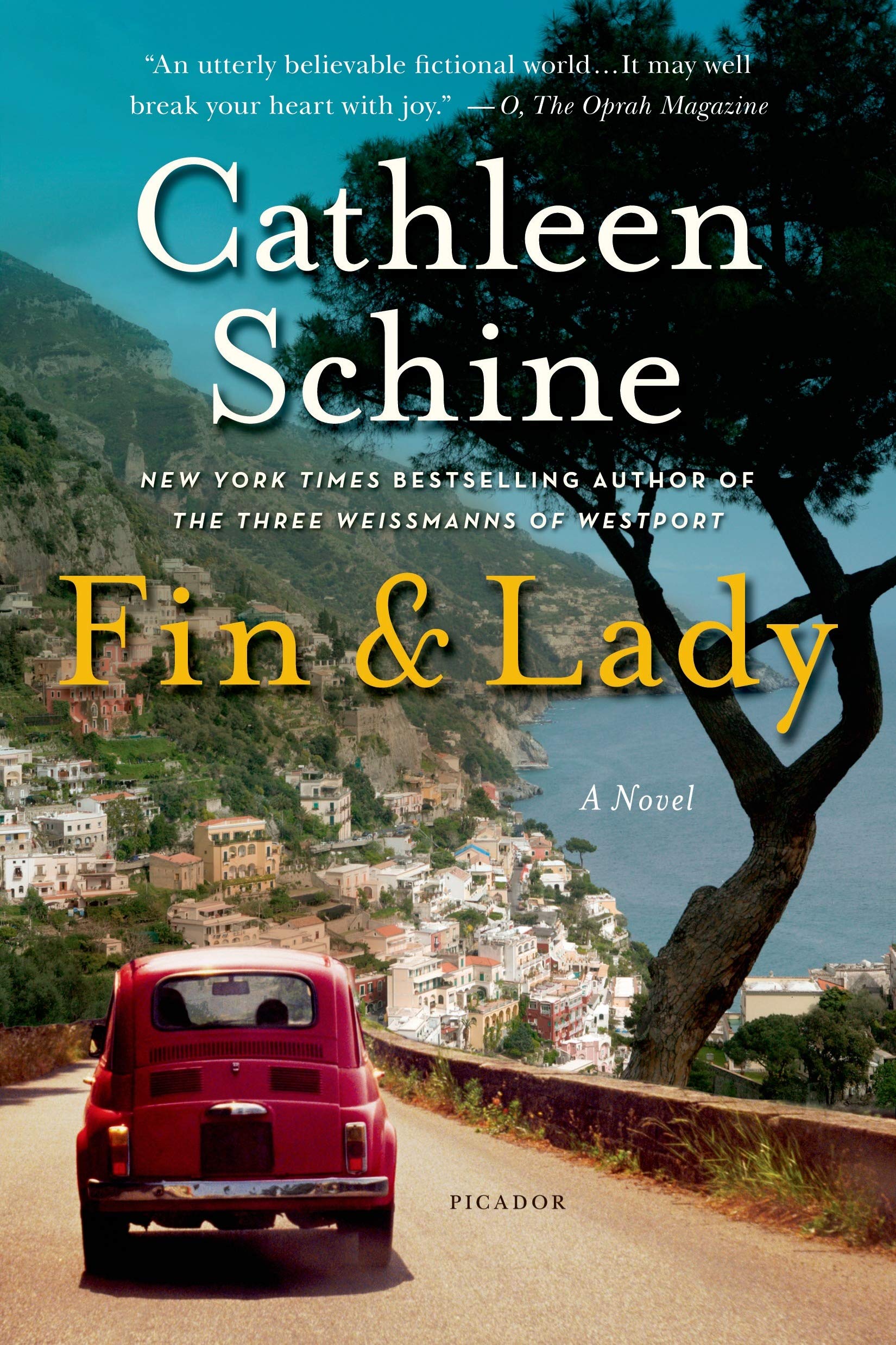



From the author of The Three Weissmanns of Westport , a wise, clever story of New York in the '60s It's 1964. Eleven-year-old Fin and his glamorous, worldly, older half sister, Lady, have just been orphaned, and Lady, whom Fin hasn't seen in six years, is now his legal guardian and his only hope. That means Fin is uprooted from a small dairy farm in rural Connecticut, landing in Greenwich Village in the middle of the Swinging Sixties. He soon learns that Lady-giddy, impulsive, and pursued by an ardent and dogged set of suitors-is as much his responsibility as he is hers. From a writer the New York Times has praised as "sparkling, crisp, clever, deft, hilarious, and deeply affecting," Cathleen Schine's Fin & Lady is a comic love story for the ages: an enchanting novel of a brother and sister who must form their own unconventional family in increasingly unconventional times. “Schine's writing sparkles, and her finale proves as unexpected and luminous as love itself.” ― Caroline Leavitt, People “An utterly believable fictional world...It may well break your heart with joy.” ― O, The Oprah Magazine “[Like] writers before her, from Shakespeare to Jane Austen and Evelyn Waugh, Schine skillfully plays with the conventions and the reader's expectations....A wise and wistful comic novel.” ― The New York Times Book Review “An exuberant, tender novel...the prose is zippy and sweet.” ― The New Yorker “Cathleen Schine can always be counted on for an enticing, smart read.” ― NPR “Full of invention, wit, and wisdom that can bear comparison to Austen's own.” ― The New York Review of Books on The Three Weissmanns of Westport “A clever, frothy novel...Schine playfully probes the lies, self-deceptions, and honorable hearts of her characters.” ― The New Yorker on The Three Weissmanns of Westport Cathleen Schine is the author of The Grammarians , The Three Weissmanns of Westport , and The Love Letter , among other novels. She has contributed to the New Yorker , the New York Review of Books , the New York Times Magazine , and the New York Times Book Review . She lives in Los Angeles. “Let’s go home” Fin’s funeral suit was a year old, worn three times, already too small. He knew his mother was sick. He knew she went to the hospital to get treatments. He saw the dark blue lines and dots on her chest. “My tattoos,” she said. She sang “Popeye the Sailor Man” and raised her skinny arms as if to flex her Popeye muscles, to make him laugh. He knew she was sick. He knew people died. But he never thought she would die. Not his mother. Not really. Lady came to the funeral, an unmistakably foreign presence in the bare, white Congregational church: she wore large sunglasses and wept audibly. Fin’s neighbors, the Pounds, who raised big, thick Morgan horses, had been looking after Fin since his mother was taken to the hospital. “I’m sure your mother knew what she was doing,” Mr. Pound said doubtfully when he saw Lady Hadley approach, her arms open wide, a lighted cigarette dangling from her lips. “I don’t think she had much choice, dear,” Mrs. Pound whispered to him. “There was no one else, was there?” “I like Lady,” Fin said loyally. But she was terrifying, coming at him like some mad bird with a squawk of “ Fratello mio! It’s all so dreadful!” Lady put her arms around him and held him close. She was all he had, as Mrs. Pound had pointed out. All he had. He barely knew her. Unfamiliar arms. A stranger’s cheek, wet with tears leaking from beneath her dark glasses. He wanted to cry, too, for so many reasons that they seemed to cancel one another out. He stood there like a statue, nauseated and faint. The other mourners stared at Lady. Why wouldn’t they? She stood out. She vibrated, almost, in that quiet church. She was beautiful. Fin liked her hair, which was long. He liked her teeth. She thought they were too big, but she was wrong. She was like a horse. Not one of the Pounds’ heavy Morgan horses with short sturdy necks and thick clomping legs. She was like a racehorse. Jittery. Majestic. Her long neck and long legs—and her face, too. She had a horsey face, in a beautiful way. And bangs, like a forelock. He’d told her that, the last time he’d seen her. He had been five. “You look like a horse,” he’d said. “Charming,” said Lady. “Me and Eleanor Roosevelt.” He had not meant that at all. Eleanor Roosevelt, whose picture he’d seen in the newspaper, did not look like a horse. More like his grandmother. Big, sloping breast. Important face. He meant that Lady’s eyes were huge and dark, that her cheekbones were high and pronounced, that her face was aristocratic and long, that her hair flew in the wind like a mane, that she was coltish even in her movements of tentative wildness and reckless dignity. He didn’t know that he meant all that when he was five. He just knew that she reminded him of a horse. He was eleven now. He had not seen her for six years. She still reminded him of a horse. “A racehorse,” he had added w