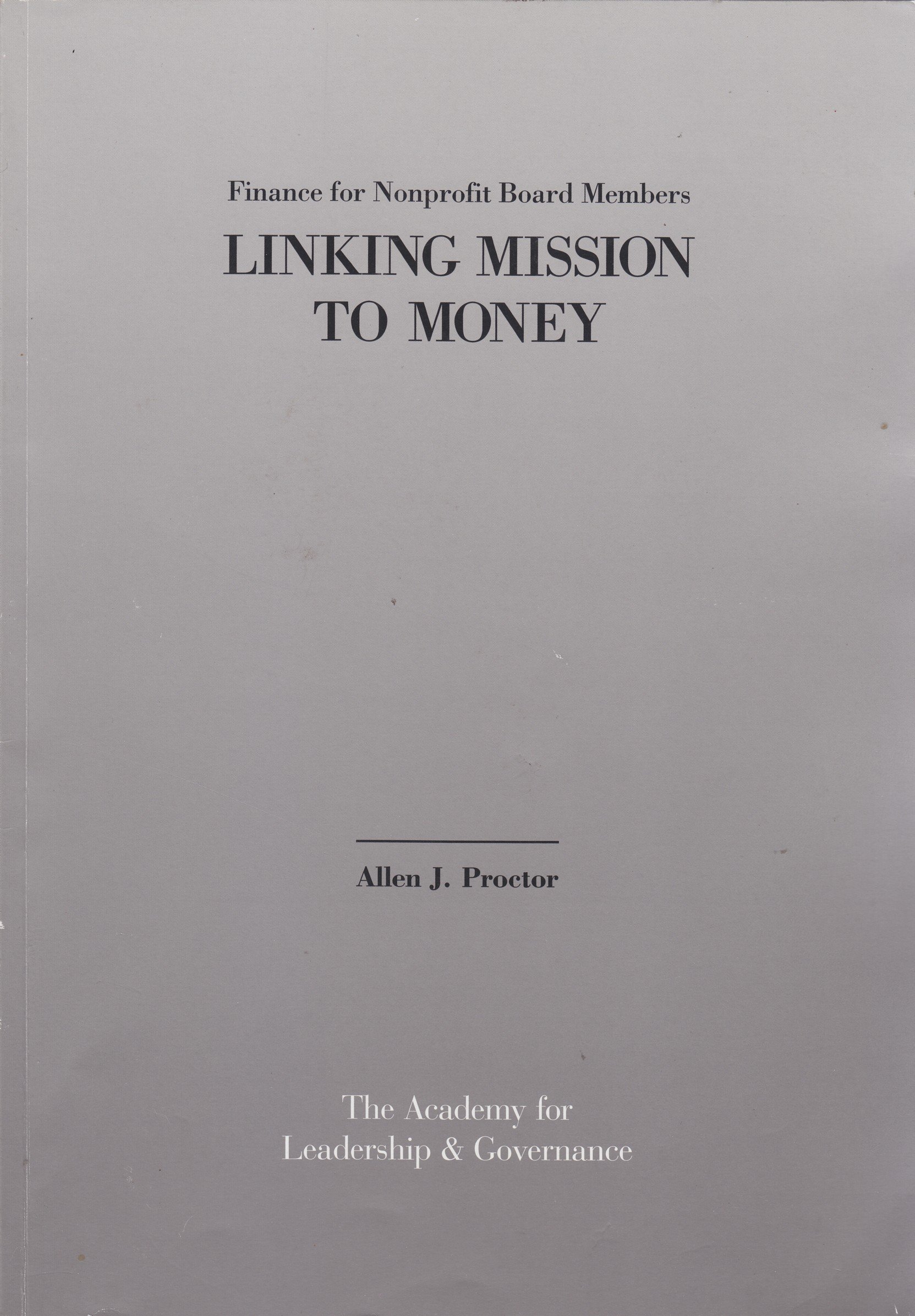



A valuable set of financial tools and strategies for the nonprofit board member. The book combines basic definitions with more sophisticated strategies for board members of any financial background. All major aspects of a nonprofit’s financial life are addressed, including budget-building and monitoring, monthly and yearly reports, audits, and endowments, as well as strategies for sustaining the organization’s mission in good and bad economic times. Linking Mission to Money was designed to help volunteer board members positively impact an organization's mission by achieving financial goals. "The benefit and the liability of being a board member lies with each member of the board," Proctor commented. "This book is intended to help volunteers satisfy their commitment by explaining finance as the core of a holistic approach to fulfilling board responsibility." Proctor noted that the Sarbanes-Oxley Act (2002) has refocused attention on the responsibility and accountability that board membership brings. He said that board members are fiduciaries, which means they have the legal responsibility and personal liability to know what is going on at their organization. Linking Mission to Money is a publication of The Academy for Leadership & Governance, a division of The Jefferson Center for Learning and the Arts. The Academy serves board presidents, executives, and boards with research, publications and educational programs. The Jefferson Center is a campus of not-for-profit organizations housed in historic buildings, creating a lively community environment. Allen J. Proctor advises chief executives and boards on financial management, strategic planning, investment oversight and organization effectiveness. He previous served as chief financial officer of Harvard University and Executive Director of the New York State Financial Control Board. A nationally recognized expert in finance and budgeting, he has taught at the Kennedy School of Government at Harvard University and the Graduate School of Business at Columbia University. Mr. Proctor earned his A.B. magna cum laude from Harvard University and his Ph.D. in economics from the University of Wisconsin-Madison. The key role of boards in financial management has become so apparent that the U.S. Congress has become involved. The Sarbanes-Oxley Act (2002) has refocused attention on the responsibility and accountability that board membership brings. Board members are fiduciaries, which means they have the legal responsibility and personal liability to know what is going on at their organization. Each board member is individually accountable that the organization adheres to its mission, spends it money in line with that mission, and attracts sufficient resources to remain financially viable. Pablo Eisenberg of Georgetown University put it succinctly, "Nonprofit boards are the first and last line of defense against poor performance, corruption and lack of accountability. They are supposed to be the protectors of the public interest. The buck stops with them." I would go further: the buck stops with you. You cannot rely on the efforts of other board members to take you off the hook of knowing what is going on. The benefit--and the liability--of being a board member lies with each member of the board. The book is intended to help you fulfill that role by explaining finance as the core of holistic approach to fulfilling your board responsibility. This broad-base approach aids you in linking money to mission, mission to action and action to accomplishment. It argues that finance is far more than a set of numbers; rather, it can serve as your primary tool to carry out your most important board obligation--to know what is going on. This book is written especially for non-financial experts, using a conversational style and short, digestible chapters that allow the reader to dabble, choosing whichever chapters catch their eye. Nevertheless, it is not a subject for a one-night read before going to bed. A more systematic approach for readers with limited time is suggested at the end of the last chapter. However you choose to read the book, I hope that the approach to finance described in these pages can help you and all board members participate equally and fully in financial reviews and deliberations. I have benefited from an excellent panel of advisors that have reviewed repeated drafts. Grateful thanks to them for their patience and their willingness to let this book take the direction it needed to go. The final version also benefited from the insights and critiques of my colleagues Len Schlesinger, Larry Ladd, Denny Griffith, Dall Forsythe and Barbara Brandt. Their observations helped me to fill numerous gaps in the argument. Despite their best efforts, gaps surely remain. I hope however they are few enough that this book can be a practical tool for nonprofit board members to use in carrying out their responsibilities over many fulfilling and satisfying years. Allen J. Proc