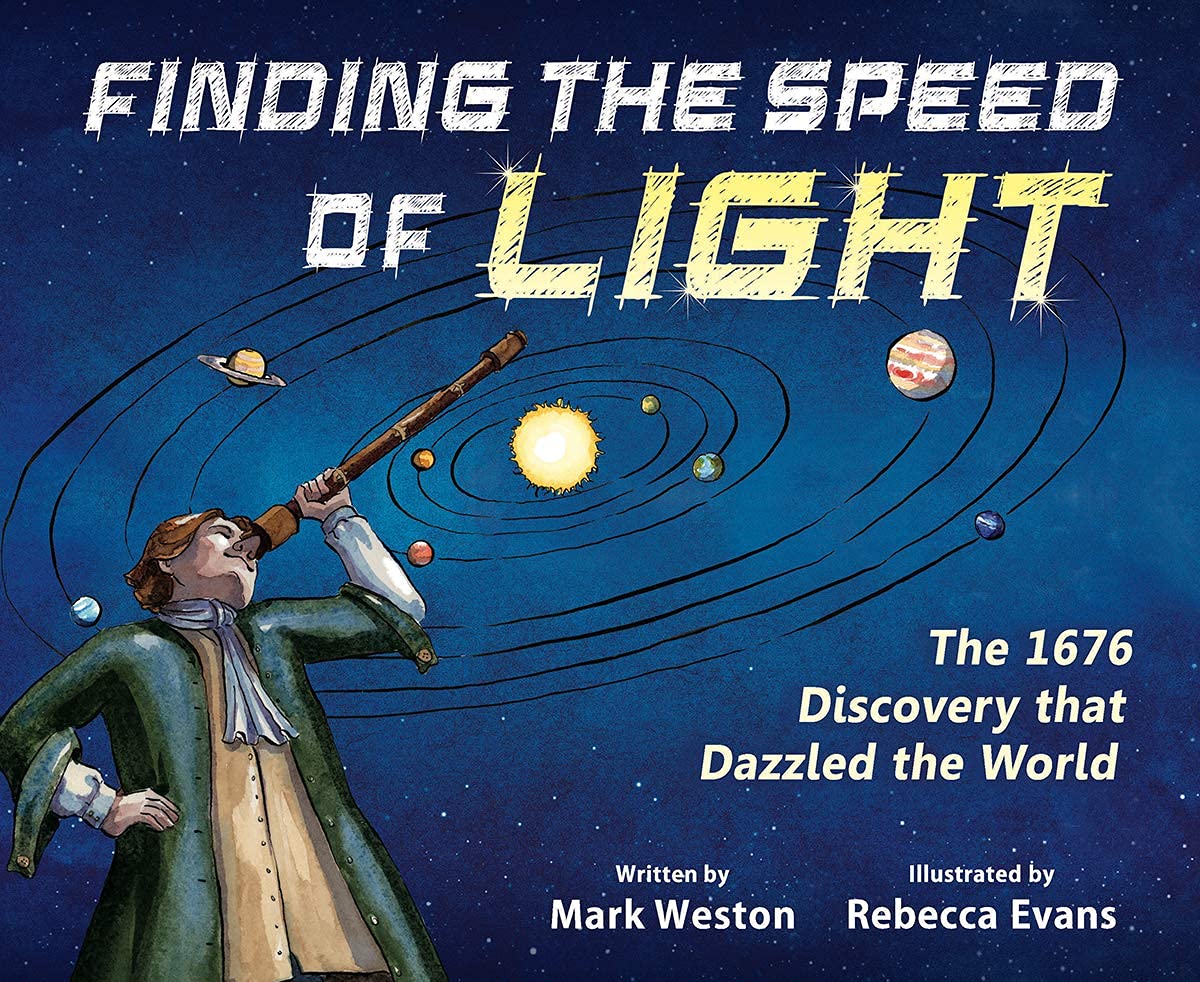
Finding the Speed of Light: The 1676 Discovery that Dazzled the World (The History Makers Series)
$17.95
by Mark Weston



Kirkus Star Junior Library Guild Gold Selection Mark Weston’s high-interest story and Rebecca Evans’s colorful graphics make scientific discovery the coolest thing this side of Jupiter. More than two centuries before Einstein, using a crude telescope and a mechanical timepiece, Danish astronomer Ole Romer measured the speed of light with astounding accuracy. How was he able to do this when most scientists didn’t even believe that light traveled? Like many paradigm-shattering discoveries, Romer’s was accidental. Night after night he was timing the disappearance and reappearance of Jupiter’s moon Io behind the huge, distant planet. Eventually he realized that the discrepancies in his measurements could have only one explanation: Light had a speed, and it took longer to reach Earth when Earth was farther from Jupiter. All he needed then to calculate light’s speed was some fancy geometry. Color throughout Gr 3–5—Ole R'mer was a young Danish scientist in 1676 working for a French astronomer when he made the remarkable discovery that the appearance of light is not instantaneous; light actually moves and has a speed. It all started with his fascination with Io, one of Jupiter's moons, and his observations that Io's orbit seemed to slow down every now and then. Through careful and intricate math calculations, R'mer eventually realized that Io wasn't slowing down; rather, the light from Io was taking longer to reach Earth because of its uneven orbit. This book includes a lot of text, and the narrative occasionally meanders, making it confusing to follow. Speech bubbles sometimes complement the story of R'mer and the scientists with whom he worked, and sometimes focus on facts or explanations, adding to the inconsistent feel. Descriptions of scientific and mathematical concepts are detailed and fairly complicated. The lovely watercolors are full of washes of blues and deep purples, fitting the subject. Back matter includes a brief time line and an afterword that extends some of the ideas from the book, but there is no bibliography or further reading list. VERDICT Beautiful illustrations and an intriguing idea are counterbalanced with complex concepts and uneven pacing, making this a secondary purchase for most libraries.–Jody Kopple, Shady Hill School, Cambridge, MA " STARRED REVIEW! How the observation of a small anomaly in a distant moon's orbit led to a discovery of, literally, astronomical significance. Weston spins thin historical records into an account of the career of 17th-century Danish astronomer Ole Romer from schoolboy days through nights spent watching the skies through a self-built telescope at the court of Louis XIV to final years as a renowned scientist (and police chief). Noticing that Jupiter's moon Io seemed to speed up and slow down on a regular schedule as it passed behind its planet, Romer not only concluded that light did not propagate instantaneously (a radical notion then), but, using the relatively crude clocks and other instruments of the time, came up with a wrong but close estimate of its speed. Along with retracing Romer's line of reasoning, the author explains how other researchers of the time and later roughed out the distances between major members of the solar system and refined those measurements over time, then closes with nods to Einstein, astronomical distances, and light's truly mind-bending pace. Evans tucks diagrams and mathematical calculations as well as banter and fanciful details into her lighthearted cartoon illustrations, wedging single and sequential panels of Romer and others at work into views of starscapes and planetary surfaces. Human figures in the art are white and predominantly male. A significant, unjustly obscure highlight from modern science's early days. (timeline) (Informational picture book. 8-12) " ― Kirkus Reviews "I really liked reading Finding the Speed of Light because it was educational. I loved that it was kind of like a comic book, with speech balloons. This made it fun to read. I also loved the illustrations. I would recommend Finding the Speed of Light: The 1676 Discovery that Dazzled the World to kids who wonder about science and astronomy and who want to learn about the speed of light." ― Jewel Age 11, Kids' Book Buzz " The unique combination of Weston’s writing style and Evans’ colorful, cartoon-like illustrations make this book a delight. This would be a great discussion starter for young scientists as they explore this text and note the process and missteps that go along with scientific investigation and inquiry. Recommended " ― Terry Roper, Library Consultant, Region 10 ESC, Richardson, Texas, School Library Connection Reviews One of history's greatest scientific achievements, 200 years ahead of its time, presented in graphic novel format. MARK WESTON graduated from Brown University with a B.A. in History; studied for a year at the London School of Economics; and earned a law degree from the University of Texas. He