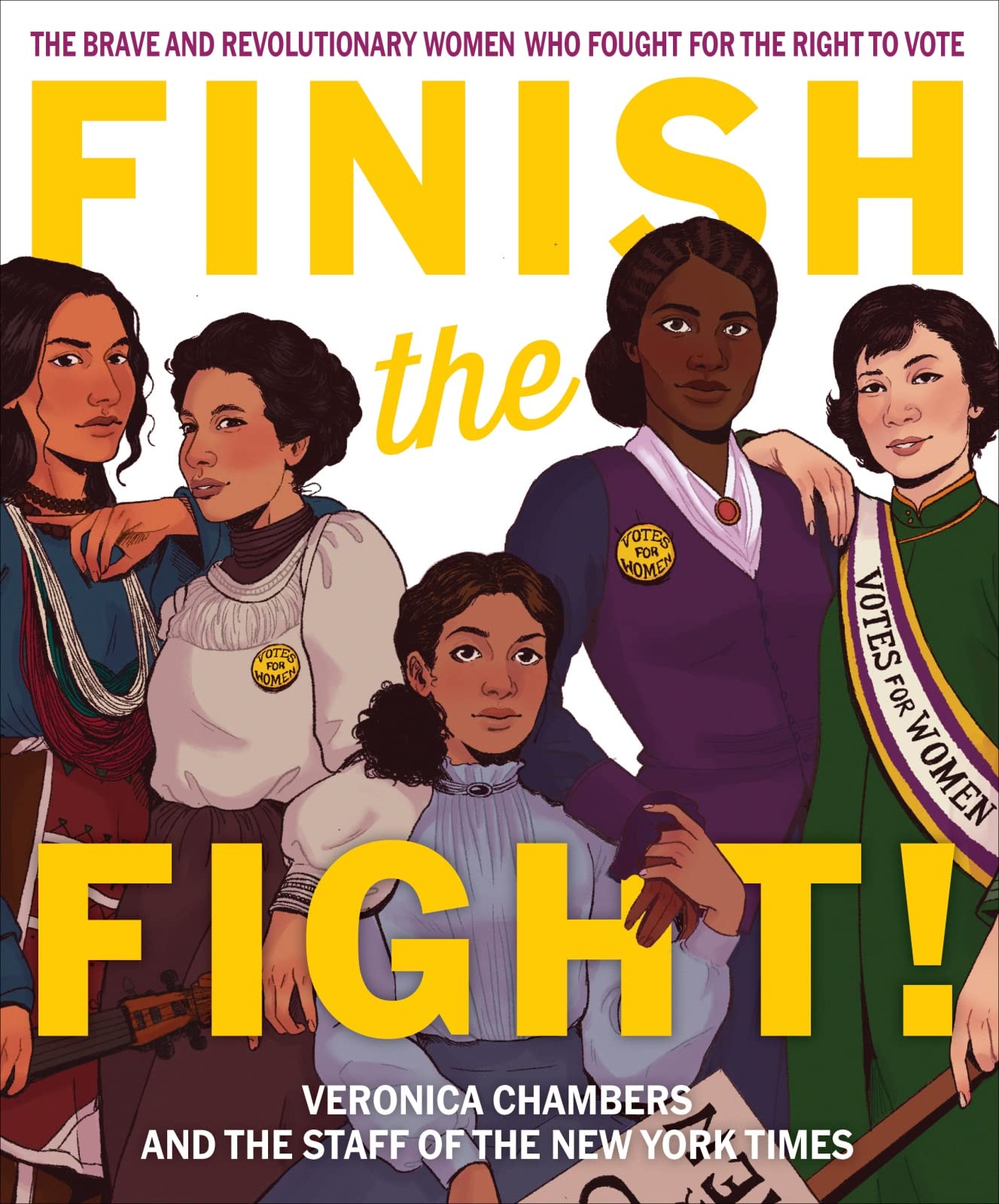
Finish the Fight!: The Brave and Revolutionary Women Who Fought for the Right to Vote – A New York Times Bestselling Biography About Diverse Suffrage
$10.55
by Veronica Chambers



A New York Times Bestseller! In collaboration with the New York Times , Finish the Fight! reveals untold stories of diverse heroines who fought for the 19th amendment—celebrate the historic win for women’s rights and voting rights that changed the fabric of America. Who was at the forefront of women's right to vote? We know a few famous names, like Susan B. Anthony and Elizabeth Cady Stanton, but what about so many others from diverse backgrounds—black, Asian, Latinx, Native American, and more—who helped lead the fight for suffrage? On the hundredth anniversary of the historic win for women's rights, it's time to celebrate the names and stories of the women whose stories have yet to be told. Gorgeous portraits accompany biographies of such fierce but forgotten women as Yankton Dakota Sioux writer and advocate Zitkála-Šá, Mary Eliza Church Terrell, who cofounded the National Association of Colored Women (NACW), and Mabel Ping-Hua Lee, who, at just sixteen years old, helped lead the biggest parade in history to promote the cause of suffrage. Finish the Fight! will fit alongside important collections that tell the full story of America's fiercest women. "This informative book takes a refreshingly inclusive approach to the history of women’s voting rights in the United States.... It widens the spotlight, profiling leaders who have represented minorities and describing the particular challenges they have faced as they worked to promote women’s suffrage." - Booklist (starred review) “Fortifying.... Will remain valuable in years to come.” - Washington Post "Lushly illustrated." - New York Times Book Review “[A] refreshing compilation featuring some of the American suffrage movement’s unsung heroines.... Sidebars add context, one cleverly depicting the state ratification process through a game board.... A welcome, more inclusive panorama of suffrage history.” - Publishers Weekly (starred review) "Timely, moving, and necessary." - Kirkus Reviews (starred review) "Eye-catching." - Horn Book Magazine "This collection of remarkable women will make for a thorough primary source for middle grade research projects.... Recommended for school and public libraries, especially where whitewashed histories detailing the suffrage movement need updating." - School Library Journal Veronica Chambers is the editor for Narrative Projects at The New York Times. She is a prolific author, best known for the New York Times bestseller Finish the Fight! , which was named a best book of the year by The Washington Post , the New York Public Library, and others. Her other works include the critically acclaimed memoir Mama's Girl , Shirley Chisholm Is a Verb, and the anthologies The Meaning of Michelle —a collection by writers celebrating former first lady Michelle Obama—and Queen Bey: A Celebration of the Power and Creativity of Beyoncé Knowles-Carter. Born in Panama and raised in Brooklyn, she writes often about her Afro-Latina heritage. She speaks, reads, and writes Spanish, but she is truly fluent in Spanglish. CHAPTER 1 The Haudenosaunee Model On July 14, 1848, an advertisement appeared in a newspaper in Seneca Falls in upstate New York, announcing 'a Convention to discuss the social, civil, and religious condition and rights of woman.' A few days later, on July 19, some three hundred women and men gathered in a local church for what is often said to be the first meeting dedicated specifically to women's rights. There, after two days of impassioned conversation, one hundred people signed a document modeled on the Declaration of Independence'but adding two words to its most famous passage: 'All men and women are created equal." The document was known as the Declaration of Sentiments. It had been hashed out on a parlor table by a small group of women, including Elizabeth Cady Stanton and Lucretia Mott. Elizabeth was a well-to-do woman who was chafing under traditional ideas about marriage and motherhood. Lucretia was a Quaker, a member of a religious group that already had strong ideas about equality between men and women. Like many of the early suffragists, these two women were ardent abolitionists'a term for people, both black and white, who were fighting to put an end to slavery. The fight against slavery spurred some white women to think about their own situations. Although marriage was hardly slavery, women in 1848, no matter their race, had highly unequal rights compared with men. In some states, married women were required to surrender all their property to their husbands. In a divorce, women often had no right to custody of their children. And in many places it was not illegal for their husbands to beat them. Even in the abolitionist movement, men and women weren't equal. At meetings, women often weren't allowed to speak. At one antislavery meeting in London in 1840, the women were forced to sit silently behind a curtain, which left many of them, including Elizabeth and Lucretia, fumin