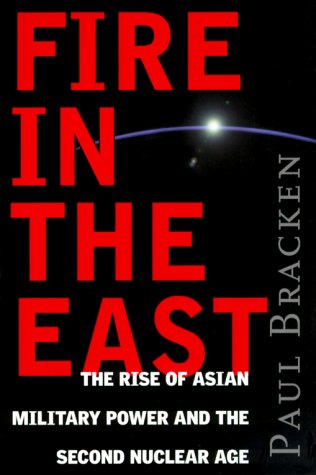
Fire In The East: The Rise of Asian Military Power and the Second Nuclear Age
$25.00
by Paul Bracken



The world changed forever on May 11, 1998. That was the day India defied the rest of the world by testing nuclear weapons. The Indian test of five atomic bombs, and the Pakistani tests that answered a few weeks later, marked the end of an arms control system that has kept the world from nuclear was for half a century. But much more important, as Paul Bracken, professor of management and political science at Yale University, explains in this landmark study, they signal the re-emergence of something the world hasn't seen since the sixteenth century--modern, technologically adept military powers on the mainland of Asia. In an unbroken crescent stretching six thousand miles from Israel to North Korea, Asian countries are building missiles and topping them with atomic, biological, or chemical warheads. This is a development that cannot help but concern anyone who plans to live in the twenty-first century. In this book, Professor Bracken: reveals new details about the Iraqi missile and biological warfare program, showing how close Israel actually came to a germ attack during the Gulf War. explodes the comforting Western belief that "globalization" will inevitably lead Asian nations into peaceful economic competition. In fact, he says, it works the other way: economic progress both spurs and makes possible the development of weapons of mass destruction. shows how American bases, allies, and interests are increasingly endangered by Asian nationalism. teaches us how to navigate not the post-cold war era, but what he names The Second Nuclear Age. Generals, it said, are always preparing to fight the last war. Equally true, policy makers, academics, and journalists draw their metaphors from limited historical experience and use them to debate the future. Just as cold war thinking was dominated by fears of a nuclear Pearl Harbor or an atomic Munich, the United States is entering the twenty-first century with an outdated mind-set drawn from the Cuban Missile Crisis and the Gulf War. Professor Bracken provides a new intellectual framework for a world in which being the only superpower poses as many dangers as it does opportunities. Fire in the East is a template for thinking about the future in the new global order. Yale political science professor Paul Bracken suggests that the second nuclear age offers many more risks than the first one, the main problem being not that the United States is getting weaker, but that Asia is growing stronger. China looks increasingly aggressive, India and Pakistan have gone nuclear, and more countries--such as Iran, Syria, and North Korea--are waiting in the wings. "Proliferation of modern weaponry is driven not by anything that happens in Washington, but by the national strategies set in Beijing, Delhi, and Tehran," writes Bracken. This has disturbing implications: "Since the War of 1812, only one country in modern history has ever been able to mount a convincing threat to the territory of the United States--the Soviet Union. Now there will be many," he says. Going far beyond the stale debate over engagement versus containment, Bracken argues that the West--especially the United States--must prepare all-new national security strategies to meet the emerging realities of the 21st century: "The long era in which Asia was penetrated by outside powers is coming to a close. An age of Western control is ending, and the challenge is not how to shape what is happening but how to adapt to it." Fire in the East is an outstanding book written by a wise man for a nonspecialist audience, but one so provocative and important that the experts can't ignore it. --John J. Miller Bracken (political science, Yale) argues convincingly in this book-length essay that when Pakistan and India engaged in their 1998 series of nuclear tests, the power balance of the world radically changed. The Eurocentric model of the last 400 years has given way to one in which Asian countries with border problems or grandiose ideas and access to new generations of small nuclear, biological, or chemical weapons can attempt to upset the power balance in Asia, with disastrous consequences. At a time when our morning papers report on Iraq and anthrax, China and purloined American nuclear secrets, and North Korea and a ballistic missile program, this is thought-provoking reading. For general-interest and foreign-policy collections, this essay merits careful perusal along with the front pages of the news.AMel D. Lane, Sacramento, CA Copyright 1999 Reed Business Information, Inc. "A major contribution to what should be an increasingly urgent re-examination of the global security environment for which the U.S. must plan its defense. Throughout Asia'from the Mediterranean to North Korea'missile systems are being acquired and deployed, capable of delivering weapons of mass destruction with improving accuracy, reliability and range. Bracken argues cogently that American forces and the base structure on which they rely are b