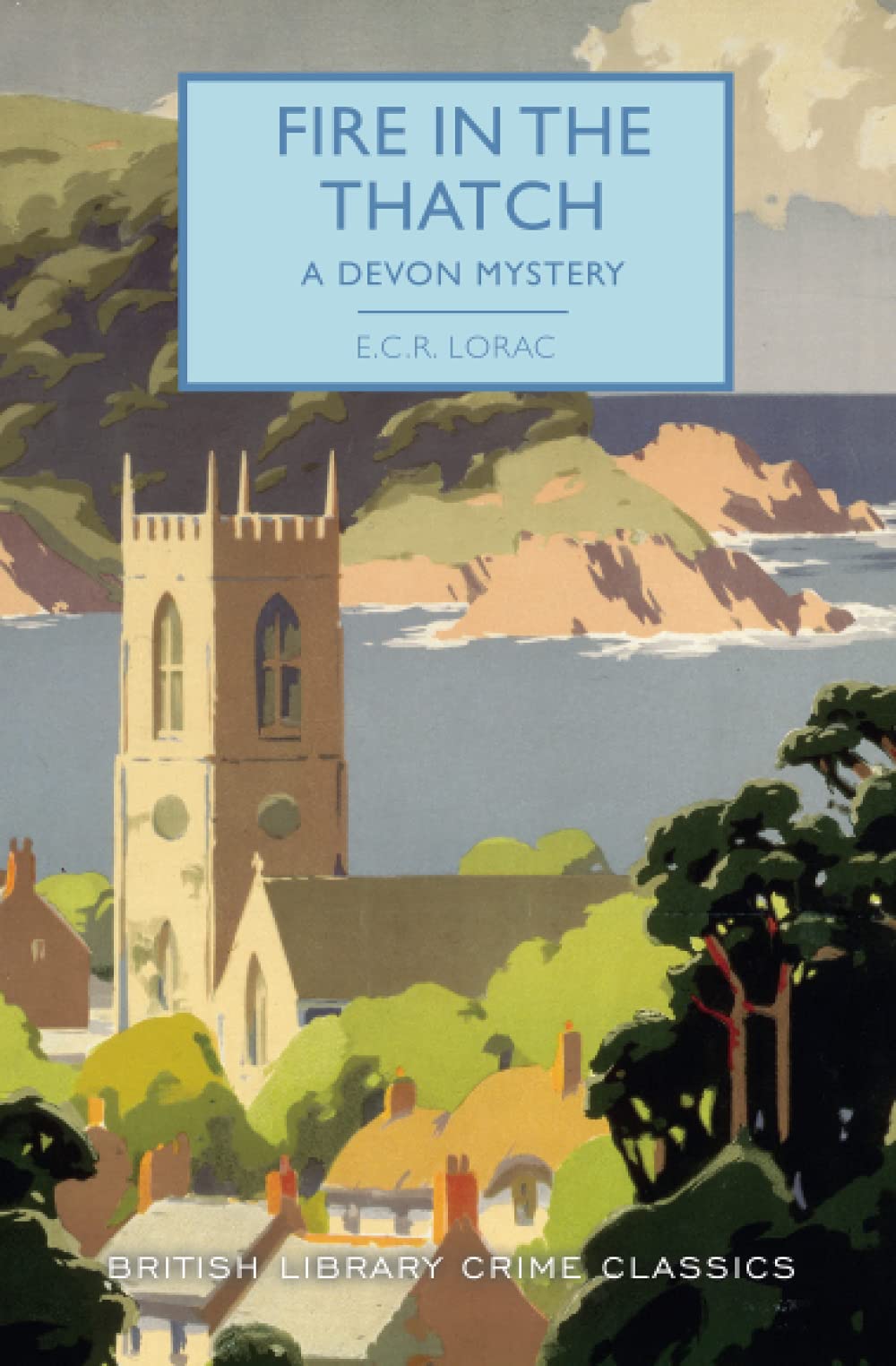
Fire in the Thatch: A Devon Mystery (British Library Crime Classics)
$12.30
by E.C.R. Lorac



Mystery crime fiction written in the Golden Age of Murder "Readers will enjoy watching the conflicts that arise between the wary country folk and the cocktail-drinking Londoners invading their habitat. In sum, this is jolly good fun." ― Publishers Weekly The Second World War is drawing to a close. Nicholas Vaughan, released from the army after an accident, takes refuge in Devon―renting a thatched cottage in the beautiful countryside at Mallory Fitzjohn. Vaughan sets to work farming the land, rearing geese and renovating the cottage. Hard work and rural peace seem to make this a happy bachelor life. On a nearby farm lives the bored, flirtatious June St Cyres, an exile from London while her husband is a Japanese POW. June's presence attracts fashionable visitors of dubious character, and threatens to spoil Vaughan's prized seclusion. When Little Thatch is destroyed in a blaze, all Vaughan's work goes up in smoke―and Inspector Macdonald is drafted in to uncover a motive for murder. An inherently gripping read from beginning to end, Fire in the Thatch is unreservedly recommended for community library Mystery/Suspense collections.-- " Midwest Book Review " Lorac (the pen name of Edith Caroline Rivett) liberally sprinkles the narrative with red herrings and fairly presents all the potential clues. Readers will enjoy watching the conflicts that arise between the wary country folk and the cocktail-drinking Londoners invading their habitat. In sum, this is jolly good fun.-- " Publishers Weekly " E.C.R. LORAC was a pen name of Edith Caroline Rivett (1894-1958) who was a prolific writer of crime fiction from the 1930s to the 1950s, and a member of the prestigious Detection Club. Her books have been almost entirely neglected since her death, but deserve rediscovery as fine examples of classic British crime fiction in its golden age. Fire in the Thatch A Devon Mystery By E.C.R. Lorac Poisoned Pen Press Copyright © 2018 Estate of E.C.R. Lorac All rights reserved. ISBN: 978-1-4642-0967-3 CHAPTER 1 1 Colonel St Cyres stepped out of the French window on to the terrace and drew in a deep breath of frosty air, conscious of the exhilaration of a glorious December morning. He always felt better out of doors. In the open air the worries and irritations of life seemed less immediate, and he felt that he lost a burden when he closed the window behind him. The prospect before him was one to give a sense of wellbeing to any healthy man, and St Cyres, still in his early sixties, was vigorous enough to enjoy the keen still air and the glory of winter sunshine. Beyond the low wall of the terrace the frost-rimed meadows gleamed and sparkled, sloping down to the river a couple of hundred yards below. On the farther bank the land rose again in a series of gentle ridges, meadow land, plough land, and finally wood land in the distance. Here and there a thatched roof seemed to be tucked into the comfortable folds of the rich Devon valley, and blue wood smoke coiled into the still cold air. Everything was agleam with hoar frost, scintillating in the level rays of a sun which threw shafts of intense light along the valley and made the swift-running river flash back the white beams. Down by the river some bullocks grazed in the lush grasses which never fail in a Devon pasture. Colonel St Cyres chuckled as a couple of the lusty young beasts horned one another around the pasture — Red Devons, the famous Ruby beef cattle, snorting and blowing in their youthful vigour. St Cyres thrust some letters into the pocket of his old tweed coat and hastened along the terrace towards the corner where a cluster of outbuildings stood against a larch coppice. In his other hand was a good crust of bread and he munched it appreciatively though with a shamefaced grin. He had done a bolt, he admitted it frankly; he had brought his breakfast to finish out of doors or in the wood-shed, and he knew just why he had done it. "God knows why he married her, poor chap — but scent at breakfast is more than I can stomach," he said to himself. The "poor chap" of whom the Colonel was thinking was his son, Denis, now a prisoner of war in Japanese hands. Whether the Colonel's epithet was due to Denis's plight or to the wife he had married was uncertain, but Colonel St Cyres disliked his daughter-in-law as heartily as any well-bred man allowed himself to dislike a woman. The Colonel was a countryman. He loved the country and his own ancestral acres with an unquestioning tacit devotion. He liked country clothes and country ways, the smell of dung, the rich red Devon mud, the slow slurred speech of his humble country neighbours and the inconveniences of an ancient house set miles away from trains or bus routes. June St Cyres was a Londoner. She had been born in a flat in Mayfair, and a flat in Mayfair was her ideal of happiness. She liked fashionable clothes and shoes, French cooking, modern dance music, and what she called Society. She used elaborate make-up,