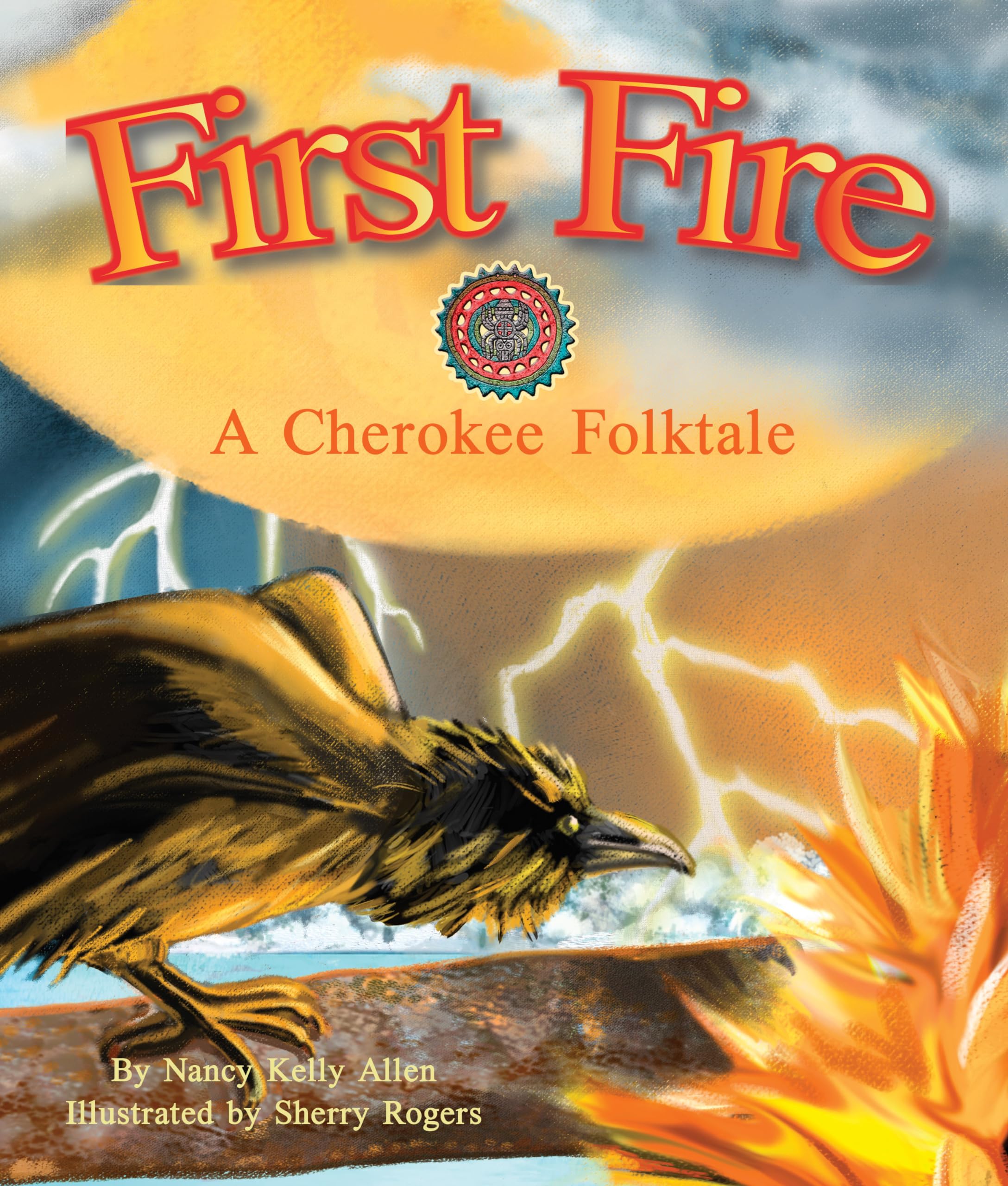



Why are ravens black? Why do screech owl eyes look red in light? How did we get fire? You’ll find the answers to those questions in this retelling of a Cherokee pourquoi folktale. The earth was cold and dark but the animals could see fire coming from the tree on the island. They tried to fly or swim to the island to bring back the fire heat and light. What happened to some of the animals? Which animal brought it back and how? K-Gr 2—Long ago, "when the world was new," Earth had no fire. Then the Thunders threw a lightning bolt, striking a sycamore tree on an island. Seeing the smoking tree, the animals wanted and needed that fire, but didn't know how to get to the island to carry fire back. Many animals wanted the honor of bringing fire across the water, but Raven, citing his great strength, made the first attempt. While Raven perched on a branch trying to figure out how to accomplish his task, fire scorched his feathers, turning them black. Frightened, he returned to the others without fire. Still today, a raven's feathers are black. Raven is followed by Screech Owl, Hoot and Horned Owl and Racer Snake all of which are unsuccessful in their quests and return to the fold with some fire-induced change in their appearance. Finally, Water Spider announces she has a plan and indeed, returns with a spark of the fire that warms Earth and its creatures to this day. This pourquoi tale's text is in a large, clear font accessible to emerging readers. The full-bleed illustrations use a lively palette and the large, animal renderings are quite realistic, which might be frightening to younger readers. There are extensive endnotes that share Cherokee history and further information about fire and water spiders. A serviceable title for those wanting a more illustrated version than those in text-heavy folklore compilations.—Sara-Jo Lupo Sites, George F. Johnson Memorial Library, Endicott, NY K-Gr 2―Long ago, "when the world was new," Earth had no fire. Then the Thunders threw a lightning bolt, striking a sycamore tree on an island. Seeing the smoking tree, the animals wanted and needed that fire, but didn't know how to get to the island to carry fire back. Many animals wanted the honor of bringing fire across the water, but Raven, citing his great strength, made the first attempt. While Raven perched on a branch trying to figure out how to accomplish his task, fire scorched his feathers, turning them black. Frightened, he returned to the others without fire. Still today, a raven's feathers are black. Raven is followed by Screech Owl, Hoot and Horned Owl and Racer Snake all of which are unsuccessful in their quests and return to the fold with some fire-induced change in their appearance. Finally, Water Spider announces she has a plan and indeed, returns with a spark of the fire that warms Earth and its creatures to this day. This pourquoi tale's text is in a large, clear font accessible to emerging readers. The full-bleed illustrations use a lively palette and the large, animal renderings are quite realistic, which might be frightening to younger readers. There are extensive endnotes that share Cherokee history and further information about fire and water spiders. A serviceable title for those wanting a more illustrated version than those in text-heavy folklore compilations.―Sara-Jo Lupo Sites, George F. Johnson Memorial Library, Endicott, NY --From School Library Journal This pourquoi tale’s text is in a large, clear font accessible to emerging readers. The full-bleed illustrations use a lively palette and the large, animal renderings are quite realistic, which might be frightening to younger readers. --School Library Journal This would make a good addition to a library’s folktale collection, especially given the access to multicurricular teaching activities. --Library Media Connection Nancy Kelly Allen is a school librarian and the award-winning author of more than 30 picture books. Her inspiration for writing The First Fire was to honor her Cherokee great-grandmother, Sarah. She hopes that this book will provide younger generations an insight into the mystery and wonder of traditional folktales. Some of her recent and award-winning titles include On the Banks of the Amazon, What Sea Creature Is This?, and Trouble in Troublesome Creek. Nancy lives in Kentucky with her husband and two dogs. Sherry Rogers spent twelve years as a corporate graphic designer and artist before "leaving it all behind" for the freelance world of illustrating children's books. Through illustrating The First Fire, Sherry remembers her own ancestor, Na Ni, a Cherokee woman from the mountains of North Carolina. Some of Sherry's other Arbordale titles include The Penguin Lady, Ten for Me, Hey Diddle Diddle, Newton and Me, Moose and Magpie, Paws, Claws, Hands & Feet, and The Deductive Detective; as well as her award-winning titles: Sort It Out!, Kersplatypus, Burro's Tortillas, and If You Were a Parrot. Sherry lives in Northern California with her