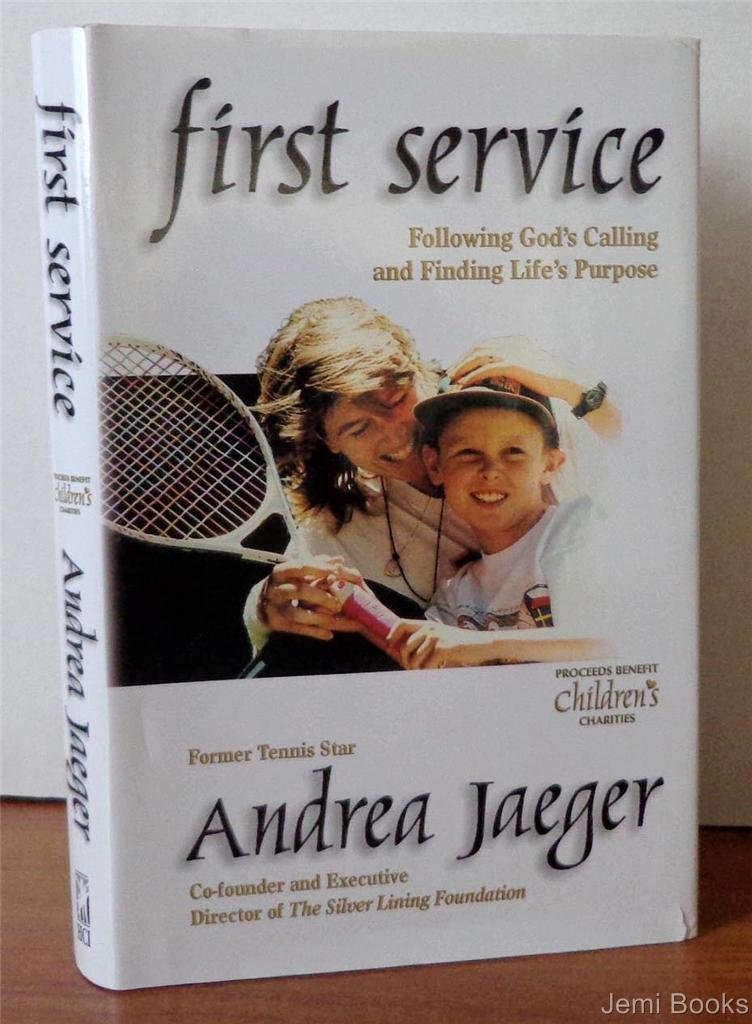



The one-time tennis prodigy describes how an injury led to the premature end of her career and her decision to follow the Word of God and dedicate her life to The Silver Foundation, a non-profit camp for children with cancer. Andrea Jaeger is a former #2 ranked female tennis player turned philanthropist. An active Christian (nondenominational), she co-founded The Silver Lining Foundation, based in Aspen, Colorado, which she has run for more than a decade. She also operates the Little Star Program, headquartered in Durango, Colorado, which gives money and provides programs to children afflicted with a variety of hardships and diseases. Chapter 1 Worthiness, not Pride Before I formed you in the womb I knew you; before you were born I sanctified you. ―Jeremiah 1:5 As with many Americans, I was a child of determined immigrants seeking freedom and a better life in a new country with countless opportunities. My parents, Roland and Ilse Jaeger, longed to leave their native homeland of Germany, where everyone they knew told stories of the ravaging effects of two world wars. They had both lived through horrors of their own, and this added to their personal strength and determination to make a new life for themselves and, eventually, a better life for the family they hoped to start. My father was a gifted athlete, but his frequent bouts with sports injuries curtailed his dreams of becoming an international soccer or boxing superstar. As much as this disappointed him, these injuries might have saved his life since they prevented him from being drafted into the German military. War had been difficult for the Jaeger family. While my dad's father, my grandfather, was fighting at the front, his mother battled the ravages of a brain tumor and died in the prime of her child-rearing years. My dad's father was then taken prisoner by the Russians and held captive for four years. Filled with sorrow and despair, my father was determined to keep the remains of his family together to rise up against the death and decay all around him. My mother had a fateful encounter during the war that, if acted upon differently, would have altered the course of many lives―including mine. In the pastoral German countryside, in view of the Rhine River, a soldier broke into my mom's home at the end of the war. French troops had captured the town of Brennet, Germany. The Americans were in Berlin. The Nazi regime was falling. As in all wars, bullets, mortars and bombs bring down innocent bystanders. Soldiers have to make split-second decisions to spare and take lives, including their own. This particular soldier was securing the perimeter around my mother's home when his attention was drawn to a noise in the kitchen. He made his way inside. My mom sensed a presence behind her and turned from the kitchen counter where she was undertaking her daily chores of preparing a meal. Startled by the invasion, her eyes locked on the soldier. She feared for her life. He slowly came closer to my mother, lowered his firearm and withdrew a long blade. The soldier lifted the knife high in the air, apparently ready to slash my mother, but she didn't flinch. She watched the knife slice through the air. If it was her time to die, she certainly wasn't going down as a coward. But rather than harming my mother, the soldier decided to smash the knife down on the counter. In a mark of compassion, in the blink of an eye, the soldier spared my mom's life. Staring at my mother, the soldier expressed that this was not her time to die. She had her own destiny to fulfill. Long seconds passed as they stared at each other, taking in how quickly life can turn to death and vice versa. The soldier made the next move, slicing himself some cheese, and then proceeded to quietly make his way out the door, never to be seen again. With the life-threatening situation over, Mom, in her typical no-nonsense fashion, continued about her chores. Nothing would deter her from her duty of making sure the family had food on the table. My parents survived these rough challenges and more harrowing ones as well. No one lives through war without scars―emotional, spiritual or physical, or worse yet, all three―but it gave them an even stronger will to succeed and more reason to focus on their future and fulfill their hopes and dreams. My mother's aunt lived in Chicago. Roland and Ilse, in love but not yet married, were encouraged by her stories of life in America―the land of prosperity. With few possessions, but a wealth of dreams, they set sail for the strange new land that would soon be their home. They had to travel separately, as my father had difficulty getting a visa from the German government, which wanted to keep as many of its citizens as possible―especially the men―to help in the rebuilding effort. In February 1956, undaunted by the challenges of traveling alone, my mother bravely ventured by boat to the United States of America, where her aunt met her in Chicago. My father final