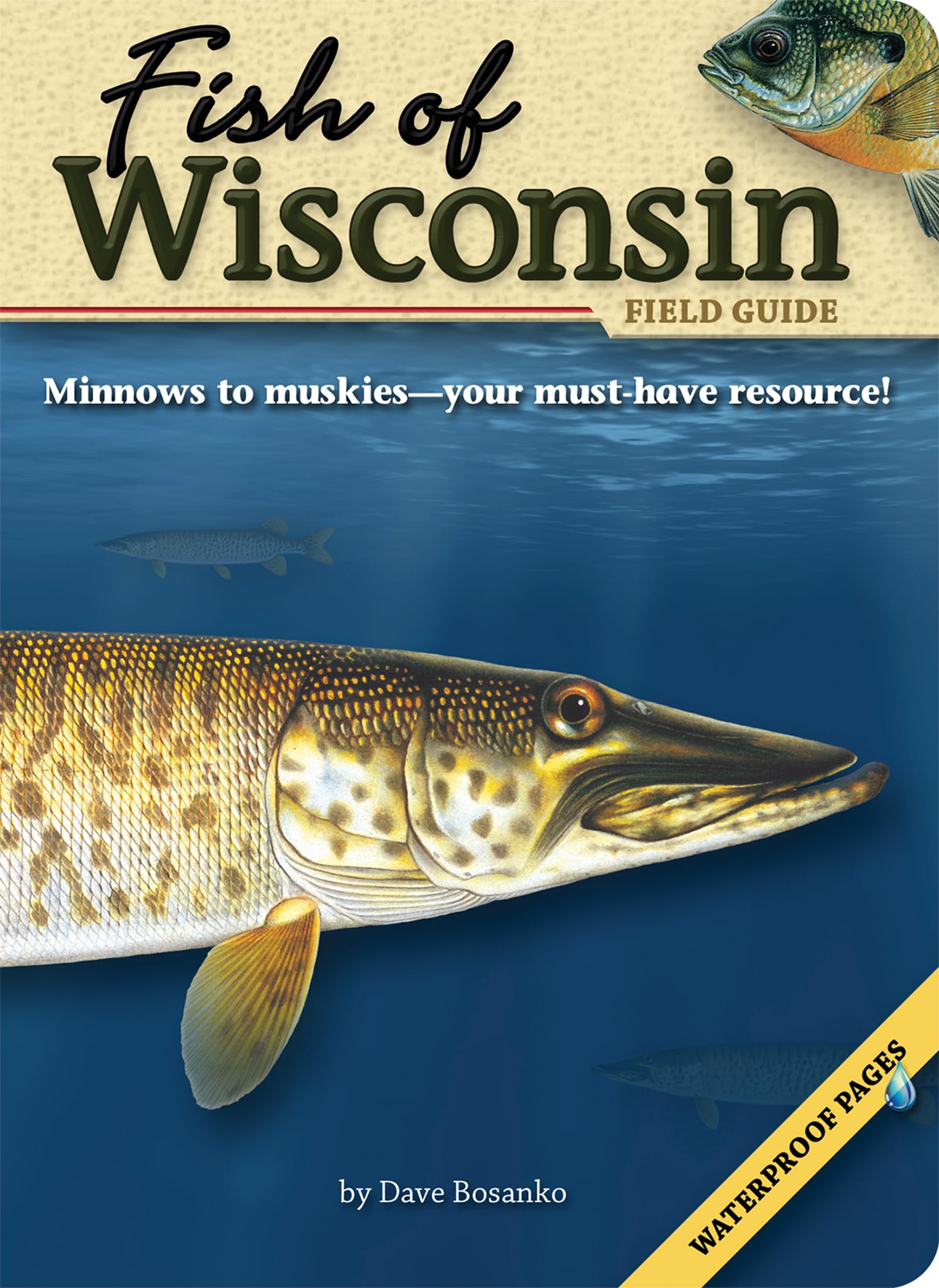



Go Fishing with Wisconsin’s Famous Identification Guide! Fishing is a perfect outdoors activity for all ages and skill levels, and the Badger State is an angler’s paradise. Reel in fish, and make identifying your catches a snap. The Fish of Wisconsin Field Guide by Dave Bosanko features detailed information about 76 species of Wisconsin fish. When you’re not sure what you caught, grab the handy guide and narrow your choices by family. Then identify your prize with the intricately detailed fish illustrations. Further verify the type of fish using the “Similar Species” comparisons. Book Features: Detailed information about 76 species - Professional-quality illustrations―perfect for fish identification - Fascinating facts on spawning behavior, feeding habits, and more - Fishing tips and inside information for easily locating fishing hotspots - Bonus resources such as state fishing records and answers to frequently asked questions Grab the Fish of Wisconsin Field Guide for your next angling adventure. It’s essential for every tackle box, beach bag, RV, and cabin. Plus, its convenient size makes it perfect for the dock or boat. FISH OF WISCONSIN FIELD GUIDE by Dave Bosanko, Adventure Publications, Cambridge, MN, 170 pages, $12.95. Anglers will love this waterproof guide to 76 Wisconsin fish. The book fits easily in a jacket pocket or tacklebox. To identify a catch, start by matching it to one of the family silhouettes in the table of contents. From the family entries, pick the species from a series of two-page spreads that include color illustrations, keys to distinguish your fish from similar species, other common names and natural history information like habitat, range, food, reproduction, average 'size and state records. There's a nice glossary and the index is cross-referenced so if you know your fish by another name, you can easily find its scientific name. The author prefaces the book with illustrations of fish anatomy, photos of fish diseases, frequently asked questions and interesting fish facts like how to estimate your fish's weight if you know its length and girth. Looking for a unique Valentine gift for your favorite angler? This is it!--Kathryn A Kahler"Wisconsin Natural Resources" (02/01/2008) Dave Bosanko was born in Kansas and studied engineering before following his love of nature to degrees in biology and chemistry from Emporia State University. He spent thirty years as staff biologist at two of the University of Minnesota’s field stations. Though his training was in mammal physiology, Dave worked on a wide range of research projects ranging from fish, bird, and mammal population studies to experiments with biodiversity and prairie restoration. An avid fisherman and naturalist, he has long enjoyed applying the fruits of his extensive field research to patterning fish location and behavior, and observing how these fascinating species interact with one another in the underwater web of life. Largemouth Bass Micropterus salmoides Family: Sunfish family (Centrarchidae) Other Names: black bass, green bass, green trout, slough bass Description: dark green back, greenish sides often with dark lateral band; belly white to gray; large, forward-facing mouth; lower jaw extends to rear margin of eye Habitat: shallow, fertile, weedy lakes and river backwaters; weedy bays and extensive weedbeds of larger lakes Range: southern Canada through the U.S. into Mexico; widely introduced; common throughout Wisconsin Food: small fish, frogs, crayfish, insects, leeches Reproduction: in May and June when water temperatures reach 60 degrees, male builds nest in 2 to 8 feet of water, usually on firm bottom in weedy cover; female deposits 2,000 to 40,000 eggs, which the male fans and guards; male also protects fry until the “brood swarm” disperses Average Size: 12 to 20 inches, 1 to 5 pounds Records: State―11 pounds, 3 ounces, Lake Ripley, Jefferson County, 1940; North American―22 pounds, 4 ounces, Montgomery Lake, Georgia, 1932 Notes: Largest member of the sunfish family in Wisconsin. Most popular game fish in the United States, the largemouth is known for strong fights and high leaps. Though it is not highly regarded as table fare in the North, it is commonly eaten in the South. A carnivore, it will devour any live prey that fits into its mouth. Found in thick weedbeds, shallow woody cover and around docks; often feeds near the surface; not commonly located in water deeper than 20 feet. Similar Species: Smallmouth Bass (pg. 140) Largemouth Bass: mouth extends beyond non-red eye - Smallmouth Bass: mouth does not extend beyond red eye