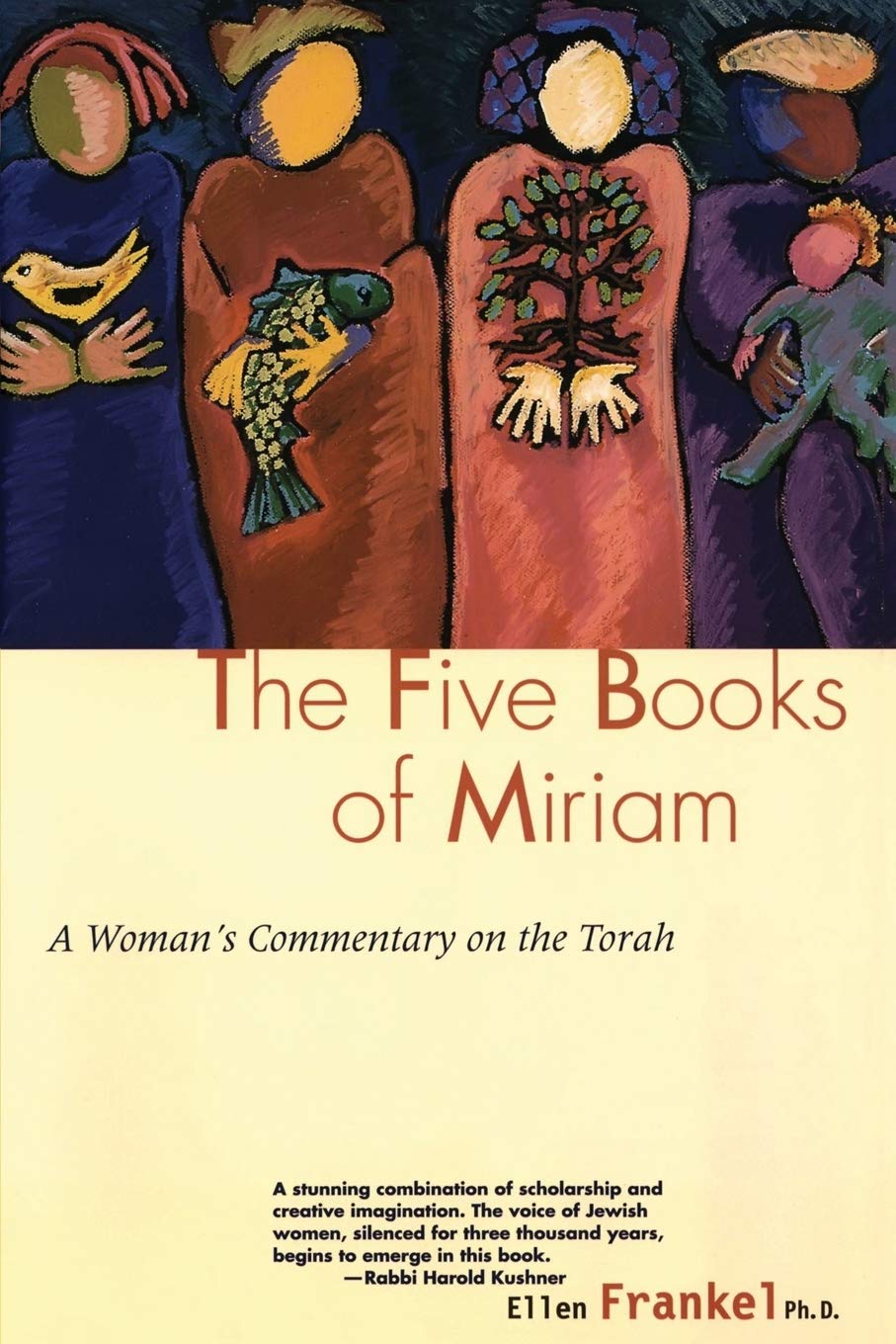
Five Books Of Miriam: A Woman's Commentary on the Torah – Voices of Foremothers and Daughters in Conversation with Jewish Tradition
$10.61
by Ellen Frankel



Weaving together Jewish lore, the voices of Jewish foremothers, Yiddish fable, midrash and stories of her own imagining, Ellen Frankel has created in this book a breathtakingly vivid exploration into what the Torah means to women. Here are Miriam, Esther, Dinah, Lilith and many other women of the Torah in dialogue with Jewish daughters, mothers and grandmothers, past and present. Together these voices examine and debate every aspect of a Jewish woman's life -- work, sex, marriage, her connection to God and her place in the Jewish community and in the world. The Five Books of Miriam makes an invaluable contribution to Torah study and adds rich dimension to the ongoing conversation between Jewish women and Jewish tradition. "A wonderful weave of women's voices that invites the reader to participate in a conversation both thousands of years old and utterly new."--Judith Plaskow, author of Standing Again at Sinai "This book is a masterpiece that should be in every library."-- Publishers Weekly " The Five Books of Miriam has the spin of the storyteller, the feel of the folklorist, and the wisdom of the scholar. All women should carry this portable Miriam around with them. This is a necessary, strong, and witty commentary."--E.M. Broner, author of The Telling "A stunning combination of scholarship and creative imagination. The voice of Jewish women, silenced for three thousand years, begins to emerge in this book."--Rabbi Harold Kushner Ellen Frankel, folklorist, writer, scholar, has written the book that lets the Torah speak to women and that welcomes women into its sacred pages. In The Five Books of Miriam, she helps us discover the stories, conflicts, and dreams of the many women - named and nameless - who populate the biblical landscape. Building on the centuries-old tradition of Jewish commentary, Frankel expands the conversation about what the Torah means to women. The Five Books of Miriam includes folktales and folklore, homespun wisdom, Yiddish lore, songs, midrash, modern scholarship, and feminist criticism. Weaving together Jewish lore, the voices of Jewish foremothers, Yiddish fable, midrash, and stories of her own imagining, Ellen Frankel has created in this book a breathtakingly vivid exploration into what the Torah means to women. Here are Miriam, Esther, Dinah, Lilith and many other women of the Torah in dialogue with Jewish daughters, mothers, and grandmothers, past and present. Together these voices examine and debate every aspect of a Jewish woman's life--work, sex, marriage, her connection to God, and her place in Jewish community and the world. The Five Books of Miriam makes an invaluable contribution to Torah study and adds rich dimension to the ongoing conversation between Jewish women and Jewish tradition. Ellen Frankel is an acclaimed storyteller and writer, popular lecturer and accomplished scholar. She is the author of many books, including The Classic Tales: Four Thousand Years of Jewish Lore . Chater one I. BERESHIT:Sexuality and Desire (GENESIS 1:1-6:8) TORAH SPEAKS: In the beginning, Shekhinah, the Holy-One who-Dwells-in-This-World, spins the world into being: light, water, earth, heavenly bodies, seed-bearing plants, sea creatures, birds, animals-and Adam, the only creature cast in the divine image, double-gendered and unique. And then the Holy One rests. And Adam then untwins, differentiating into two separate creatures: man and woman. Seeing the woman, the man names her "bone of my bone, flesh of my flesh," name of my name, isba of my ish, Cleaving together, they embody the divine image in their unity. In partnership, they set up house in Eden. But like all idylls, this one too proves false, and soon comes to an end. Adam and Eve awaken to desire, and beget history and sin. In turn, their sons, Cain and Abel, follow after their own hearts, and beget death. Thus the human drama begins to run its course. Many generations follow, until the earth fills up with evil, and God-like any heartbroken parent-wonders how it all could have gone so wrong. THE CREATION OF SOULS ESTHER THE HIDDEN ONE REVEALS: During the first hour of the first day of creation, before anything else was created, Shekhinah created all human souls and placed them in the highest heaven. When a baby is conceived, Laylah, the Angel of Night, brings it before God to learn its fate. At that moment it is written: where it will live and when it will die, whether it will be a girl or a boy, rich or poor, strong or weak, beautiful or ugly, wise or foolish. Only one decision is left unwritten: whether it will be righteous or wicked. Then the Angel of Souls ascends to the highest heaven to bring back the soul destined for this particular child. It enters the child and nestles quietly beneath the mother's breast. And then a different angel teaches the soul all that it will learn during its days on earth. And when it comes time for the child to be born, the angel strikes the newborn under its nos