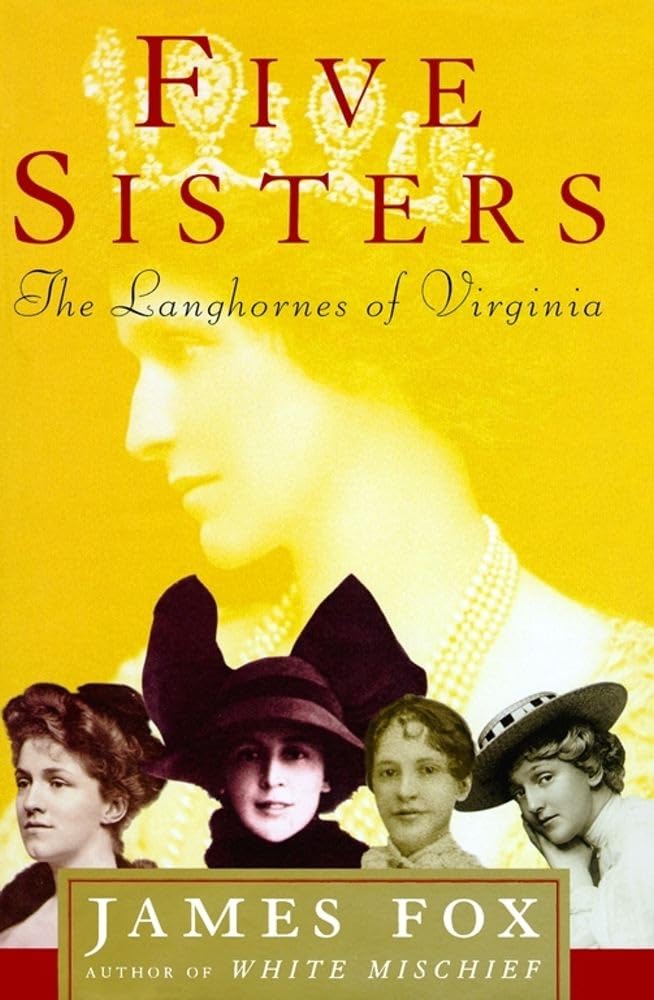



The beautiful Langhorne sisters lived at the pinnacle of society from the end of the Civil War through the Second World War. Born in Virginia to a family impoverished by the Civil War, Lizzie, Irene, Nancy, Phyllis, and Nora eventually made their way across two continents, leaving rich husbands, fame, adoration, and scandal in their wake. At the center of the story is Nancy, who married Waldorf Astor, one of the richest men in the world. Heroic, hilarious, magnetically charming, and a bully, Nancy became Britain's first female MP. The beautiful Irene married Charles Dana Gibson and was the model for the Gibson Girl. Phyllis, the author's grandmother, married a famous economist, one of the architects of modern Europe. Author James Fox draws on the sisters' unpublished correspondence to construct an intimate and sweeping account of five extraordinary women at the highest reaches of society. Jay Strafford Richmond Times-Dispatch As a family history, Five Sisters is compellingly readable....As a portrait of a faded society, it is a social study at its best....The Langhornes come alive again in a book the reader will linger over, find ultimately moving, and finish with regret. Stacy Schiff The New York Times Reads like Pride and Prejudice as recast by Margaret Mitchell. Robert Skildelsky The New York Review of Books James Fox has written a psychological masterpiece....[he] has, with consummate artistry, constructed a work that is witty and sad, affectionate but just. It is impossible to put down. One wishes it would never end. Sophy Burnham The Washington Times This book has everything everything: wealth, privilege, politics, and clandestine love affairs -- the golden dance of goddesses and the slow, inexorable decline into tragedy. Dominick Dunne Oh, how I loved taking my time reading James Fox's Five Sisters, absorbing the sort of dazzling details of privilege and class that made his White Mischief so utterly perfect. The Langhorne sisters fascinated their contemporaries on two continents. Now one of the sister's grandsons has written their tale and shown us their worlds with enormous style. John Richardson The most fascinating chronicle of American highlife I have ever read. James Fox deftly steers us from Margaret Mitchell country, via Henry James's New York and London, to a wonderful Evelyn Waugh-ish finale that is sad and grand and raffish. Houston Chronicle Fox has wrestled all the Langhorne myths into coherent whole and shaped them into a rich and instructive portrait of a family and an era. Gloria Vanderbilt James Fox draws us intimately into a domain of wealth, glamour, politics, and tragedy. One is bedazzled and repelled and ultimately bewitched by the relentless narcissism, selfishness, and cruelty of the amazing Langhorne sisters. A mesmerizing book. Charlottte Grey The Toronto Sun A compelling portrait of high life in the most glamorous era of the British Empire....A wonderful story. London Observer [ Five Sisters ] is not just a study of a family, or of an age, it is a living, breathing re-creation of a singular way of life....Fox has done more than create a monument to his family -- he has captured a fading impression and made it flow. The Langhornes are alive again. James Fox was born in Washington, D.C., in 1945. He worked as a journalist in Africa, and later at the Sunday Times in London. He is the author of the bestselling White Mischief. Chapter One: The Langhornes The Langhorne sisters of Virginia were a phenomenon in America, in the South and then in the North, long before the third of Chillie Langhorne's five daughters crossed the Atlantic and became, as Nancy Astor, in 1919, the first woman to take her seat in the British Parliament. For a decade or two after that, she was probably the most famous woman in the world. Nancy, in turn, had grown up in the shadow of her elder sister Irene. It was Irene who had first projected the sisterhood into the public imagination when she emerged in 1890 in Virginia, aged seventeen, as the last great Southern Belle; two years later, she was the first to go north since the Civil War, to lead the debutante balls. She married, in 1895, the illustrator Charles Dana Gibson, creator of the Gibson Girl, into whose image Irene merged, thus achieving celebrity comparable now only in movie star or supermodel terms. Irene's rise to fame coincided with the moment that Chillie Langhorne, the patriarch of this family, who was born into the old Virginian squirearchy, a class ruined -- like every other in Virginia -- by the war, made a sudden fortune on the railroads and rescued his family from twenty-five years of poverty and hardship in the years of Reconstruction. Langhorne installed his family at Mirador, a colonnaded house at the foot of the Blue Ridge Mountains, where the younger children, Nancy and her closest sister, Phyllis, Nora, and Buck, grew up. For the northern admirers who came down on the train to propose to Irene