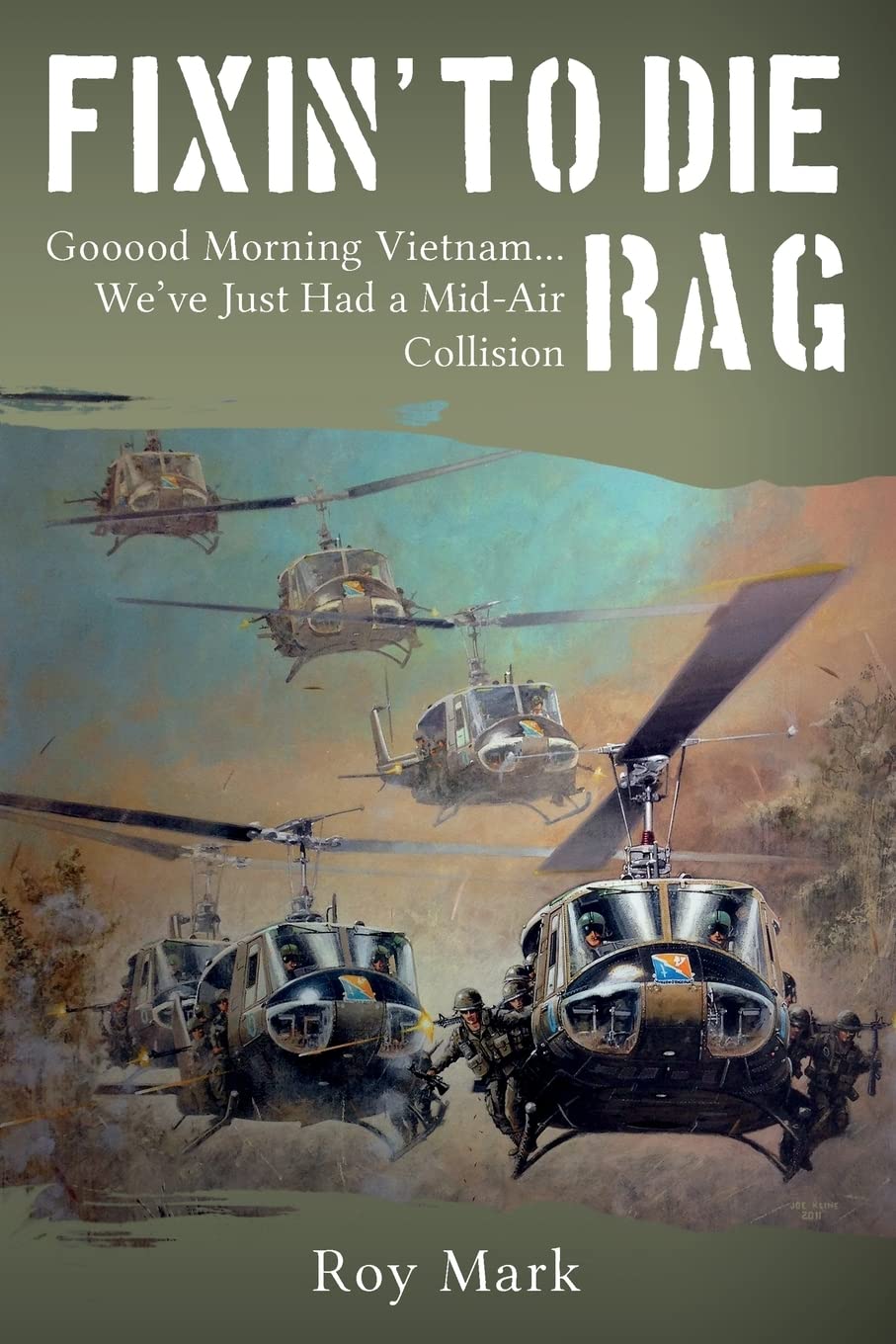



FIXIN' TO DIE RAG is the true story of helicopter pilots and their crews in Vietnam. It’s the story of young warriors that were called to duty by conscience or country. They flew hazardous missions; they fought a deadly enemy; they prevailed against horrific odds; some good men died. This is the story of Charlie Company of the First Cavalry Division’s 229th Assault Helicopter Battalion. They were decorated with medals of valor and Purple Heart—far too many Purple Hearts.Fasten your seat belts and join them in the war-torn Vietnamese skies of 1970. SABER Newsletter: Fixin’ To Die Rag,by Roy Mark, is the true story of Charlie Company, 229th Aviation Battalion inVietnam between March and September 1970. It borrows its unusual name from ananti-Vietnam War protest song by County Joe and the Fish, “I Feel Like I’mFixin’ to Die Rag” and is sometimes also referred to as the “Vietnam Song.”Author Roy Mark, served in the U.S. Marine Corps as a radiotelegraph operatorfrom 1963 until 1967 and served in Vietnam in 1966. While doing research intohis family genealogy, Roy, learned that WO1 Mark Holtom, C/229th, was killed ina mid-air collision of Huey Helicopters, 68-15648 and 68-16123 on 26 September1970. He began writing about that incident and the story expanded into, Fixin’To Die Rag: Gooood Morning Vietnam… We’re Just Had a Mid-Air Collision. I give the book a Silver Wings ofthe Cav “Thumbs Up.” A quick read (two scotches and one cigar). It’s a finetribute to our brothers, the men of Charlie Company; a slice of life in Vietnamof those brave pilots and crews can be found between its pages. —Hank Llewelyn, 1st CavDivision Association SABER Newsletter, Jan/Feb 2015 Edition The VHPA AVIATOR Magazine Fixin’ To Die Rag by Roy Mark, is the story of thosewho served with Charley Company of the 229th Assault Helicopter Battalion, 1stCav, between March and September 1970. During that period C/229 lost 18Aviators and crewmembers along with 4 passengers. Mark, is a Marine Corpsveteran and writer. He read a story written by a C/229 member about amid-air collision the unit suffered. After numerous interviews with C/229veterans, Mark has shaped this and other stories of their service and sacrificein those 7 months of 1970 in Vietnam into an excellent, although at times, verysomber reading experience, which is hard to put down. Mark uses chapter titles that refer to song titles we all knewwell in Vietnam; music which continues to resonate with us. There are manyblack and white photos in the book, most of which were originally incolor. Each photo in the book has a QR code which can be scanned by asmart phone or tablet computer allowing the reader to view all of the photos intheir original quality. —John Penny, TheVHPA AVIATOR Magazine, Jan/Feb 2015 Edition Roy Mark grew up in New Orleans. He joined the U.S. Marine Corps in 1963 and received his basic training at Parris Island, South Carolina. He later served as a radiotelegraph operator with the First Anti-Tank Battalion at Camp Pendleton and with the Marine Communications Detachment onboard the USS Mount McKinley (AGC-7). His final assignment was as an instructor at the Radiotelegraph School, Marine Corps Recruit Depot, San Diego. During his service, he served nine days in Vietnam in support of Vietnamese Counteroffensive (Phase II) during July of 1966. Mr. Mark attended Southeastern Louisiana University before beginning a career in the oil industry. In a career spanning three decades, he worked as a mud engineer, mud school instructor, oil well blowout prevention instructor, and drilling supervisor. Roy has worked in locations around the world, including North and South America, Europe, and Southeast Asia. He lived in Indonesia from 1988 until relocating to Chiang Mai, Thailand in 2001. Mr. Mark has written technical manuals on oil well blowout prevention for two companies and has written numerous short stories. He published "The Mark Family History" in 2005 and "The Texan and The Ice-Boy" in 2014.