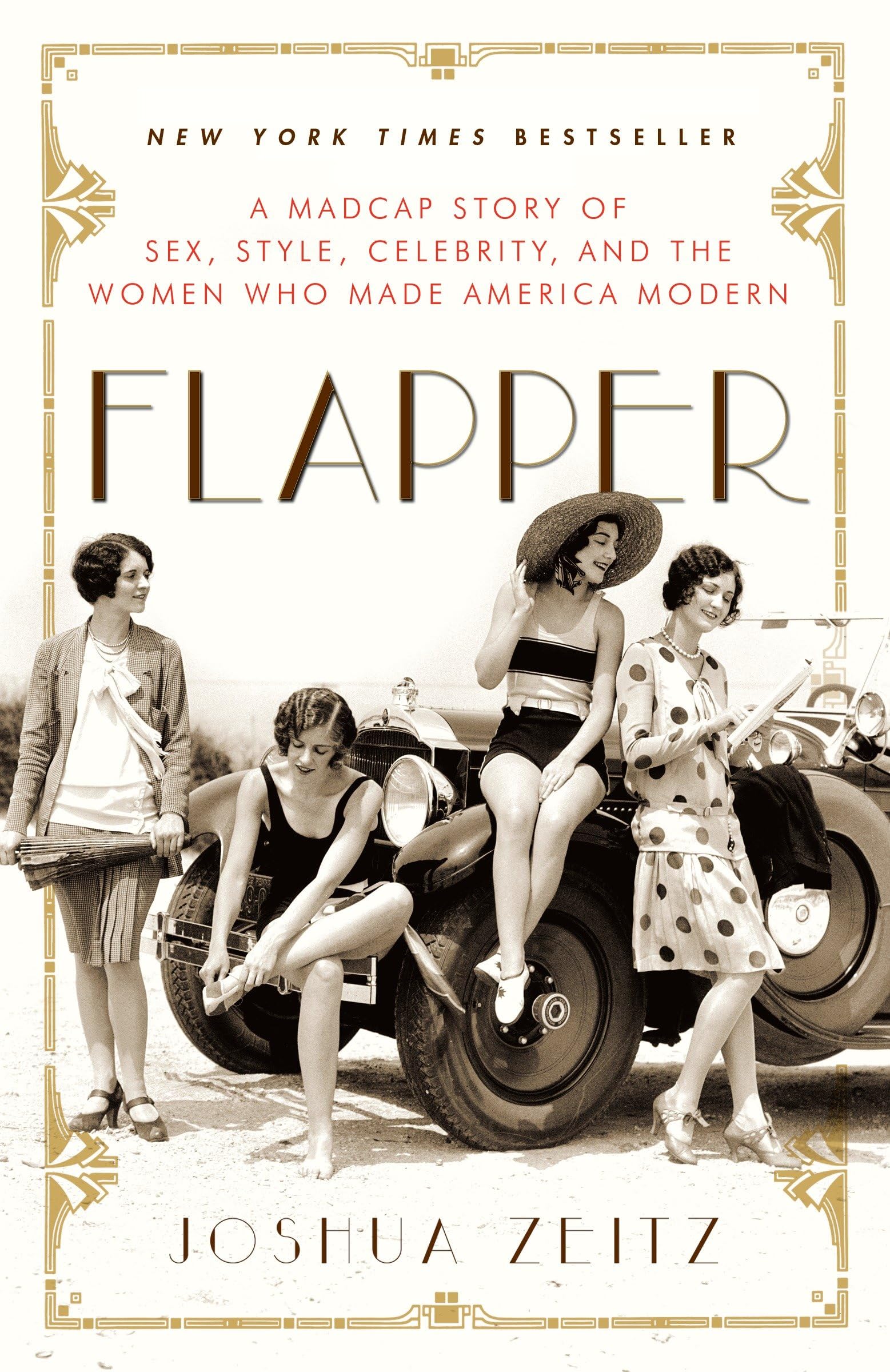
Flapper: A Madcap Story of Sex, Style, Celebrity, and the Women Who Made America Modern
$11.65
by Joshua Zeitz



Flapper is a dazzling look at the women who heralded a radical change in American culture and launched the first truly modern decade. The New Woman of the 1920s puffed cigarettes, snuck gin, hiked her hemlines, danced the Charleston, and necked in roadsters. More important, she earned her own keep, controlled her own destiny, and secured liberties that modern women take for granted. Flapper is an inside look at the 1920s. With tales of Coco Chanel, the French orphan who redefined the feminine form; Lois Long, the woman who christened herself “Lipstick” and gave New Yorker readers a thrilling entrée into Manhattan’s extravagant Jazz Age nightlife; three of America’s first celebrities: Clara Bow, Colleen Moore, and Louise Brooks; Dallas-born fashion artist Gordon Conway; Zelda and Scott Fitzgerald, whose swift ascent and spectacular fall embodied the glamour and excess of the era; and more, this is the story of America’s first sexual revolution, its first merchants of cool, its first celebrities, and its most sparkling advertisement for the right to pursue happiness. Whisking us from the Alabama country club where Zelda Sayre first caught the eye of F. Scott Fitzgerald to Muncie, Indiana, where would-be flappers begged their mothers for silk stockings, to the Manhattan speakeasies where patrons partied till daybreak, historian Joshua Zeitz brings the 1920s to exhilarating life. Joshua Zeitz has taught American history and politics at Cambridge University, Harvard University, and Princeton University. He is the author of several books on American political and social history and has written for the New York Times , Washington Post , The New Republic , The Atlantic , Dissent , and American Heritage . A former congressional campaign aide and gubernatorial policy advisor and speechwriter, Zeitz lives with his wife and daughter in Hoboken and Ocean Grove, NJ. From the Hardcover edition. Chapter 1 1 The Most Popular Girl For all intents and purposes, and purely by virtue of chance, America’s Jazz Age began in July 1918 on a warm and sultry evening in Montgomery, Alabama. There, at the Montgomery Country Club—“a rambling brown-shingled building,” as one contemporary later remembered it, “discreetly screened from the public eye by an impenetrable hedge of mock oranges”—a strikingly beautiful woman named Zelda Sayre sauntered onto the clubhouse veranda and caught the eye of First Lieutenant Francis Scott Fitzgerald. At seventeen, Zelda was “sophisticated for her age,” recalled one of her friends, but “she still had the charm of an uninhibited, imaginative child.” As she stood outside the clubhouse amid the dull murmur of the brass dance music emanating from within, bathed by the Alabama moonlight, her “summer tan gave her skin the color of a rose petal dripped in cream. Her hair had the sheen of spun gold. Wide and dark-lashed, her eyes seemed to change color with her prismatic moods; though in reality they were deep blue, at times they appeared to be green or even a dark Confederate gray.” Just one month out of high school, Zelda was “slender and well-proportioned,” “lithe,” and “extraordinarily graceful.” Among the younger set, Zelda Sayre was commonly acknowledged as something of a wild child. She particularly delighted in scandalizing her father, Judge Anthony Sayre, a staid Victorian who, in his capacity as an associate justice of the Alabama Supreme Court, was one of Montgomery’s leading citizens. Given her family’s standing in the community, Zelda’s frequent exploits were sure fodder for gossip. There was the day she climbed to the roof of her house, kicked away the ladder, and compelled the fire company to rescue her from certain injury and disgrace. Or the time she borrowed her friend’s snappy little Stutz Bearcat to drive down to Boodler’s Bend, a local lover’s lane concealed by a thick orchard of pecan trees, and shone a spotlight on those of her schoolmates who were necking in the backseats of parked cars. Or those other occasions when she repeated the same trick, but at the front entrance to Madam Helen St. Clair’s notorious city brothel. Most disturbing to Judge Sayre was Zelda’s well-earned reputation for violating the time-honored codes of sexual propriety that seemed everywhere under attack by the time the opening shots were fired in World War I. Already a veritable legend among hundreds of well-heeled fraternity brothers as far and wide as the University of Alabama, Auburn University, and Georgia Tech, Zelda was “the most popular girl at every dance,” as a would-be suitor remembered years later. Part of Zelda’s renown surely was owed to her habit of sneaking out of country club dances—and sometimes her bedroom window—to join Montgomery’s most eligible bachelors for a few hours of necking, petting, and drinking in secluded backseat venues. On more than a few occasions, the inviting aroma of pear trees, the dim glow of a half-moon, and the tentative sound of a bo