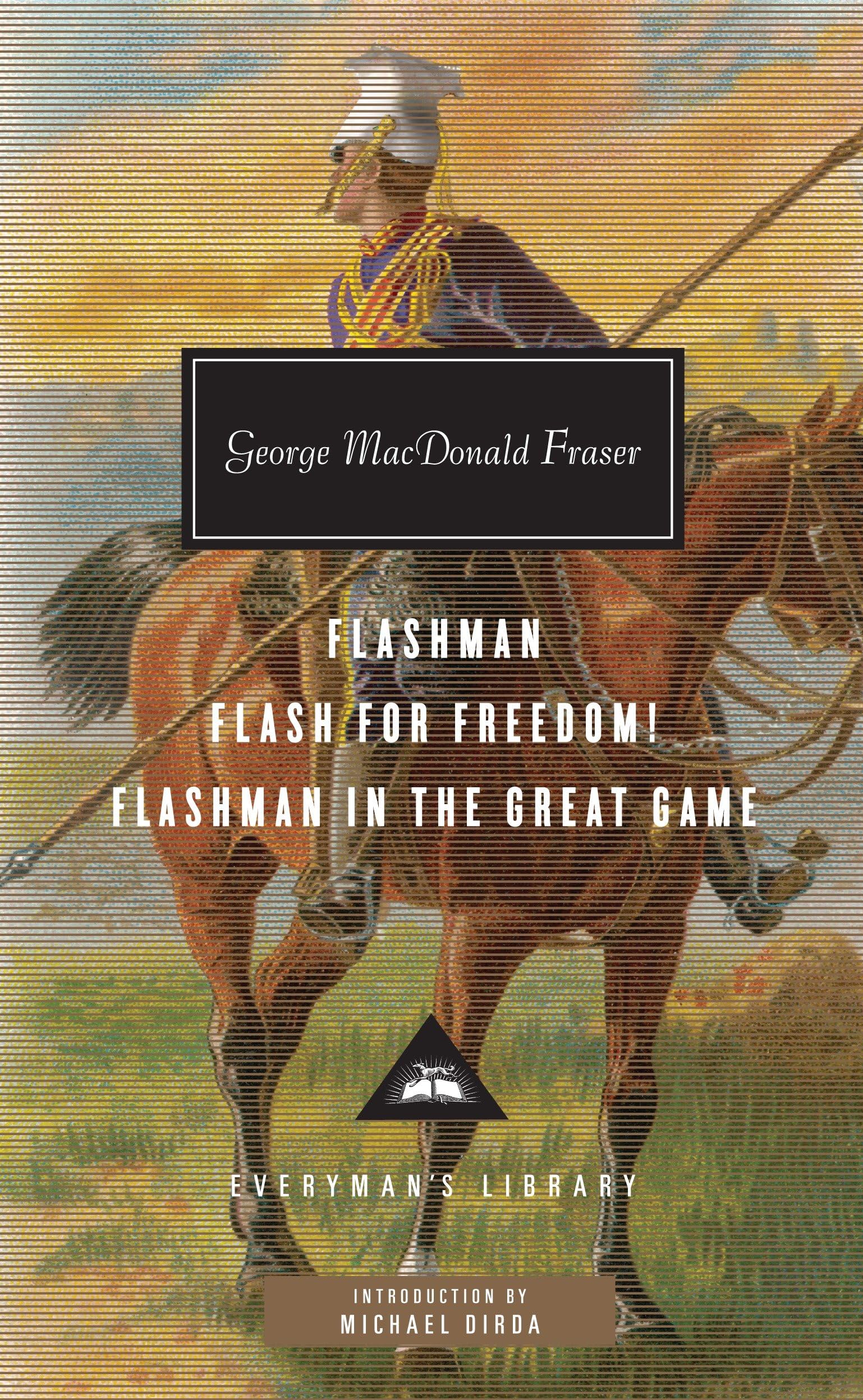
Flashman, Flash for Freedom!, Flashman in the Great Game: Introduction by Michael Dirda (Everyman's Library Contemporary Classics Series)
$24.58
by George MacDonald Fraser



Three of George MacDonald Fraser’s incomparable and hilarious novels featuring the lovable rogue, soldier, cheat, and coward: Harry Paget Flashman. Praised by everyone from John Updike to Jane Smiley, Fraser was an acknowledged master of comedy and satire, an unrivaled storyteller, whose craft was matched only by his impeccable historical research. And his greatest creation was, of course, Flashman. The novels collected here find our hero in the midst of his usual swashbuckling adventures of derring-do: fleeing adversaries in the First Anglo-Afghan War; meeting and nearly deceiving a young Abraham Lincoln in America; alternately impersonating a native Indian cavalry recruit and wooing women in India; and managing, whatever the circumstances, to keep his hero’s reputation unsullied. A must-have treat for the legions of dedicated Flashman fans, and a delightful introduction for those lucky enough to be encountering him for the first time. “A novelistic gallop through history and imagination. . . . Fraser can easily juggle Conan Doyle and Holmes, Fleming and Bond, Wodehouse and Wooster, and Chandler and Marlowe.” — Vanity Fair George MacDonald Fraser was born in England and served in a Highland regiment in India, Africa, and the Middle East. In addition to the twelve Flashman novels, he wrote screenplays, most notably for the James Bond film Octopussy . He died in 2008. Michael Dirda is a Pulitzer Prize–winning critic for The Washington Post and the author of the memoir An Open Book and of four collections of essays: Readings, Bound to Please, Book by Book, and Classics for Pleasure. ‘Don’t wait to die on the field of honour. Heroes draw no higher wages than the others.’ – soldier of fortune Paolo di Avitabile in Flashman Just before World War I, Mark Franklin, the hero of George MacDonald Fraser’s Mr American, travels to London, where he spends a bibulous evening with an elderly military man by the name of Sir Harry Paget Flashman. ‘He had looked Sir Harry up in Who’s Who and read incredulously through the succinct list of campaigns and decorations – that gnarled old man sleeping there had seen Custer ride into the broken bluffs above the Little Big Horn, and fought hand to hand with Afghan tribesmen more than seventy years ago; he had ridden into the guns at Balaclava and seen the ranks form for Pickett’s charge at Gettysburg; he had known Wellington and Lincoln . . .’ Who wouldn’t be incredulous? Sir Harry’s numerous honors include not only England’s Victoria Cross, but also the French Legion of Honour and the American Congressional Medal of Honor. His Who’s Who entry – should you ever happen upon it – requires four inches of small type just to list some of his nearly unbelievable exploits. During the course of a long life, Sir Harry Paget Flashman (1822–1915) served as a political adviser to Chancellor Bismarck on the Schleswig-Holstein question, briefly functioned as chief of staff to the Rajah of Sarawak, rode with both John Brown and Jeb Stuart, and even assisted the Emperor Maximilian of Mexico as an aide-decamp. Over the years this far-ranging traveler also spent some time as a buffalo hunter, western scout, Australian prospector, ‘reluctant deputy marshal to J. B. Hickok, Esq.,’ and native interpreter – Sir Harry spoke nine languages fluently and could ‘rub along’ in another dozen or so. Naturally, Who’s Who – with British discretion – barely hints that Harry Flashman frequently spied for Her Majesty’s government and that he was mixed up in both the African slave trade and the Underground Railroad. Moreover, through a run of astonishing bad luck, the man seems to have landed smack in the middle of virtually every major battle or civil insurrection of the nineteenth century – the Siege of Gandamack in Afghanistan, the Zulu attack at Rorke’s Drift, the rising of the Mahdi at Khartoum, the Charge of the Light Brigade, the Battle of Chancellorsville, the Peking Rebellion of 1900. During the American Civil War he even inexplicably managed to serve as a major in the Union forces and a colonel in the army of the Confederacy. As it happens, when Mr Franklin met Sir Harry the then 92- year-old general had recently completed his personal memoirs, memoirs so disturbing that after his death they were quickly sealed and, it would appear, instantly forgotten. Indeed, the memory of Sir Harry himself gradually faded away, so that otherwise reliable histories of the Victorian era failed to assign him even a footnote. But, then, in 1965 during a sale of household furniture at Ashby in Leicestershire, the manuscript miraculously resurfaced. Ably edited by George MacDonald Fraser, the so-called Flashman Papers were eventually published in twelve volumes, each ‘packet’ focusing on one or more episodes from their author’s martial career. They begin with the teenaged Flashman’s expulsion from Rugby School for drunkenness – an incident mentioned in Thomas Hughes’s almost libelous Tom Brown’s School Days