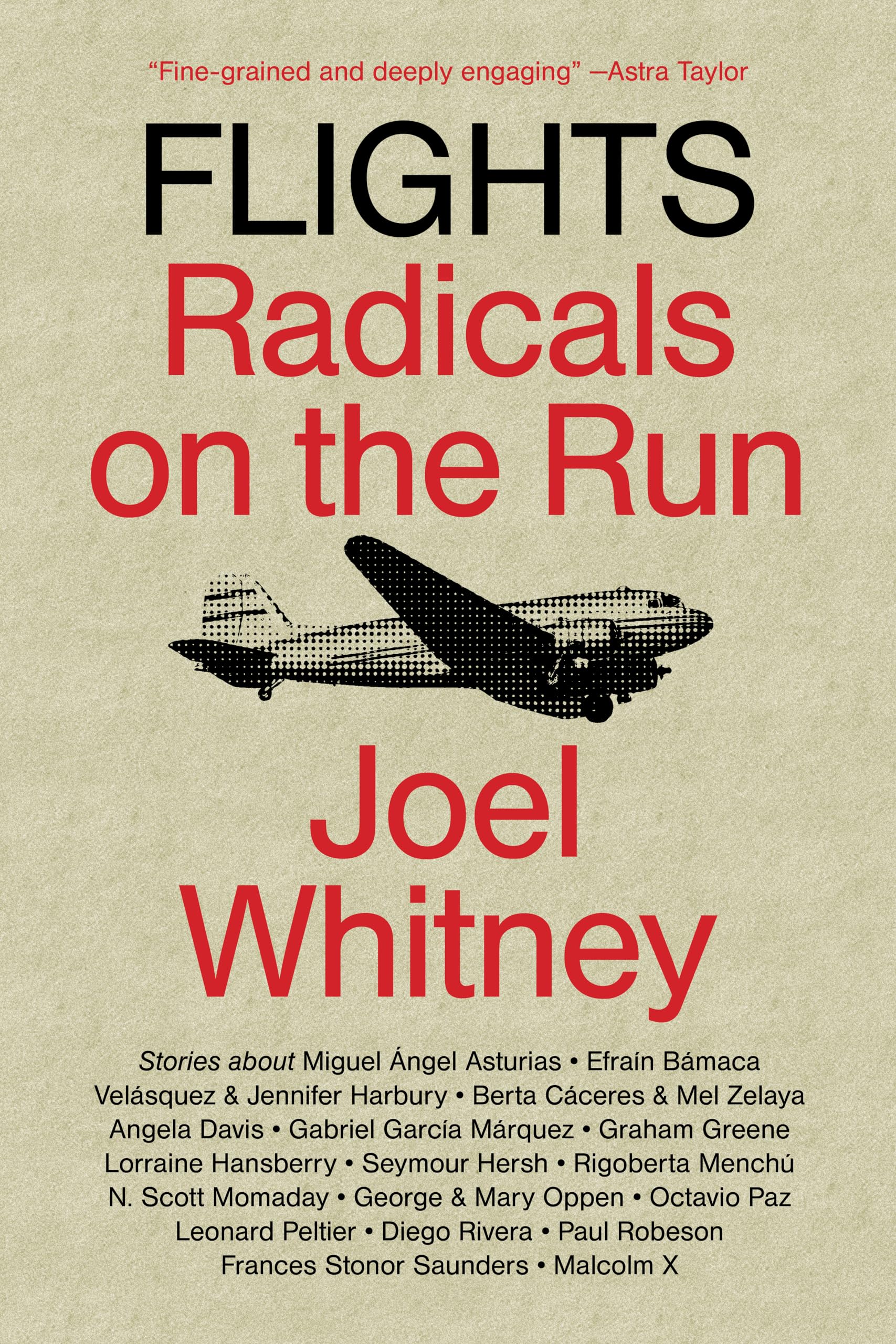



Told through the lives of the American Century’s most talented and stubborn dissidents, Flights is the archetypal hero’s journey of a group of progressives whose struggle for truth, and for freedom from persecution, sent them into exile, both literal and metaphorical. Wanted for a crime she did not commit, Professor Angela Davis went on the run in 1970, describing the struggle against panic in her nightly safehouse transfers: “Living as a fugitive means resisting hysteria, distinguishing between the creations of a frightened imagination and the real signs that the enemy is near.” In her quest “to elude him, outsmart him,” she recalled, “Thousands of my ancestors had waited, as I had…for nightfall to cover their steps…” Davis is just one of a rich array of refugees portrayed here by Joel Whitney, all forced to flee homes and/or friends because of their progressive stance. In these pages are compelling profiles of Seymour Hersh, Lorraine Hansberry, Graham Greene, Paul Robeson, Gabriel García Márquez, George & Mary Oppen, Frances Stonor Saunders, Malcolm X, Octavio Paz, Diego Rivera, Angela Davis, Leonard Peltier, N. Scott Momaday, Miguel Ángel Asturias, Guatemalan guerrilla fighter Everado and his American wife Jennifer Harbury, Nobel Peace laureate Rigoberta Menchú, deposed Honduran President Manuel "Mel" Zelaya and murdered Lenca environmentalist Berta Cáceres. At once a group portrait of these geniuses of creative escape, Flights is also a prehistory (and indictment) of American mass surveillance, culminating in Edward Snowden’s revelations, of torture, culminating in Abu Ghraib, of censorship, culminating in the incarceration of journalist Julian Assange, of fascism, culminating in January 6, and of political murder, culminating in the Bush-Obama-Trump air assassination program. “An absolutely overwhelming, magisterial tour-de-force .” —Junot Diaz, Pulitzer Prize-winning author of The Brief Wondrous Life of Oscar Wao “Mind-bending . . . so profound and original it defies a brief endorsement.” —Roxanne Dunbar-Ortiz, author of An Indigenous People's History of the United States "Marvelous vignettes [that] shed new light on intriguing lives." —Gerald Horne, author of The Counter-Revolution of 1776: Slave Resistance & the Origins of the USA "Fine-grained and deeply engaging." —Astra Taylor, author of Democracy May Not Exist, but We’ll Miss It When It’s Gone "Necessary, compelling and often shocking." —Francine Prose, author of The Vixen "[ Flights ] is a wonderfully written text about a truly remarkable if also painfully elusive subject: artists and others on the run from Cold War capitalism." — CounterPunch "Whitney has provided an important insight into the way in which the US state has sought to influence the cultural agenda, shape the political landscape and sanitise the way in which the world views the United States." — Liberation Joel Whitney is the author of , which The New Republic called a “powerful warning.” His writing has appeared in The New York Times , The Daily Beast , The Baffler , The Wall Street Journal , Boston Review , New York Magazine , and elsewhere. He is a former features editor at Al Jazeera America and a founder and former editor-in-chief of Guernica , for which he was awarded the 2017 PEN/Nora Magid Award for Excellence in Editing. His essays in The Baffler, Dissent and Salon were Notables in Best American Essays 2017, 2015 and 2013. “Embodying the Enemy”: Angela Davis in California In December of last year, the activist, intellectual, and educator Angela Davis took the podium at Pilgrim Baptist Church in Nyack, New York. The church was not the planners’ first choice but scurrilous red baiting campaigns led two venues to cancel. Waiting for the 500-strong standing ovation to quiet down, the former Communist Party member and political prisoner told her audience that “I think every day about the fact that I am associated with a people who refuse to give up, after centuries and centuries. Not only that, but who have created beauty in the process of struggling.” As interviewer Amy Goodman noted on Democracy Now! , it was “a reprise” of what happened two years before in Davis’s hometown of Birmingham, Alabama. Emphasizing words to underline her subject’s heroism, Goodman recalled an award that was canceled and reinstated after the granting organization was shamed for wavering. “You ended up doing an event outside the place you were actually invited, and so many more people turned up.” Davis admitted being stunned by the ways people misrepresent her. But more important, she told Goodman, “I’m concerned about the misrepresentation of movements against racism. Against gender inequality. For freedom.” Indeed, misrepresentation followed Davis around throughout her public career. It was why she went on the lam in 1970, after a gun she bought to protect herself from death threats turned up in a Marin County courtroom. During an attempted prison bre