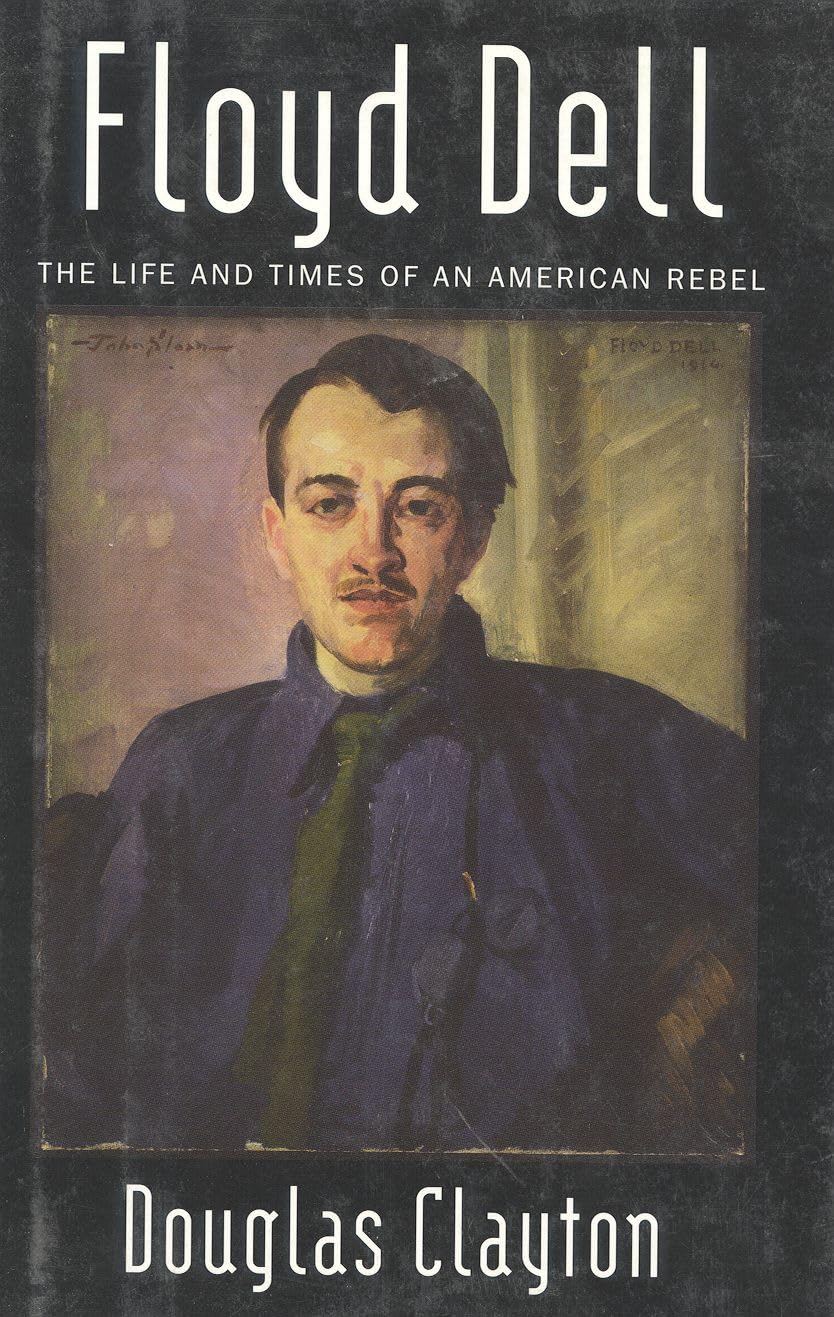



In the heyday of the American avant-garde and Greenwich Village bohemianism, in the early years of the twentieth century, Floyd Dell was one of the scene's brightest lights. "The prose laureate of Greenwich Village," some called him, "the most talented of literary young men." In a galaxy of high-spirited artists, writers, and playwrights, no figure was more colorful and brilliant. Douglas Clayton's biography of Floyd Dell traces the life of a boy from the Midwest who rose to influence in the Chicago Literary Renaissance and moved on to New York to become a celebrated novelist, critic, editor, poet, and playwright. Beyond his literary pursuits, Dell was also a notorious bohemian, proponent of free love, and champion of feminism, progressive education, socialism, and Freudianism. When he was editing The Masses, perhaps the best radical magazine ever, Dell once famously remarked that it "stood for fun, truth, beauty, realism, freedom, peace, feminism, revolution." So did Dell's own life. Yet, as Douglas Clayton shows, while Dell was central to radical culture, he was also profoundly skeptical of it. He was a leader among the cultural rebels while also a shrewd satirist of their countless causes and tendencies. He was an early escapee from Marxism, and his career never followed the familiar left-to-right course of some radical writers. All his life Dell struggled with this perspective, and with the larger relationship between politics and art - a struggle that continues to have meaning for us today. Through his advocacy of feminism, socialism, psychoanalysis, and progressive education, Floyd Dell shocked the American bourgeoisie. His novels, plays, essays, and bohemian antics came to epitomize the Greenwich Village avant-garde of the 1910s and 1920s. By the time of his death in 1969, however, Dell had been largely forgotten. Clayton's solid biography provides a detailed account of a fascinating literary and political career. But it ultimately fails to bring the subject to life. It also neglects to ask an important question: What lessons does Dell's uneasy synthesis of creativity and political commitment hold for our times? Despite this lapse, Clayton's study is a useful contribution to scholarship. Recommended for scholarly libraries. Kent Worcester, Social Science Research Council, New York Copyright 1994 Reed Business Information, Inc. Floyd Dell influenced writers as diverse as Max Eastman and Henry Miller, and as editor of the Masses championed John Reed, William Carlos Williams, and Djuna Barnes, among other artists. Despite the fact that Dell was also one of the central figures of the so-called Chicago literary renaissance and Greenwich Village bohemianism of the early twentieth century, we have had no full-length biography of this pivotal American novelist, playwright, critic, and editor until now. Clayton's biography is a masterly, delightfully readable account of Dell's activities during the 1920s, tightly focused in its examination of the contradictions between the bourgeois social norms and iconoclastic radicalism that motivated and informed Dell's achievements in literature and journalism, as well as his marriages and numerous affairs. Although information on Dell's later years is much scantier than Clayton's accounts of his intellectual and political participation in the heyday of Village literary life, this biography is an indispensable study not only of one of the most important and neglected American freethinkers, but also of the aesthetic and social tensions at play in the American Left of the time. Greg Burkman “Revealing, fascinating...there is a sense of the real past here. More important, there is a real sense of the present revealed to us in that past.” ―Dan Jaffe, American Studies “This is sure to become the standard for any work on a classic American radical!” ―Elliott Shore, Journal of American History “Dell deserves the intelligent, sympathetic, yet probing treatment Clayton has given him in this highly readable book.” ―William L. O'Neill, Professor of History, Rutgers University; author of Coming Apart “Not only a perceptive analysis, but a thoughtful reflection...There's much to be learned here.” ―Daniel Aaron “Mr. Clayton builds a skillful intellectual portrait of one of America's radical literary figures.” ―Douglas A. Silva, The New York Times Revealing, fascinating...there is a sense of the real past here. More important, there is a real sense of the present revealed to us in that past. -- Dan Jaffe ― American Studies This is sure to become the standard for any work on a classic American radical! -- Elliott Shore ― Journal of American History Dell deserves the intelligent, sympathetic, yet probing treatment Clayton has given him in this highly readable book. -- William L. O'Neill, Professor of History, Rutgers University; author of Coming Apart Not only a perceptive analysis, but a thoughtful reflection...There's much to be learned here. -- Daniel Aaron Mr. C