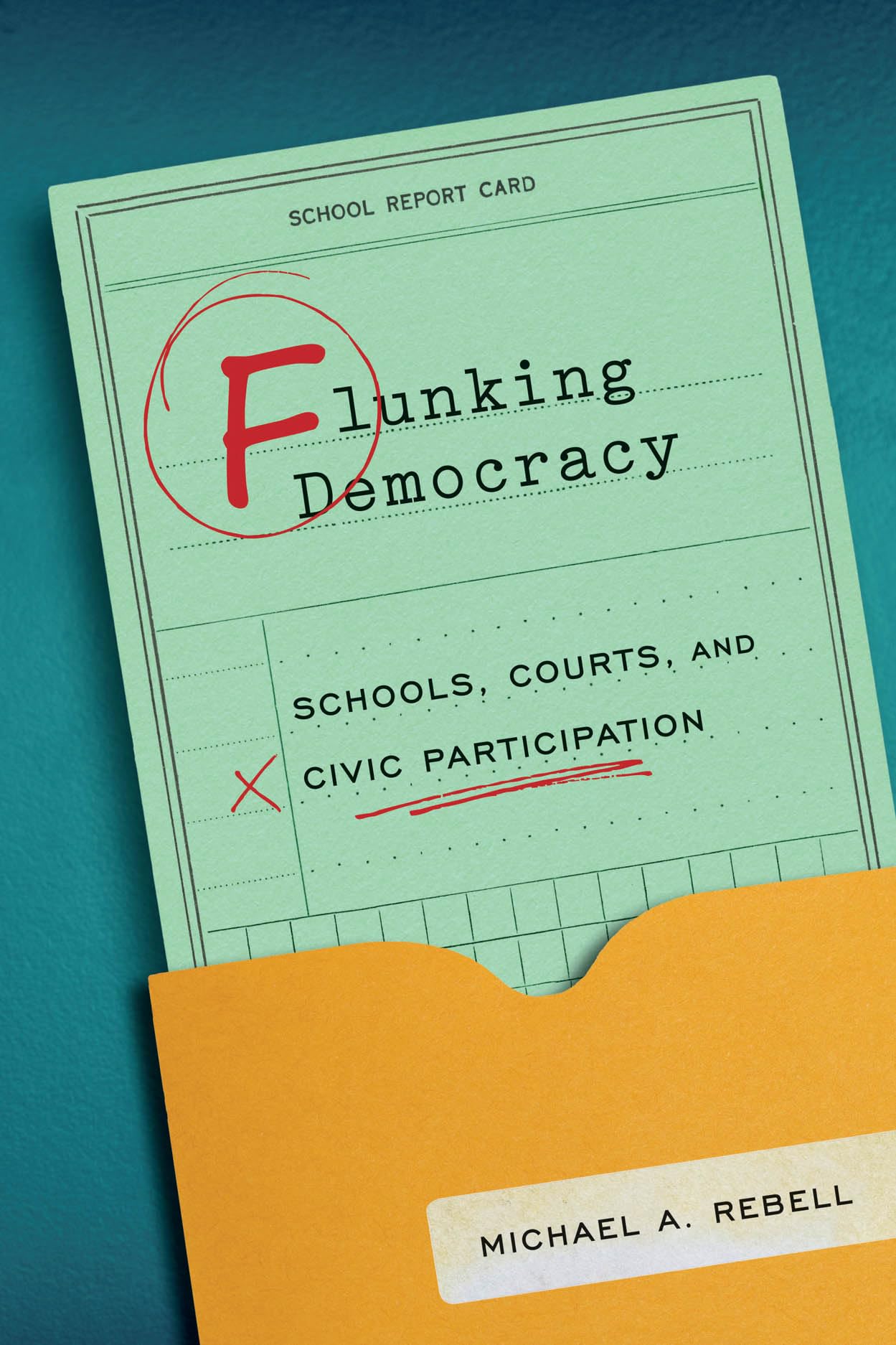



The 2016 presidential election campaign and its aftermath have underscored worrisome trends in the present state of our democracy: the extreme polarization of the electorate, the dismissal of people with opposing views, and the widespread acceptance and circulation of one-sided and factually erroneous information. Only a small proportion of those who are eligible actually vote, and a declining number of citizens actively participate in local community activities. In Flunking Democracy , Michael A. Rebell makes the case that this is not a recent problem, but rather that for generations now, America’s schools have systematically failed to prepare students to be capable citizens. Rebell analyzes the causes of this failure, provides a detailed analysis of what we know about how to prepare students for productive citizenship, and considers examples of best practices. Rebell further argues that this civic decline is also a legal failure—a gross violation of both federal and state constitutions that can only be addressed by the courts. Flunking Democracy concludes with specific recommendations for how the courts can and should address this deficiency, and is essential reading for anyone interested in education, the law, and democratic society. "Calling on federal and state courts to take a more active role in overseeing education standards and benchmarks, Rebell addresses various complex questions, including whether a federal right to education should exist and what types of judicial action would not violate the separation of powers." ― Trial "Michael Rebell has spent a career challenging advocates, courts, and legislatures to establish and provide children a meaningful right to a public education. With Flunking Democracy, Rebell not only sustains that challenge, he urges us all to consider the very purpose of public education, calling for a robust right to an education that prepares all children for effective civic participation. Weaving together empirical evidence, moral and political philosophy, and legal doctrine and strategy, Rebell makes the case that public schools should provide children the civic knowledge, cognitive and analytic skills, experiential opportunities, and fundamental character values that will ensure effective participation in twenty-first century civic life. Nothing could be more important for our collective future." -- William S. Koski, Stanford Law School “Michael Rebell makes a powerful and original case that litigation can and should improve civic education. He skillfully assembles evidence from the existing literature to show that civic education is important for the future of our democracy and requires improvement, then further applies his deep knowledge and experience with education-reform litigation to argue persuasively that courts ought to consider lawsuits requiring states to improve their policies for civic education.” -- Peter Levine, Tisch College of Civic Life, Tufts University Michael A. Rebell is executive director of the Campaign for Education Equity, executive director of the National Access Network, professor of law and educational practice at Teachers College, Columbia University, and adjunct professor of law at Columbia Law School. He is the author or coauthor of many books, including Moving Every Child Ahead: From NCLB Hype to Meaningful Educational Opportunity . Flunking Democracy Schools, Courts, and Civic Participation By Michael A. Rebell The University of Chicago Press Copyright © 2018 The University of Chicago All rights reserved. ISBN: 978-0-226-54981-1 Contents Acknowledgments, INTRODUCTION, CHAPTER 1. The Civic Participation Crisis — and the Civic Empowerment Gap, CHAPTER 2. Civic Participation and the Federal Courts, CHAPTER 3. Civic Participation and the State Courts, CHAPTER 4. A Conceptual Framework for Preparing Students for Civic Participation, CHAPTER 5. Education for Civic Participation in the Twenty-First Century, CHAPTER 6. Advancing Civic Preparation through the State Courts, CHAPTER 7. Advancing Civic Preparation through the Federal Courts, CHAPTER 8. The Legitimacy of the Courts' Role, Notes, Index, CHAPTER 1 The Civic Participation Crisis — and the Civic Empowerment Gap We live today in a polity ... that lacks the civic resources to sustain self-government. — Lorraine Smith Pangle and Thomas L. Pangle The American Revolution was not only a war for independence from England; it was also the catalyst of an unprecedented experiment in democratic government and civic participation. The war gave new impetus to concepts of liberty, freedom, and democracy that had inspired the colonists; it involved many more people in thinking about those ideas, and it compelled citizens of the states to enter into weighty conversations about how to create effective local and national political structures to guide the new nation. The nation's founders also realized that to maintain and expand this fledgling demo