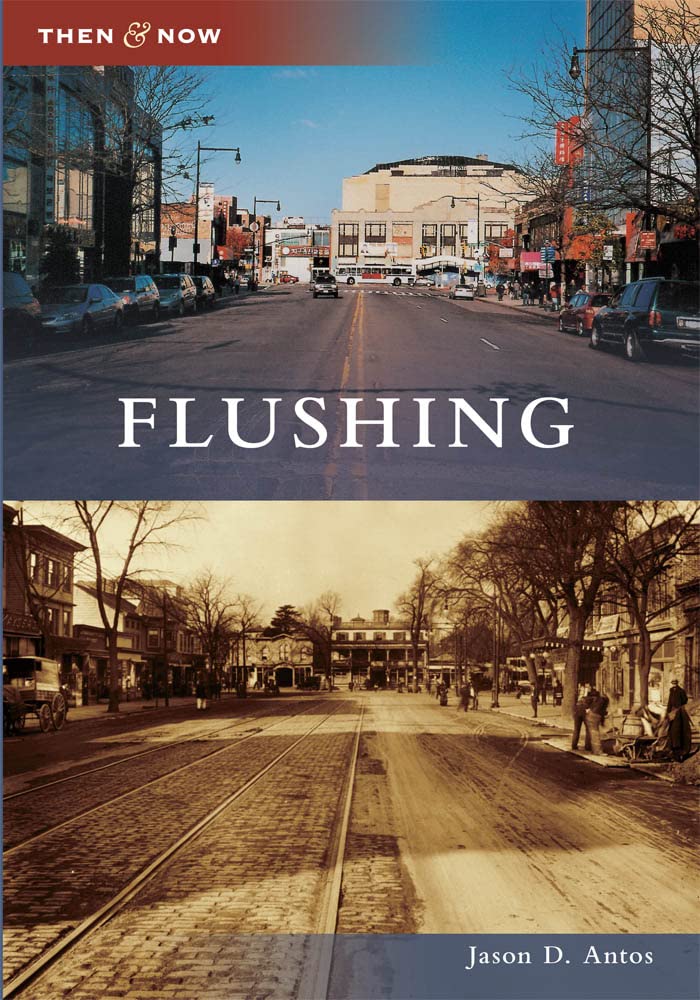



Flushing explores the dramatic changes of this ever growing city with many never-before-seen images. Jason D. Antos is the author of three other local Queens history books. In the 1890s, electric lighting and improved roads were just the beginning of the changes about to take place in Flushing, New York. Once a rural village of wide-open farms and magnificent estates, Flushing transformed into a community of more than 200,000 people and quickly became one of the busiest neighborhoods in Queens. Title: Books Give Glimpse Into Boro History Author: Barbara Arnstein Publisher: Queens Tribune Date: 7/28/2011 Reading any one of the series of historical captioned photo books from Arcadia Publishing is like traveling through time. Queens resident Jason Antos, a Queens newspaper editor, is the author of "Images of America: Whitestone," "Then & Now: Queens" and "Then & Now: Flushing." Each book features interesting photos, postcards, drawings and documents that trace the progress of Queens from 1645 to the present, and depict a wide variety of scenes and structures, including roads, restaurants, railroad stations, banks, bridges, libraries, churches, trolley cars, stores, and so on. One page of "Flushing" quotes part of an 1886 letter, in which a woman wrote to her husband, "There is a rumor of a horse railroad to College Point and also talk of electric lights too. Oh! Flushing is changing, dear," and includes a 1926 photo, which depicts the dramatic differences in size and style between a huge furniture factory and the old-fashioned mansion beside it. Another page includes an undated photo of the "King Neptune Fountain," decorated with statues of Neptune and four mermaids, and bedecked with flower urns, that stood at the intersection of Northern Boulevard and Main Street from 1874 to 1946. Sadly, there is no photo of the RKO Keith's theatre in its cinematic heyday, or any mention of its older history of hosting vaudeville acts. Among other fascinating facts, "Queens" reveals that Bayside boasts America's oldest hamburger fast-food restaurant (open since 1932). Although it mentions that "Congress closed Fort Totten in September 1995," it should also have mentioned that it is now used as a training area for the police and fire departments. The mention of Astoria Park says nothing about the popular pool there, the oldest and largest in the city, but "Flushing" does include the intriguing fact that the Roosevelt Avenue Subway Bridge over Flushing Creek was built as a lift bridge that was the largest of its kind at the time. Strangely, there is no photo in "Flushing" of the 1964-1965 World's Fair at Flushing Meadows, and the only photo of the 1939-1940 World's Fair in it disappointingly shows only the Trylon and Perisphere (its symbols) from a distance. More strangely, although many long- vanished mansions are mentioned in all three books, there is no mention of Flushing's Voelker-Orth Museum, the beautifully restored mansion (with a beautiful Victorian Garden), at 149-19 38th Ave., where tours are regularly conducted, and events held. Most strangely of all, in "Whitestone", Antos states that "developers created beautiful beach clubs but their time was short-lived," ignoring the fact that private beach clubs still exist there, and have for decades. There is so much interesting history in Beechhurst that I am now gathering material for an Arcadia Publishing book about that area. If you have any photos, postcards, maps, letters or other materials relating to its development, or even interesting family stories involving Beechhurst to share, please allow me to consider them for the book. Write to me in care of the Queens Tribune, 150-50 14th Road, Whitestone, NY, 11357. Title: ' Flushing' Is Latest Addition To 'Then & Now' Series Author: Linda J Wilson Publisher: Queens Gazette Date: 07/28/10 Arcadia Publishing's Then & Now series makes such local comparisons available. Books in this series offer a special view of American life by placing historical images side by side with contemporary photographs. Flushing, Jason D. Antos' latest work published by Arcadia, a notable addition to this list, transcends time, providing readers with a unique opportunity to view a particular municipality as it once was and now is. It is best described in the Foreword by Nicholas Hirschorn, as the compilation of "a wide-ranging array of streetscapes [that] document how the area has transformed so remarkably with time". Antos' Introduction begins by noting the perils that those who would become the custodians of their town's records occasionally face and moves on to the ecumenism officially conferred by the Dutch governor of the colony of Flushing, William Keift. That ecumenism was later threatened by Keift's successor, Peter Stuyvesant, and led to the spirit showed by early settlers who gave their names to the document known as the Flushing Remonstrance of 1657. The Quaker Meeting House and the John Bowne House are two of t