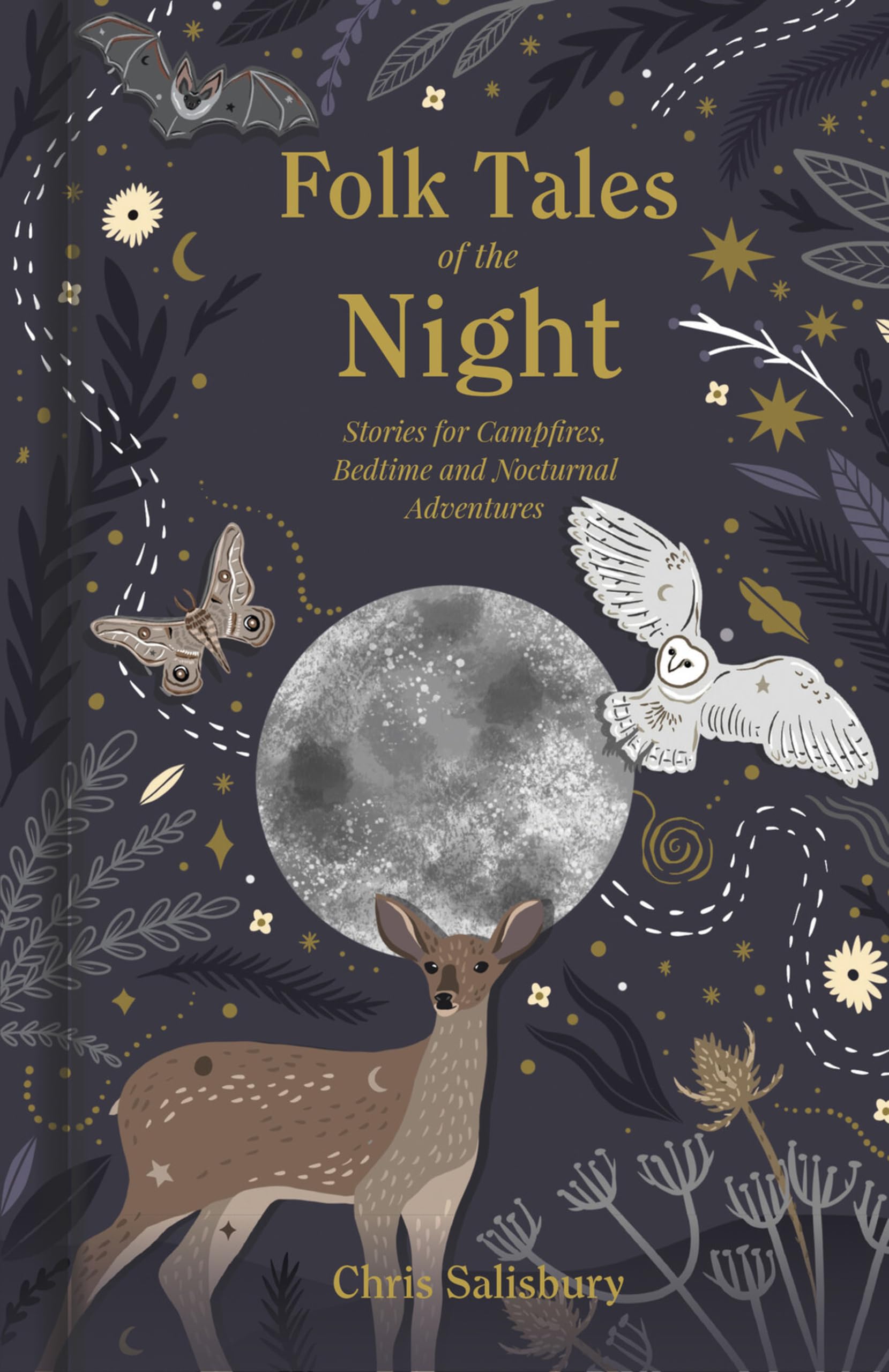
Folk Tales of the Night: Stories for Campfires, Bedtime and Nocturnal Adventures
$23.44
by Chris Salisbury



Who knew about the Moon being captured by Dartmoor pixies, the dauntless and devious serving-girl, or the sleeping sovereign deep beneath the Earth? Star stories and creature tales, good-old-fashioned ghost stories together with traditional narratives about how the night became, kindle the fires of our imagination and deepen our acquaintance with the dark in this compendium of stories to tell out loud. Filtered through the wild imaginations and indigenous tongues of storytellers from all over the world, this collection is rewritten and represented here by a master storyteller from the UK, who has been spinning nocturnal narratives around the campfire for 3 decades. This is a delicious midnight feast of 'tales from the darkside’ to fascinate, terrify, enchant and inform about the night-time realm. Chris Salisbury is a professional storyteller who has been telling stories around the campfire and leading nightwalks for 27 years. He co-founded the Westcountry and Oxford Storytelling Festivals, and founded WildWise (www.wildwise.co.uk) in 1999 after many years as education officer for Devon Wildlife Trust. He directs the acclaimed ‘Call of the Wild’ leaders’ course as well as ‘Where the Wild Things Are’, a rewilding adventure. His first book Wild Nights Out: The Magic of Exploring the Outdoors at Night (foreword: Chris Packham) has received rave reviews. Introduction How insupportable would be the days, if the night with its dews and darkness did not come to restore the drooping world. Henry David Thoreau Without a second thought, at the day’s end, we switch on the lights to continue whatever activity we were pursuing, or simply for sanctuary from the threatening dark. Lest we forget, it wasn’t always like this. For most of our history, the night held terrors in the form of apex predators with claws and teeth and we were humbled into submissive mode without the comforting daylight. Then along came the capacity to generate fire, and along with that a chance to keep the darkness, and the animals, at bay while we enjoyed the warmth and companionship of the hearth. Thus, the perfect habitat for stories and storytelling had arrived, and humanity indulged themselves with the oral tradition for thousands of years. Until today, when the practice has sadly subsided, largely succumbing to the proliferation of artificial light. A particular acceleration point was when our homes were electrified, which afforded us the luxury of extended hours of bright light so the day’s activity could continue unabated. However, as well as interfering with our circadian rhythms, so important for the sleep cycle, the advent of artificial light had a dramatic effect on stories and storytelling. More so when that other gear-change development came with the advent of television, and latterly the prevalence of all screen devices. As the old saying goes on the Isle of Lewis, ‘When the television came in through the front door, the stories went out the back door.’ The night had always gathered people together, around the warmth and protection of the fire, or the soft atmosphere of lamplight. The shadowy dark was the ideal projection screen for our innate imaginations which, for thousands of years, were indulged by storytelling. The night-time is liminal space, a psychoactive context for us to engage the imaginal realms of the story world. The relatively blank screen of the dark provided the perfect backdrop on which to project the images that flowed forth from the storyteller’s mouth. The night-time was story time – and still is for those cultures who live without electricity and screens. The stories in this book are meant to be spoken aloud, in honour of the great tradition from which they come. Anthologies of oral narratives often seem a little lifeless on the page, and it could be said this strange ‘new’ literary form of recording them in writing is an act of imprisonment. They deserve instead to be filtered through the living strata of human flesh, bone, breath and memory so they can spring to life again, fresh and revitalised. Tell these stories as a storyteller, and you will be amazed how they seem to have a life of their own. As the old saying goes, ‘Read a story and it goes from the eye to the brain, tell a story and it goes from the mouth to the heart’. Here, I’ve done my best to make them a pleasure to read too and, by all means, read them aloud to your kids. However, I want to encourage you to learn at least one and see for yourself the difference in the experience, for both you and whoever is listening, and how your life experience and imagination can help the story take flight with new wings. This anthology is divided into chapter headings that reflect the night’s constituency. Thus, there are the obvious components of the night, featuring stories about the moon and stars, but also a procession of dramas and characters that are engendered by the darkness, at least from a human perspective. As