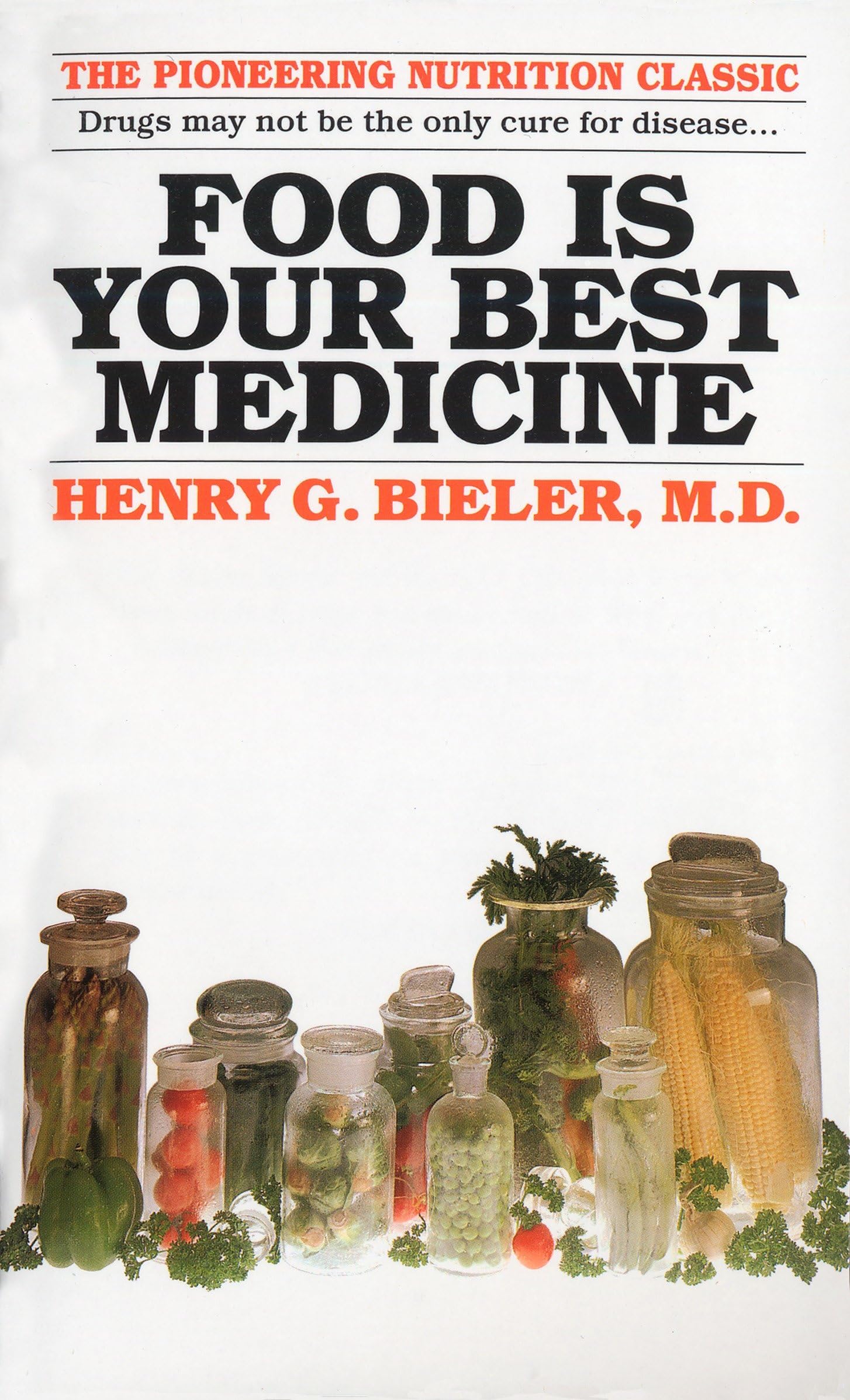



Drugs may not be the only cure for disease . . . What do Gloria Swanson and Greta Garbo have in common? They owe their good health to Dr. Henry Bieler's sane, simple, and utterly profound philosophy that food is your best medicine! You are what you eat, and Dr. Bieler contends, based on over fifty years of practice, that proper diet plays a key role in warding off and curing disease. Food Is Your Best Medicine features a fascinating interpretation of how the body functions to maintain good health and addresses all kinds of ailments with specific nutritional approaches. Zucchini and other vegetables, simple broths, nourishing whole grains—all so much better for you than drugs, and they really work! A fascinating interpretation of how the body functions to maintain good health and addresses all kinds of ailments with specific nutritional approaches. A pioneering nutrition classic. A fascinating interpretation of how the body functions to maintain good health and addresses all kinds of ailments with specific nutritional approaches. A pioneering nutrition classic. Henry G. Bieler, MD, studied medicine at the University of Cincinnati, where he came under the lifelong influence of Dr. Martin Fischer, the great physiologist and philosopher. For more than 50 years Dr. Bieler treated great motion-picture stars, coal miners, politicians and professional men, farmers and Pasadena dowagers. He brought thousands of healthy babies into the world, including his own children and grandchildren. He died in October 1975. 1 The Cure Is Worse than the Disease To live by medicine is to live horribly. —CARL LINNAEUS (1707–1778) Eighteen times in every second a prescription is filled by a white-coated pharmacist at one of the fifty-six thousand drugstores in the United States. The staggering cost of these pink, violet, yellow, white, and green tablets, capsules, lozenges, and ampules amounts to $3 billion * a year. —MARGUERITE CLARK, MEDICINE TODAY, 1960 Twenty-five hundred years ago on the island of Cos in classical Greece a bearded physician-teacher, Hippocrates, sat in the shade of an Oriental plane tree on a lovely hillside and admonished his wide-eyed circle of medical students in one of his most pithy and precise aphorisms: “Thy food shall be thy remedy.” No one, to date, has more eloquently given us a way of life. The medical profession insists it strives to emulate the Father of All Physicians and, indeed, is required, before licensing, to take the Hippocratic Oath, one of the most sublime declamations for lofty ethical standards ever penned. Yet today there are thousands of dedicated bacteriologists, pharmaceutical researchers and chemists sitting in gleaming white laboratories in every major city throughout the world, busily turning out synthetic, if highly touted, magic panaceas for every known ailment. Unlike that of the venerable Hippocrates, their battle cry appears to be: “Thy remedy shall be our newly invented remedy.” Yet despite the advances in technological knowledge and the millions spent on medical research programs, mankind sickens and dies; hospitals and mental institutions are filled to overflowing with the diseased and the hopeless. Here in our own country—where the greatest abundance of foodstuffs and the highest living standards in history are to be found—a truly radiantly healthy person is as rare as a pearl in a barrel of oysters. And although extremely low standards of physical fitness were used, approximately 40 percent of America’s young men were judged unfit for military service in World War II. Three times during the last decade military physical-fitness requirements were lowered. So that while we are the most wealthy country in the world, we are also, comparatively, one of the least healthy. Why? What of the future? Our forecasts for the continued increase in the incidence of cancer, high blood pressure, heart disease—in fact, all the degenerative diseases—are most dismal. To be sure, new drugs and techniques are waging battle against these great killers. And some succeed. “More often,” admits Furness Thompson, vice-president of a large drug laboratory, “failure is our most important product.” While it is true that no medicine is innocent, one cause of grave concern is the untoward reactions these sometimes dangerously potent drugs may cause—reactions which may extend far into the future. Another serious adverse result of the use of certain drugs is the possibility of addiction. And when the layman goes in for self-medication, using drugs prescribed for others, the result may become truly catastrophic. Patients storm doctors’ offices, begging for a “quick cure” with a “miracle drug” they’ve just read about in their newspapers, only to discover—in increasing numbers—side effects so serious that presently they have additional disorders in urgent need of treatment. So the help they seek is often outweighed by the tragic damage to the