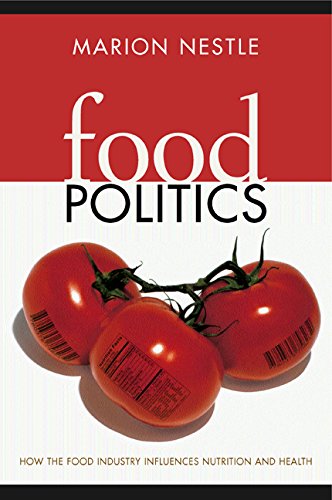
Food Politics: How the Food Industry Influences Nutrition and Health (California Studies in Food and Culture)
$21.78
by Marion Nestle



We all witness, in advertising and on supermarket shelves, the fierce competition for our food dollars. In this engrossing exposé, Marion Nestle goes behind the scenes to reveal how the competition really works and how it affects our health. The abundance of food in the United States--enough calories to meet the needs of every man, woman, and child twice over--has a downside. Our overefficient food industry must do everything possible to persuade people to eat more --more food, more often, and in larger portions--no matter what it does to waistlines or well-being. Like manufacturing cigarettes or building weapons, making food is very big business. Food companies in 2000 generated nearly $900 billion in sales. They have stakeholders to please, shareholders to satisfy, and government regulations to deal with. It is nevertheless shocking to learn precisely how food companies lobby officials, co-opt experts, and expand sales by marketing to children, members of minority groups, and people in developing countries. We learn that the food industry plays politics as well as or better than other industries, not least because so much of its activity takes place outside the public view. Editor of the 1988 Surgeon General's Report on Nutrition and Health, Nestle is uniquely qualified to lead us through the maze of food industry interests and influences. She vividly illustrates food politics in action: watered-down government dietary advice, schools pushing soft drinks, diet supplements promoted as if they were First Amendment rights. When it comes to the mass production and consumption of food, strategic decisions are driven by economics--not science, not common sense, and certainly not health. No wonder most of us are thoroughly confused about what to eat to stay healthy. An accessible and balanced account, Food Politics will forever change the way we respond to food industry marketing practices. By explaining how much the food industry influences government nutrition policies and how cleverly it links its interests to those of nutrition experts, this pathbreaking book helps us understand more clearly than ever before what we eat and why. In the U.S., we're bombarded with nutritional advice--the work, we assume, of reliable authorities with our best interests at heart. Far from it, says Marion Nestle, whose Food Politics absorbingly details how the food industry--through lobbying, advertising, and the co-opting of experts--influences our dietary choices to our detriment. Central to her argument is the American "paradox of plenty," the recognition that our food abundance (we've enough calories to meet every citizen's needs twice over) leads profit-fixated food producers to do everything possible to broaden their market portion, thus swaying us to eat more when we should do the opposite. The result is compromised health: epidemic obesity to start, and increased vulnerability to heart and lung disease, cancer, and stroke--reversible if the constantly suppressed "eat less, move more" message that most nutritionists shout could be heard. Nestle, nutrition chair at New York University and editor of the 1988 Surgeon General Report, has served her time in the dietary trenches and is ideally suited to revealing how government nutritional advice is watered down when a message might threaten industry sales. (Her report on byzantine nutritional food-pyramid rewordings to avoid "eat less" recommendations is both predictable and astonishing.) She has other "war stories," too, that involve marketing to children in school (in the form of soft-drink "pouring rights" agreements, hallway advertising, and fast-food coupon giveaways), and diet-supplement dramas in which manufacturers and the government enter regulation frays, with the industry championing "free choice" even as that position counters consumer protection. Is there hope? "If we want to encourage people to eat better diets," says Nestle, "we need to target societal means to counter food industry lobbying and marketing practices as well as the education of individuals." It's a telling conclusion in an engrossing and masterfully panoramic exposé. --Arthur Boehm Nestle (chair, nutrition and food studies, NYU) offers an expos of the tactics used by the food industry to protect its economic interests and influence public opinion. She shows how the industry promotes sales by resorting to lobbying, lawsuits, financial contributions, public relations, advertising, alliances, and philanthropy to influence Congress, federal agencies, and nutrition and health professionals. She also describes the food industry's opposition to government regulation, its efforts to discredit nutritional recommendations while pushing soft drinks to children via alliances with schools, and its intimidation of critics who question its products or its claims. Nestle berates the food companies for going to great lengths to protect what she calls "techno-foods" by confusing the public regardin