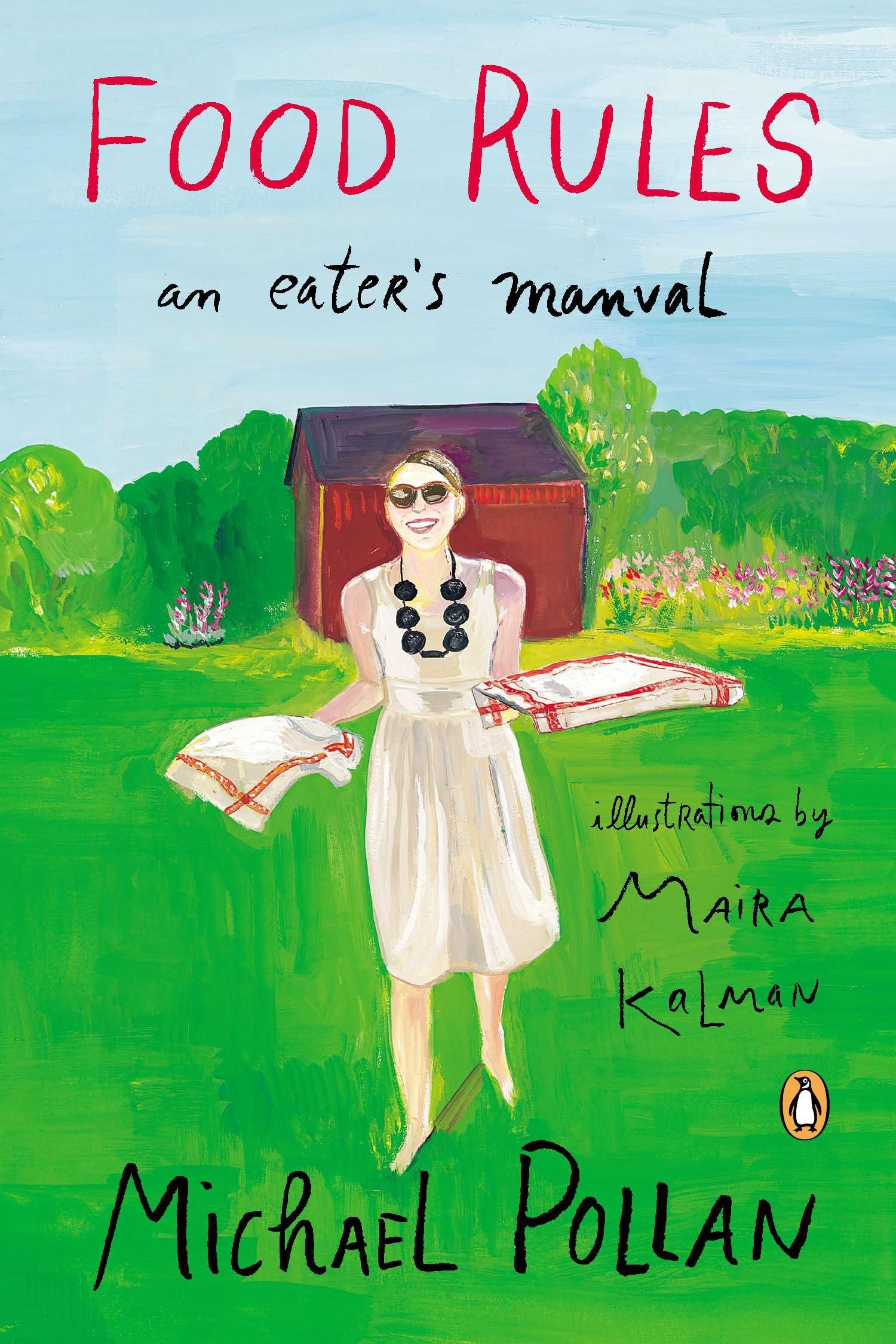



An enhanced edition of Food Rules —beautifully illustrated and packed with additional food wisdom Michael Pollan’s Food Rules prompted a national discussion helping to change the way Americans approach eating. This new edition illustrated by celebrated artist Maira Kalman—and expanded with a new introduction and nineteen additional food rules—marks an advance in the national dialogue that Food Rules inspired. Many of the new rules, suggested by readers, underscore the central teachings of the original Food Rules , which are that eating doesn’t have to be so complicated and that food is as much about pleasure and community as it is about nutrition and health. A beautiful book to cherish and share, Food Rules guides us with humor, joy, and common sense toward a happier, healthier relationship to food. "In the more than four decades that I have been reading and writing about the findings of nutritional science, I have come across nothing more intelligent, sensible and simple to follow than the 64 principles outlined in a slender, easy-to-digest new book called Food Rules: An Eater’s Manual , by Michael Pollan." — Jane Brody, The New York Times "The most sensible diet plan ever? We think it's the one that Michael Pollan outlined a few years ago: “Eat food. Not too much. Mostly plants.” So we're happy that in his little new book, Food Rules , Pollan offers more common-sense rules for eating: 64 of them, in fact, all thought-provoking and some laugh-out-loud funny." — The Houston Chronicle " It doesn't get much easier than this. Each page has a simple rule, sometimes with a short explanation, sometimes without, that promotes Pollan's back-to-the-basics-of-food (and-food-enjoyment) philosophy." — The Los Angeles Times "A useful and funny purse-sized manual that could easily replace all the diet books on your bookshelf." — Tara Parker-Pope, The New York Times Michael Pollan is the author of eight books, including How to Change Your Mind , Cooked , Food Rules , In Defense of Food , The Omnivore’s Dilemma , and The Botany of Desire , all of which were New York Times bestsellers. He is also the author of the audiobook Caffeine: How Coffee and Tea Made the Modern World . A longtime contributor to The New York Times Magazine , Pollan teaches writing at Harvard University and the University of California, Berkeley. In 2010, Time magazine named him one of the one hundred most influential people in the world. Maira Kalman is an illustrator, author, and designer. She is the author of And the Pursuit of Happiness and The Principles of Uncertainty , and she illustrated the bestselling edition of William Strunk and E.B. White's The Elements of Style. Kalman's work is shown at the Julie Saul Gallery in Manhattan. Introduction Eating in our time has gotten complicated—needlessly so, in my opinion. I will get to the“needlessly”part in a moment, but consider first thecomplexity that now attends this most basic of creaturelyactivities. Most of us have come to rely on expertsof one kind or another to tell us how to eat—doctors anddiet books, media accounts of the latest findings innutritionalscience, government advisories and foodpyramids, the proliferating health claims on foodpackages. We may not always heed these experts’ advice,but their voices are in our heads every time we orderfrom a menu or wheel down the aisle in the supermarket.Also in our heads today resides an astonishingamount of biochemistry. How odd is it that everybodynow has at least a passing acquaintance with words like“antioxidant,” “saturated fat,” “omega-3 fatty acids,”“carbohydrates,” “polyphenols,” “folic acid,” “gluten,”and “probiotics”? It’s gotten to the point where we don’tsee foods anymore but instead look right through themto the nutrients (good and bad) they contain, and ofcourse to the calories—all these invisible qualities inour food that, properly understood, supposedly holdthe secret to eating well. But for all the scientific and pseudoscientific foodbaggage we’ve taken on in recent years, we still don’tknow what we should be eating. Should we worry moreabout the fats or the carbohydrates? Then what aboutthe “good” fats? Or the “bad” carbohydrates, like highfructosecorn syrup? How much should we be worryingabout gluten? What’s the deal with artificial sweeteners?Is it really true that this breakfast cereal willimprovemy son’s focus at school or that other cerealwill protect me from a heart attack? And when dideating a bowl of breakfast cereal become a therapeuticprocedure? A few years ago, feeling as confused as everyoneelse, I set out to get to the bottom of a simple question:What should I eat? What do we really know about thelinks between our diet and our health? I’m not a nutritionexpert or a scientist, just a curious journalisthoping to answer a straightforward question for myselfand my family. Most of the time when I embark on such an investigation,it quickly becomes clear that matters are