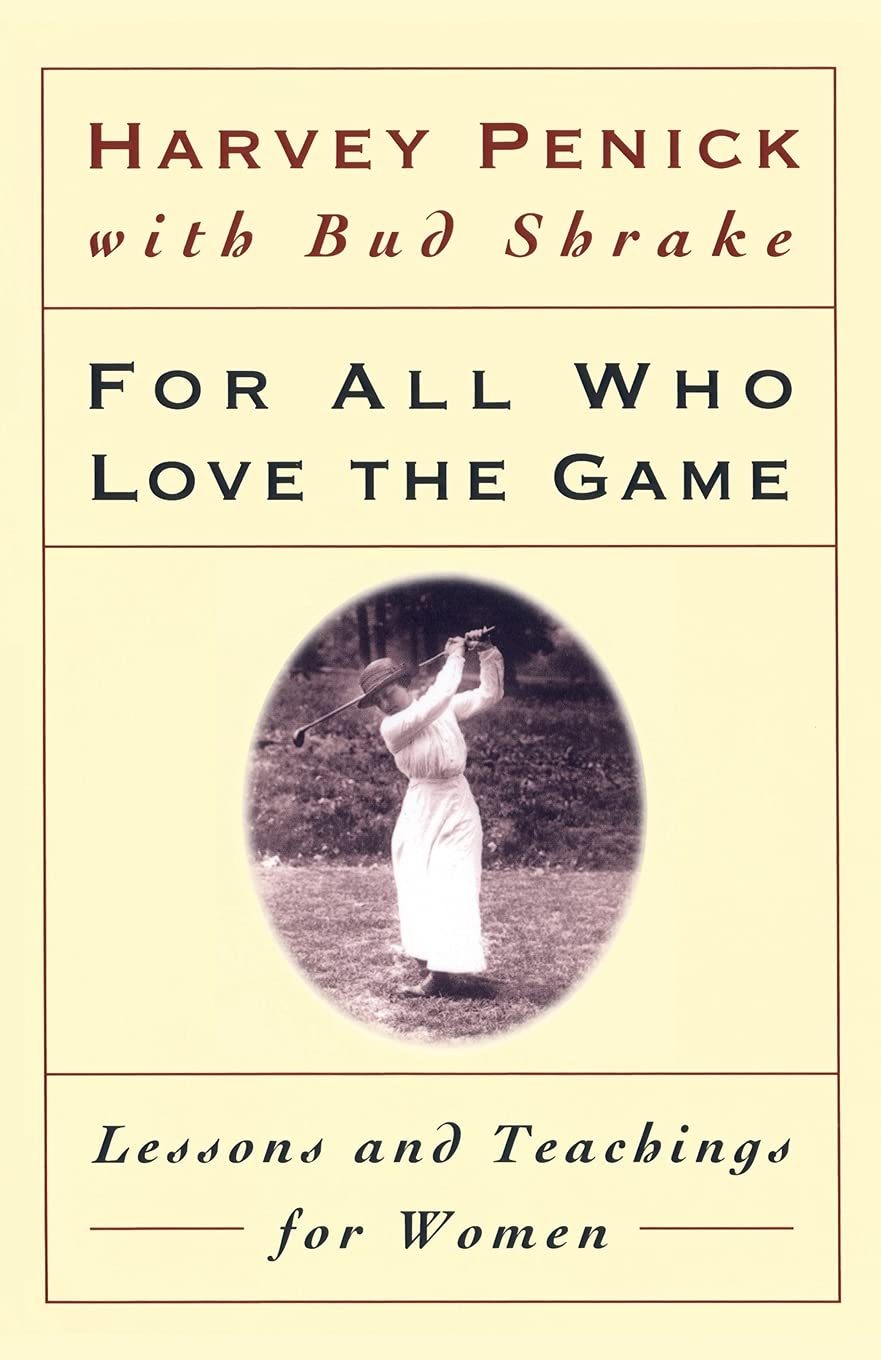



EVERY WOMAN CAN PLAY GREAT GOLF Known in the world of golf as one of the game's greatest teachers, Harvey Penick worked with U.S. Open winners, great champions, and five out of the thirteen women who are members of the LPGA Hall of Fame. Mickey Wright, Sandra Palmer, Betsy Rawls, Kathy Whitworth, Judy Rankin, and Betty Jameson all had the privilege and honor of working with Penick. While he was proud of their success and achievements, Penick took just as much pleasure from the accomplishments of the countless women who came to him hoping only to be able to hit a ball in the air for the very first time. In For All Who Love the Game, Harvey shares the lessons he's learned from female golfers: techniques to help women gain greater physical and psychological power, advice on the perfect swing, and tips for developing areas of the game where women can and should outplay their male counterparts. Interwoven with Penick's ever-present blend of common sense and insight, For All Who Love the Game is a gift to every woman who wants to enjoy the game of golf to its fullest. Harvey Penick lives in Austin, Texas, with his wife Helen. This is his first book. Chapter 1 Lessons in the Afternoon It was early on a hot Saturday afternoon in July. I had already been at the club watching Sandra Palmer hit balls for an hour or so. Now I was back at home in my lounge chair in the living room, feeling sort of achy and drained by the sun. I thought I would have a bowl of soup and a sandwich for lunch. Then I would read my mail and answer a few letters before the Women's Open appeared on TV in a little while. Sandra was spending the weekend at our house, and she planned to come from the practice range to watch the tournament with me. Watching the Open while sitting with an Open champion like Sandra is a thrill for me. I knew it would pick up my spirits. But my son, Tinsley, walked in the front door and said, "Dad, we need you at the club." "What's the matter?" I asked. "A woman needs your help." "Does it have to be right now?" I asked. "Dad, she has come a long way and is eager to see you." Ordinarily what Tinsley had said would have roused me to get into my golf cart and return to the club at once. I could never turn down a woman in distress. On this day, though, with the temperature above one hundred degrees and several things at home I wanted to be doing, it was hard for me to think about moving. "What seems to be her problem?" I asked. "She can't get the ball into the air," Tinsley said. That was all I needed to hear. "Help me out of this chair," I said. Teaching frustrated women golfers to hit the ball into the air is a challenge I love, one that when accomplished brings forth such a roar of joy from both the pupil and the teacher that I get goose bumps that make me feel I'm in the middle of an electrical storm. An attractive woman was waiting in the practice area when I arrived in my golf cart. She introduced herself as Susan Baker. She said her husband, Jim, was out on the course playing golf. They lived back and forth between Houston and Washington, D.C., she said, but were in Austin to attend a wedding. "Use your 7-iron and let me see you hit a few balls," I said. What I needed to know first was whether her frustration was caused by the path of her swing or by the angle of her clubface. Her swing looked pretty good to me, but every ball She hit rolled about thirty yards along the ground. "I've had a number of lessons, and yet I just keep on doing this," she said. I looked at her hands on the club. Her grip seemed reasonable. But having seen that her swing was all right, I knew her grip had to be the villain I asked her to remove her glove and take her grip again. Sure enough, that is where the culprit lay concealed. When she took her grip, both hands were pretty much under the handle. But then she twisted her flesh around so that her bad grip was disguised to look like a reasonable grip. "Would you mind if we back up a little and start over?" I asked. "Please do," she said. "Let's forget the word 'grip.' Let's just think about placing your hands on the club. Please let me guide you into placing them. Look at how your hands hang naturally at your sides. Now place your left hand on the handle with a natural feeling so that you can glance down and see three knuckles. That's right. That's how I want it. Leave it just like that, without twisting. Now place your right hand on the handle so that your lifeline in your palm fits against your thumb. That's very good." I leaned over and touched her left elbow. "Let go of the tension in your elbows," I said. Instead, she let go of the club with her hands. That always happens at first. I asked her to place her hands back on the handle as she had done before, without rolling her left arm or twisting her flesh. Just place her hands on the handle and hold it lightly. I touched her left elbow again. "Without letting go of the club, allow the tension