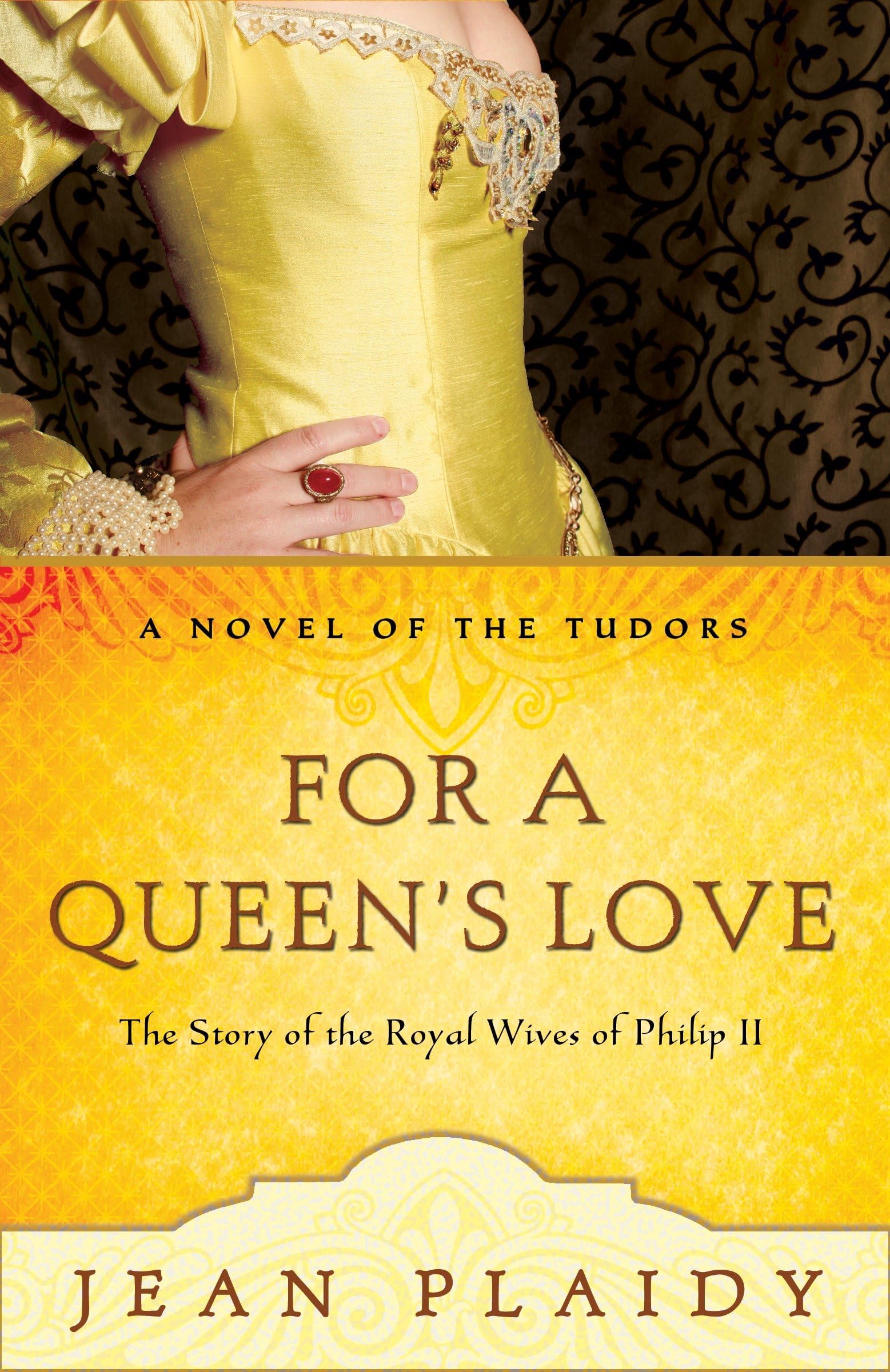
For a Queen's Love: The Stories of the Royal Wives of Philip II (A Novel of the Tudors)
$11.42
by Jean Plaidy



Power-hungry monarch, cold-blooded murderer, obsessive monster—who could love such a man? Set against the glittering courts of sixteenth-century Europe, the Spain of the dreaded Inquisition, and the tortured England of Bloody Mary, For a Queen’s Love is the story of Philip II of Spain—and of the women who loved him as a husband and father. Philip was a dark and troubled man, who, like many royals, had been robbed of his childhood. His first marriage, a romantic union with childlike Maria Manoela, brought him tragedy and a troublesome son, Don Carlos. Then followed marriage with the jealously possessive Mary Tudor, a political union that ultimately failed to bring Philip an heir that would solidify the unified power he so deeply desired. And finally, marriage again to a young bride Philip stole from his unbalanced son, sowing the seeds of brutal murder. But history is seldom what it seems, and in the hands of beloved author Jean Plaidy, we hear another side to the story of Philip II—the most powerful of kings who was at once fanatic, murderer, husband, father, and lover. Jean Plaidy is the pen name of the prolific English author Eleanor Hibbert, also known as Victoria Holt. More than 14 million copies of her books have been sold worldwide. Plaidy passed away in 1993. ONE Crowds had gathered early in the Plaza Mayor of the city of Valladolid on that May day. Peasants had come in from the slopes and valleys of the Sierra de Guadarrama, and wandering gypsies from as far south as Toledo. There were many vagabonds and beggars looking for easy pickings; they were sure they would find these in plenty, for all true Spaniards who could make the journey on this day would wish to be in the ancient capital of Castile. In the shadow of San Pablo they stood, but it was not the beautiful facade with its memories of Torquemada that interested them; nor could the exquisite traceries and canopies of San Gregorio attract them at such a time. They chattered, breathing onion-tainted odors at one another, but they did not notice such odors, which were as common as the heat of the sun at noon, the smell of goats, or that of the blood of bulls. "How long?" was the frequently uttered question. "Surely her time is at hand. Will it be a son, think you? A prince for Spain?" They hoped so, for then the great bells of San Pablo and Santa Maria la Antigua would ring out; there would be rejoicing in the town; the best bulls would be brought forth, and there would be processions bright with the purple and gold of royalty. There would be free wine for the people. Girls with flowers in their hair would dance—Castilians, Andalusians, and luscious gypsy girls. There would be feasting and merry-making throughout the country. That was what the birth of a prince would mean. So eagerly the people waited, asking one another: "How long?" In the mansion of Don Bernardino de Pimentel, which was but a stone's throw from the Church of San Pablo, a young man of twenty-seven sat alone in one of the great rooms. The room was dark and sparsely furnished, but the walls were hung with tapestry, some of which had been worked by Queen Isabella during her pregnancy. The man stared moodily before him, his hands on his knees, his prominent lower lip jutting out as he stroked the hair on his chin. He was straining his ears for the cry of a child: he did not wish to go into his wife's chamber until he heard it. There would be women everywhere—his wife's attendants, and the ladies of the court, as well as those who had come to assist at the birth. It was too important a moment for him to be there, for to these people he was a legend. He was the greatest monarch in the world; he was hard and ruthless, and men and women trembled before him. Now he felt as he did before a great battle—strong, unconquerable, ready to efface himself if necessary for the sake of victory. He, Charles the First of Spain and the Fifth of Germany, would not disturb those women at their all-important task, any more than he would disturb his soldiers in the process of ravishing a town they had won. He knew how to act, and what was more important, when to act. He was not the most feared man in Christendom for nothing. He prayed now for a son—a prince, another such as himself, a great ruler who would combine the lusty strength of a Hapsburg with the subtlety of a Spaniard. He himself was all Flemish. He had been born in Flanders, and this land of dark, fierce-tempered people often seemed an alien land to him although he was its king. An accomplished linguist, able to converse in dialect with the subjects of his wide Empire, he spoke Castilian as a foreigner speaks it. He had inherited his love of good food from his Hapsburg ancestors; his fair, florid face was Hapsburg. He had great physical energy which he enjoyed expending on war, jousts, and plump German women. He was, nevertheless, too clever to deceive himself. There were times when m