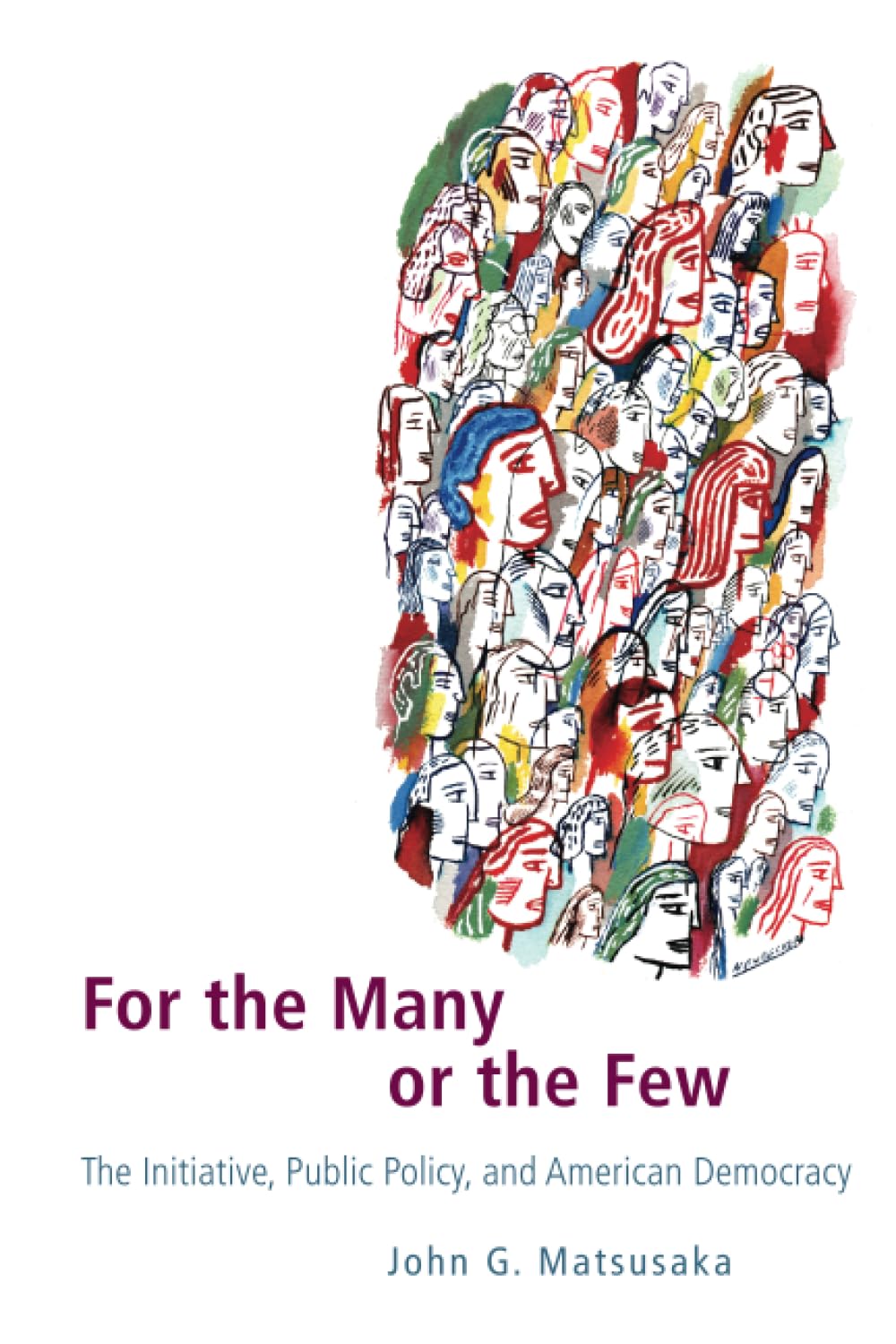
For the Many or the Few: The Initiative, Public Policy, and American Democracy (American Politics and Political Economy Series)
$30.00
by John G. Matsusaka



Direct democracy continues to grow in importance throughout the United States. Citizens are increasingly using initiatives and referendums to take the law into their own hands, overriding their elected officials to set tax, expenditure, and social policies. John G. Matsusaka’s For the Many or the Few studies a century of budget data from states and cities to provide the first comprehensive, empirical picture of how direct democracy is changing government policies. Based on a century of evidence and the most recent theory, Matsusaka argues against the popular belief that initiatives empower wealthy special interest groups that neglect the majority view. Examining demographic, political, and opinion data, he demonstrates how initiatives led to significant tax and expenditure cuts over the last 30 years and that these cuts were supported by a majority of citizens. He concludes that, by and large, direct democracy in the United States has worked for the benefit of the many rather than the few. “ For the Many or the Few is a valuable contribution to our understanding of American democratic institutions and public policy and an important book.”— Journal of Politics “John G. Matsusaka’s valuable, accessible book represents one of the few studies that attempt to test how policy outcomes are affected by the initiative process and to examine whether policies produced by the initiative reflect what the public actually wants.”— Political Science Quarterly [The author''s] comprehensive work carefully examines initiative outcomes, opinion surveys and government policies over the last century. His robustly supported conclusion: the initiative process rather closely reflects the will of the public." -- Steven Frates "Local Liberty" ""For the Many or the Few" is a valuable contribution to our understanding of American democratic institutions and public policy, and an important book." "" "A nice piece of research with many good findings and valuable data. "For the Many or the Few" extends the analysis of the fiscal effects of the initiative process in an important way by asking whether the policies that are produced in initiative states are more or less majoritarian. Matsusaka looks at the policies implemented in a clear and non-technical manner."--Bruce Cain, coauthor of "Congressional Redistricting" "A remarkable achievement. This is the first comprehensive scientific examination of how voter initiatives affect public policy in the United States. This extremely well-written book deserves attention not only from academics but also from anyone who cares about direct democracy''s impact on public policy. It is essential reading for those who want to battle long-standing conjectures about the initiative process with systematic evidence."--Arthur Lupia, coauthor of "Stealing the Initiative: How State Government Responds to Direct Democracy" "Matsusaka''s scholarly masterpiece arrives at a critical time when advances in telecommunications technology make the adoption of direct democracy mechanisms more feasible than ever before. His diligently constructed analysis of data for the twentieth century presents the facts required to evlauate the effects of the initiative process and whether it promotes policies desired by citizens."--W. Mark Crain, "Volatile States: Institutions, Policy, and the Performaace of American State Economies" "A nice piece of research with many good findings and valuable data. "For the Many or the Few" extends the analysis of the fiscal effects of the initiative process in an important way by asking whether the policies that are produced in initiative states are more or less majoritarian. Matsusaka looks at the policies implemented in a clear and non-technical manner."--Bruce Cain, coauthor of "Congressional Redistricting " "Matsusaka's valuable, accessible book represents one of the few studies that attempt to test how policy outcomes are affected by the initiative process and to examine whether policies produced by the initiative reflect what the public actually wants." "One of Matsusaka's simplest and most important accomplishments is to explain clearly that the initiative is a "normal" practice. Critics like David Broder would have us believe that the initiative is a crazy procedure that a few loony states dreamed up a century ago and have begun madly swinging about the room like a feral cat. By contrast, Matsusaka's comprehensive inventory of the process finds that more than 200 million Americans live in a city or state that has used the process for many, many years." " Matsusaka ' s valuable, accessible book represents one of the few studies that attempt to test how policy outcomes are affected by the initiative process and to examine whether policies produced by the initiative reflect what the public actually wants." " One of Matsusaka ' s simplest and most important accomplishments is to explain clearly that the initiative is a normal practice. Critics like David Brod