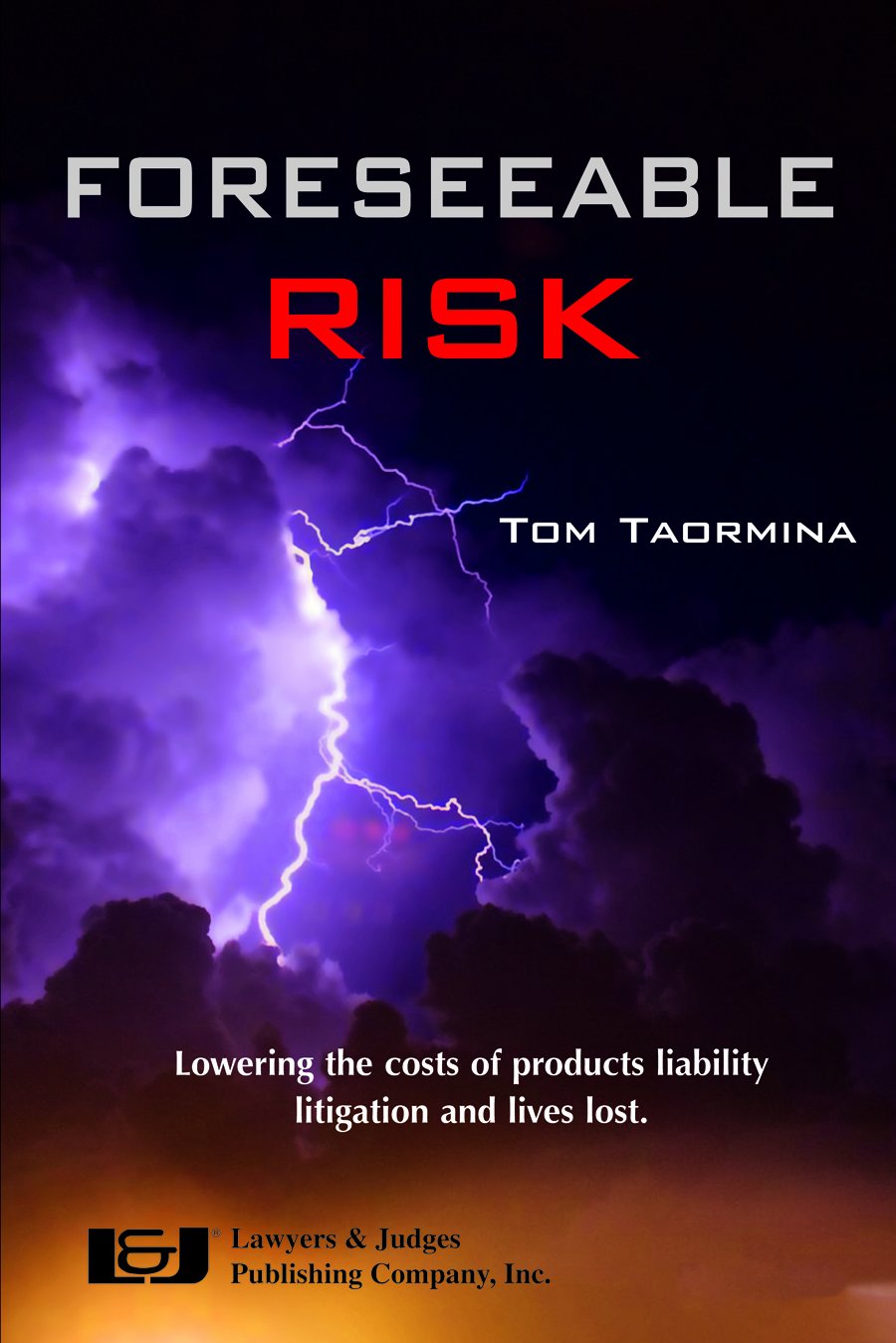
Foreseeable Risk: Minimizing Cost and Maximizing Outcomes in Products Liability Litigation
$99.00
by Tom Taormina



Plaintiffs typically spend vast amounts of time, energy and resources in products liability litigation in determining proximate cause and cause-in-fact through forensic investigations. Defendants typically expend similar amounts of resources proving their innocence. On both sides, cadres of expert witnesses relentlessly write conflicting reports and give obtuse testimony often leaving the decisions of causation and consequences to the emotional consensus of a jury. This book offers a much more exact science that can provide unimpeachable testimony for causes-in-fact, concurrent causes, combined causes, foreseeable risk, breach of warranty, design defects, failure to warn, res ipsa loquitur, negligence per se, risk utility and duty owed. Using proven tools grounded in quality and organizational management practices, it can be determined, through discovery and depositions, that the defendant s practices and standard of care were beyond either reproach, or the cause-in-fact of the accident. Author Tom Taormina has a history of 40 years in quality management and a decade of successful litigation support as a foundation. His breakthrough approach, applied in the discovery stage of cases, ensures the most efficient and equitable resolution for the clients, plaintiffs and defendants, while lowering the direct costs for all involved. This approach is called Forensic Business Pathology (FBP), a proprietary methodology used to evaluate the integrity of the business management, quality control and manufacturing practices of a defendant company. The outcome of an FBP investigation can show irrefutably that a company either did or did not exercise an appropriate standard of care, discipline and social responsibility in the production of the subject product or service. FBP is the most comprehensive approach to investigation that looks beyond the failed product incident to uncover whether or not the producing company is guilty of willful or negligent disregard for the consequences of its product failure or for alleged organizational negligence. For enlightened business leaders, FBP is a strategy for achieving peak performance while immunizing the company from products liability and organizational negligence. By virtually eliminating product defects and service errors, organizations can achieve unparalleled pinnacles of customer service. For savvy litigators, FBP is a strategy for assessing the standard of care of a defendant company to measurable standards and scientifically proving or disproving negligence. By assessing business processes with forensic precision, the wellness of a company becomes an irrefutable barometer of its legal culpability. FBP is equally applicable and compelling for plaintiff and defense. This book chronicles the evolution of Forensic Business Pathology, drawing lessons from Project Apollo and providing the reader with a new set of tools that can be used immediately to diagnose business health and well-being to new standards of precision and practicality. Tom Taormina, CMC, CMQ/OE, Forensic Business Pathologist, with a unique perspective from having worked with nearly 600 companies in his 40-year career, brings a rare talent for precision problem diagnosis, strategic thinking and outstanding written and verbal communications skills to any organization or litigation team. His forte is assessing if, and how effectively, organizations are following their own manufacturing and quality practices and if they comply with required statutory, regulatory and industry standards. Tom was a member of the Apollo 13 disaster recovery team at Mission Control in Houston. His experiences during his 14 years at NASA formed the foundation for him to be able to rapidly analyze problems, diagnose solutions and work with teams to implement successful outcomes. This skill set makes him a highly sought-after consultant and is vital to his success as a member of a defense or plaintiff s winning team of experts. Tom is a frequent speaker to professional organizations on topics ranging from quality management to organizational excellence. He has been so successful at synthesizing quality control and quality assurance techniques into mainstream business that the American Society for Quality recruited him to be managing editor for a series of publications entitled Defining Quality Management. Tom attended the State University of New York at Farmingdale and The University of Houston, majoring in Electrical Engineering. Ford Aerospace and NASA granted him the degree equivalency of Quality Control Engineer in 1969, before it was a recognized university curriculum. He received additional training from Texas A&M, The American Productivity and Quality Center and Productivity, Inc. in the fields of quality and business management. He is currently a Senior Member of The American Society for Quality and internationally acclaimed as a subject matter expert in quality management and ISO 9000. After leaving NASA, he spent ten years worki