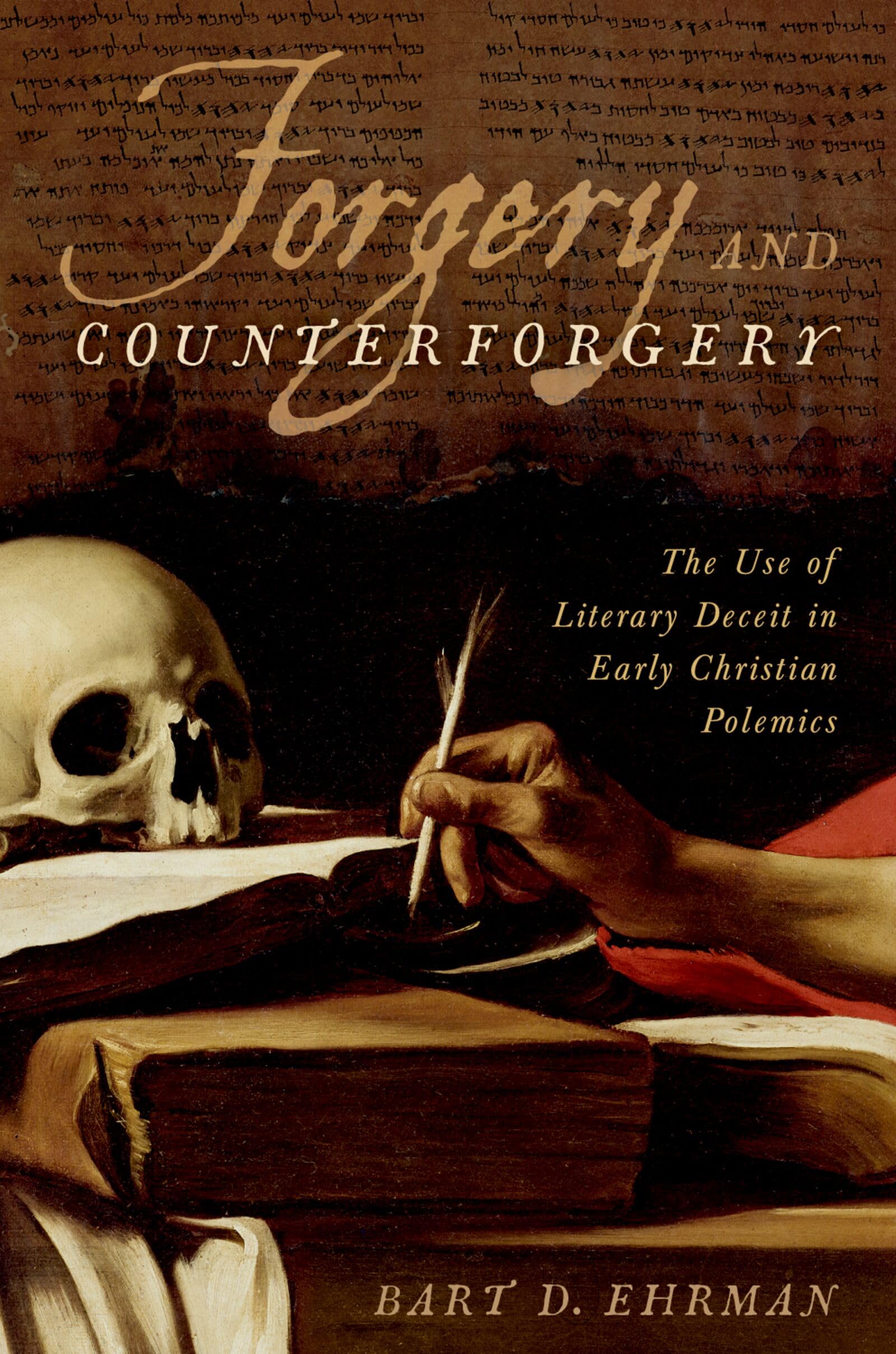
Forgery and Counterforgery: The Use of Literary Deceit in Early Christian Polemics
$76.86
by Bart D. Ehrman



"Arguably the most distinctive feature of the early Christian literature," writes Bart Ehrman, "is the degree to which it was forged." The Homilies and Recognitions of Clement; Paul's letters to and from Seneca; Gospels by Peter, Thomas, and Philip; Jesus' correspondence with Abgar, letters by Peter and Paul in the New Testament--all forgeries. To cite just a few examples. Forgery and Counterforgery is the first comprehensive study of early Christian pseudepigrapha ever produced in English. In it, Ehrman argues that ancient critics--pagan, Jewish, and Christian--understood false authorial claims to be a form of literary deceit, and thus forgeries. Ehrman considers the extent of the phenomenon, the "intention" and motivations of ancient Greek, Roman, and Jewish forgers, and reactions to their work once detected. He also assesses the criteria ancient critics applied to expose forgeries and the techniques forgers used to avoid detection. With the wider practices of the ancient world as backdrop, Ehrman then focuses on early Christian polemics, as various Christian authors forged documents in order to lend their ideas a veneer of authority in literary battles waged with pagans, Jews, and, most importantly, with one another in internecine disputes over doctrine and practice. In some instances a forger directed his work against views found in another forgery, creating thereby a "counter-forgery." Ehrman's evaluation of polemical forgeries starts with those of the New Testament (nearly half of whose books make a false authorial claim) up through the Pseudo-Ignatian epistles and the Apostolic Constitutions at the end of the fourth century. Shining light on an important but overlooked feature of the early Christian world, Forgery and Counterforgery explores the possible motivations of the deceivers who produced these writings, situating their practice within ancient Christian discourses on lying and deceit. " Forgery and Counterforgery is to be welcomed as a substantial contribution to a controversial subject. Ehrman combines clarity of writing with profound scholarship, building up a detailed case on the basis of historical evidence that those with more a skeptical view must take into serious consideration. Biblical scholars and historians of early Christianity will find much to ponder in this book."--J. Samuel Subramanian, Review of Biblical Literature "This is a significant study in English of a theme not normally explored by scholars, This book is vintage Ehrman: forthright and coherent, based on thorough research and enviably wide reading replete with rich footnoting."-- The Expository Times "[An] engrossing and learned analysis of early Christian literature, both within and beyond the covers of the Bible...A text that will have a material effect on the future of a faith that is currently experiencing one of its most interesting and fruitful phases of transformation. Few books have so effectively challenged the basis of scriptural authority in Christianity." -- London Review of Books "Impressive and wide-ranging." -- Marginalia "This comprehensive study is a valuable addition to the field of scriptural literary criticism and will be very useful to researchers and lay readers in that field. It is both an insightful study of the use and usefulness of forgeries in polemics during the first four centuries of Christianity, and a near encyclopedic survey of the forged texts themselves." -- Library Journal "The book is excellent. It will make an enormous impact on the field of New Testament studies and also studies of pseudepigraphy in the ancient world. ... The book will make a huge contribution to the field. There are comparable books in German, but this one goes beyond them all. And it will be the only thing of its kind in English." --Dale B. Martin, Professor of Religious Studies at Yale University "The book tackles an important subject--the nature of ancient Christian pseudepigraphy--and makes a significant contribution to it.... The author's contribution lies in updating Speyer's thesis that pseudepigraphy was usually, on the contrary, an attempt to deceive, and in establishing this thesis in a comprehensive English-language monograph. The greatest strength of the book is its comprehensiveness." --Joel Marcus, Professor of New Testament and Christian Origins at Duke Divinity School "Examining over fifty examples of early Christian forgery and their polemical contexts, Ehrman uncovers the varied motives that prompted ancient Christian authors intentionally to deceive their readers. Whether these authors forged their works to support or critique the Apostle Paul, to oppose or celebrate "the flesh", to promote their own views of doctrine and church leadership, or to defend Christianity against hostile critics, the sheer magnitude of early Christian forgery startles the modern reader. Ehrman demolishes the claim that forgery was an acceptable literary practice in Greco-Roman antiquity, as wel