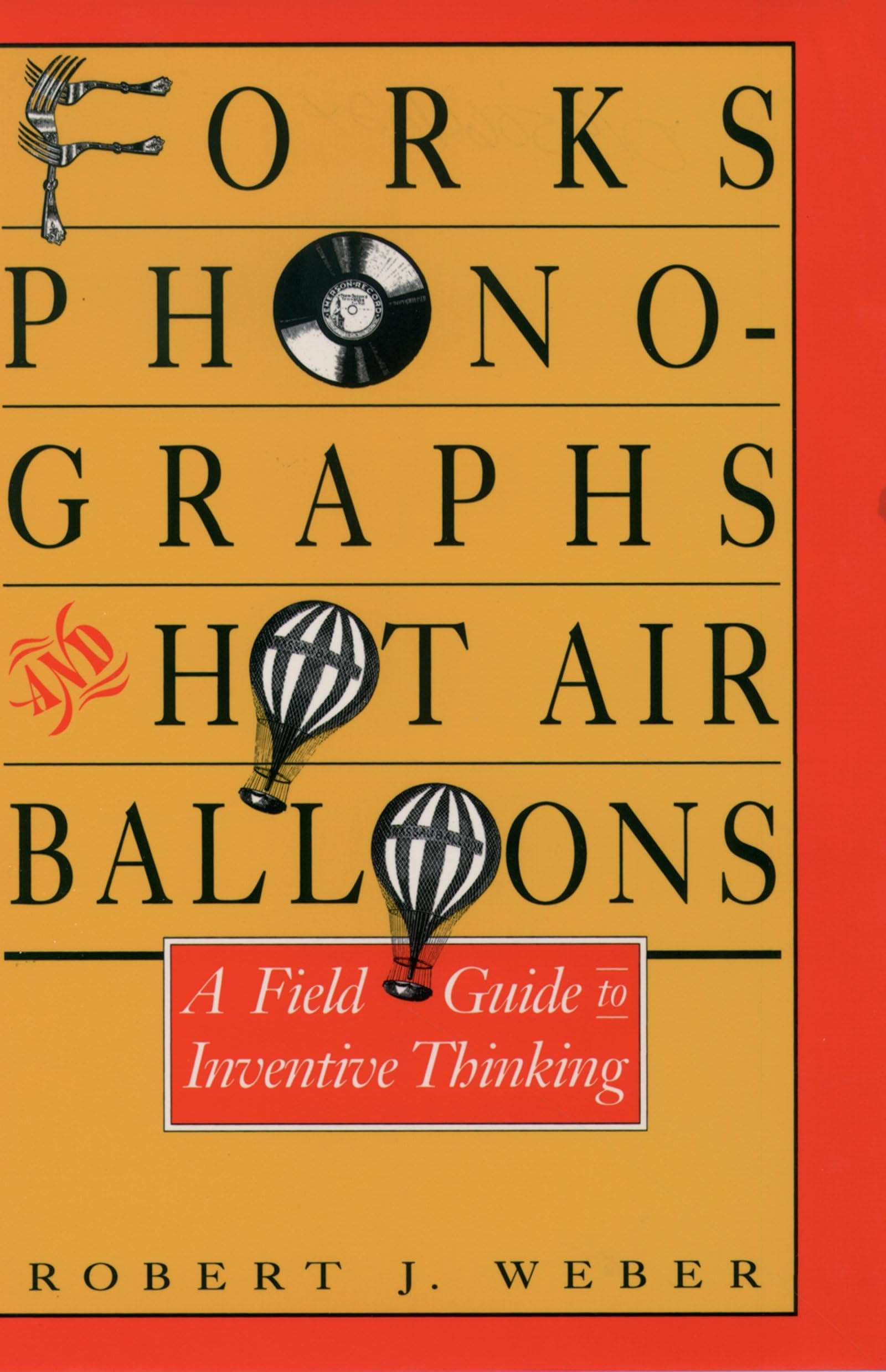
Forks, Phonographs, and Hot Air Balloons: A Field Guide to Inventive Thinking
$30.59
by Robert J. Weber



How do inventions take shape? How did the inventors of the sewing needle, the hammer, or the wheel find their ideas? Are these creations the result of random events, or are hidden principles at work? Using everyday objects most of us take for granted--from forks and Velcro to safety pins and doorknobs--noted cognitive psychologist Robert Weber takes a fascinating look at how our world of inventions came into being, and how the mind's problem-solving abilities gave them the forms they have. As an archaeologist studies shards of pottery for clues about an ancient culture, Weber examines the many forms of inventions, from stone knives to genetically engineered mice, and finds a rich record of the work of many minds over time--a record of human creativity and problem-solving handed down through the centuries. He offers various methods for analyzing what mental paths might have been taken by these inventive minds. In the test for design, for example, he ponders how an item would work if various components were shuffled or constructed differently, revealing how the optimal shape of the invention was discovered. He challenges the reader to engage in thought experiments to explore how the horse-drawn cart, the waterscrew, or the fork might have taken shape over many years, through the efforts of successive inventors and adapters. In stripping these simple artifacts to the bone, Weber finds a hidden intelligence at work in everyday objects as well as recurrent heuristics (basic principles or rules of thumb) that are common among many of our most successful inventions--heuristics powerful enough to generate endless new ideas. Weber ranges across the work of Archimedes, Leonardo da Vinci, the Wright brothers, as well as grade-school children who have won national awards for their inventions, revealing that the same principles are at work in the discoveries of all of them. Basic principles of invention, he writes, govern how we think, solve, and manipulate ideas, whether mechanical or mental, real or mythological. Weber's playful, original, and insightful look at the inventions around us reveals a hidden intelligence in everything from screws to tea bags to synthesizers--an intelligence based on principles of creativity and problem-solving. His fascinating account sheds light on how the mind hones its most original thoughts and products, and provides a field guide for how we can tap into our own creativity. Weber (psychology, Oklahoma State Univ.) examines a wide range of inventions to determine whether hidden principles guided their creation. He develops a taxonomy for classifying inventions and ties it to recurrent heuristics to establish a common thread among many of our more successful inventions. It is difficult to evaluate how well Weber's ideas would work as predictors of future developments, but as explanations of past events, his arguments have a sense of logic and insight. Even if his hindsight is better than his foresight, this is an interesting and entertaining work. - Hilary D. Burton, Lawrence Livermore National Lab, Livermore, Cal. Copyright 1992 Reed Business Information, Inc. "This book opens numerous Pandora's boxes of ideas for exhibitions and programs. It is a terrific addition to the library." --The Informal Science Review"An interesting and entertaining work."--Library Journal"Instead of studying the workings of the individual mind, Weber analyzes the mental principles involved in solving problems in the physical world, whether it's jerry-rigging a curtain rod or designing a computer. He's enthralled by the 'hidden intelligence' reflected in all human inventions and wants other people to appreciate this intelligence, too....Weber addresses himself to hardware store habitues, to Sears catalogue devotees, to the person who goes gaga over gadgets."--Publishers Weekly"Inventive thinking arguably is the hallmark of the human organism. In this lovely volume, Robert Weber takes us inside invention to reveal logic and systematicity alongside inspiration." OR "Robert Weber's fascinating volume demonstrates that invention is not only an art but a craft. It has a logic that one can survey and set forth--with ample room for inspiration too." OR "We live in an invented world--shoes, streets, satellites, and all the rest. Robert Weber takes us on a compelling journey through the world of the mind behind this world of invented things, revealing the hidden logic of human ingenuity."--David Perkins, Harvard University"Weber's excellent book breaks new ground in the psychological study of creativity. Noteworthy are the brilliant treatment of children's innovation and the process by which the Wright brothers came to invent the airplane. The connection of psychological process to patentable products is at once a contribution to theory and practice."--Michael Posner, University of Oregon"The major advantage of this book is its use of language. Weber examines discoveries from the layman's point of view, which makes