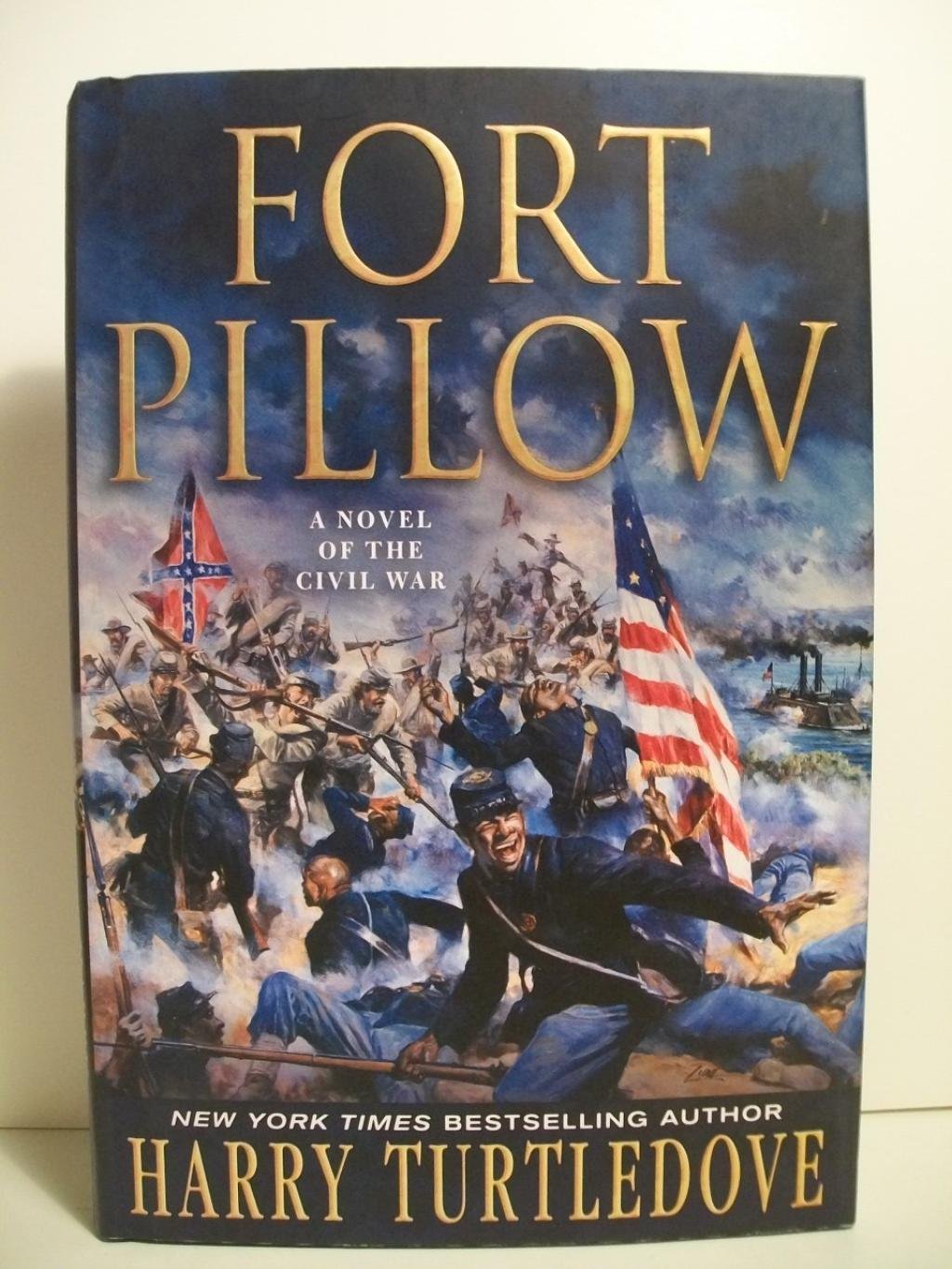



In April 1864, the Union garrison at Fort Pillow was comprised of almost six hundred troops, about half of them black. The Confederacy, incensed by what it saw as a crime against nature, sent its fiercest cavalry commander, Nathan Bedford Forrest, to attack the fort with about 1,500 men. The Confederates overran the fort and drove the Federals into a deadly crossfire. Only sixty-two of the U.S. colored troops survived the fight unwounded. Many accused the Confederates of massacring the black troops after the fort fell and fighting should have ceased. The "Fort Pillow Massacre" became a Union rallying cry and cemented resolve to see the war through to its conclusion. Harry Turtledove has written a dramatic recreation of an astounding battle, telling a bloody story of courage and hope, freedom and hatred. With brilliant characterization of all the main figures, this is a novel that reminds us that Fort Pillow was more than a battle---it was a clash of ideas between men fighting to define what being an American ought to mean. *Starred Review* In April 1864, the Union garrison at Fort Pillow, Tennessee, consisted of 600 men, more than half of them black and many of the rest Tennessee unionists. They were commanded by Major William Bradford, who had gotten his command by raising regiments. Their position was attacked by General Nathan Bedford Forrest and 1,500 men, many of whom were also Tennesseeans. The Confederates overran the fort, and when the fighting was done, there were 226 Union survivors. Only 62 of the black troops survived unwounded. Major Bradford was killed shortly after being taken prisoner. Exactly what happened has been a subject of controversy from that day to this. An immediate congressional investigation found that Forrest's forces had deliberately murdered the black troops and their officers, and "the Fort Pillow Massacre" became a rallying cry for Union victory. The investigation's report, however, contains several errors of fact. Accounts of Forrest's campaigns written by Confederate sympathizers after the war maintain that Forrest's troops only fought--they didn't massacre--the Union troops. Turtledove's most impressive novel uses known facts and persons and extremely plausible extrapolations to paint a picture of one of America's least glorious affrays. After reading it, one is convinced that it happened that way. Turtledove also depicts the people of the time and place very vividly, making the novel a true window into history. Frieda Murray Copyright © American Library Association. All rights reserved A STUNNING BATTLE, A CLASH OF IDEAS, A BLOODY FIGHT FOR FREEDOM--AN EXPLOSIVE HISTORICAL NOVEL OF THE CIVIL WAR: "Harry Turtledove knows his Civil War." --James M. McPherson, author of the Pulitzer Prize-winning BATTLE CRY OF FREEDOM "A master storyteller as well as a trained historian with an imagination." -- Houston Chronicle "Anyone who loves history will love what Harry Turtledove can do with it." --Larry Bond, New York Times bestselling author of DANGEROUS GROUND "Turtledove is an accomplished professional...and has given us an entertainment that makes us think somewhat about why we are the way we are." --LIBRARY JOURNAL HARRY TURTLEDOVE is a multiple New York Times bestselling author THE GUNS OF THE SOUTH and master of the alternate history novel. He holds a Ph.D. in history from University of California Los Angeles. Chapter One Jackson, Tennessee, was a town laid out with big things in mind. The first streets were ninety feet wide. The first courthouse was built of logs, back at the start of the 1820s. Now, more than forty years later, buildings of red and gray brick prevailed. Oaks and elms helped shade those broad streets. The Madison County seat had not flourished quite so much as its founders hoped. Still, with the Forked Deer River running through the town and two railroads meeting there, Jackson was modestly prosperous, or a bit more than modestly. It was a considerable market for lumber and furs and produce from the farms in the Forked Deer valley. When civil war tore the United States in two, Jackson went back and forth between Union and Confederacy several times. Confederate General Beauregard made his headquarters there in early 1862. From that summer to the following spring, Jackson lived under the Stars and Stripes as one of U. S. Grant's supply depots. Then Nathan Bedford Forrest's cavalry ran the Yankees out again. In June 1863, U.S. General Hatch defeated the Confederate garrison and reoccupied the town. Now, in April 1864, Forrest was back, and the Stainless Banner replaced the U.S. flag. Forrest had his headquarters in the Duke home on Main Street. Two years earlier, Grant had stayed in the same two-story Georgian Colonial house. The Dukes were happier to accommodate the Confederate cavalry commander than they had been to host his opponent in blue. Although Forrest went to church on Sunday morning, he did not treat the Sabbath as a d