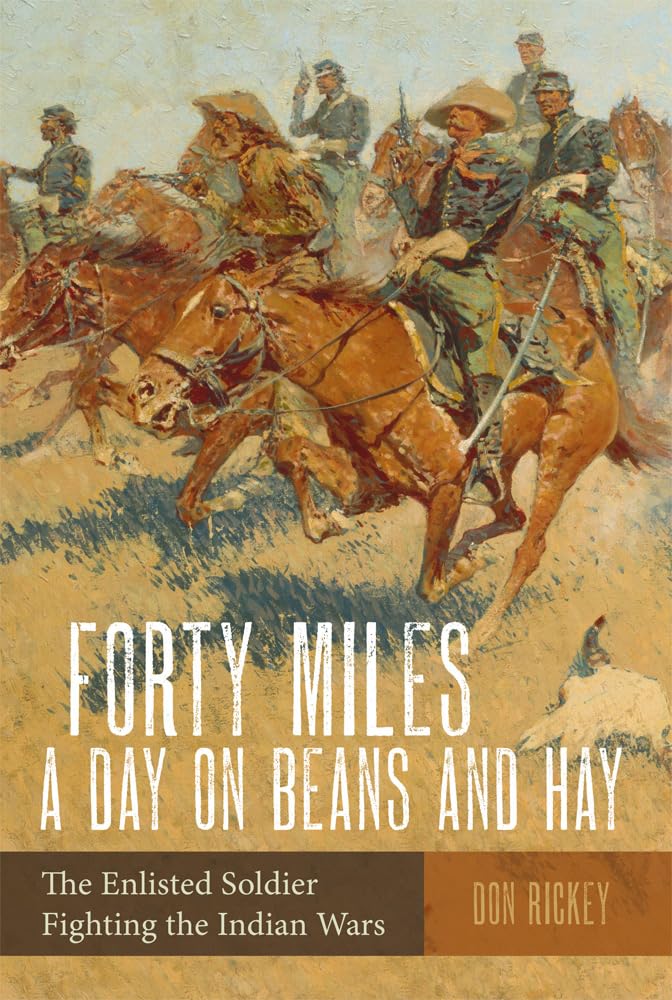



The enlisted men in the United States Army during the Indian Wars (1866-91) need no longer be mere shadows behind their historically well-documented commanding officers. As member of the regular army, these men formed an important segment of our usually slighted national military continuum and, through their labors, combats, and endurance, created the framework of law and order within which settlement and development become possible. We should know more about the common soldier in our military past, and here he is. The rank and file regular, then as now, was psychologically as well as physically isolated from most of his fellow Americans. The people were tired of the military and its connotations after four years of civil war. They arrayed their army between themselves and the Indians, paid its soldiers their pittance, and went about the business of mushrooming the nation’s economy. Because few enlisted men were literarily inclined, many barely able to scribble their names, most previous writings about them have been what officers and others had to say. To find out what the average soldier of the post-Civil War frontier thought, Don Rickey, Jr., asked over three hundred living veterans to supply information about their army experiences by answering questionnaires and writing personal accounts. Many of them who had survived to the mid-1950’s contributed much more through additional correspondence and personal interviews. Whether the soldier is speaking for himself or through the author in his role as commentator-historian, this is the first documented account of the mass personality of the rank and file during the Indian Wars, and is only incidentally a history of those campaigns. “This volume most certainly helps to reveal both the nature and the character of those who participated in the last Indian wars of the trans-Mississippi West. As such, it is a substantial addition not only to American military history in general but also a contribution to the literature of the western frontier.”— American Historical Review Don Rickey, Jr., who holds the Ph.D. degree from the University of Oklahoma, is park interpretive planner, National Park Service, Midwest Region, in Omaha, and an authority on the military history of the American West. Forty Miles a Day on Beans and Hay The Enlisted Soldier Fighting the Indian Wars By Don Rickey Jr. UNIVERSITY OF OKLAHOMA PRESS Copyright © 1963 University of Oklahoma Press All rights reserved. ISBN: 978-0-8061-1113-1 Contents Preface, 1. War in the West, 2. Enlistment in the Regular Army, 3. The Recruit Depots and Introduction to Army Life, 4. Privates, Noncoms, and Officers, 5. Companies and Regiments, 6. Routine Duty at the Western Posts, 7. Material Factors of Enlisted Life at Western Posts, 8. Discipline and the Frontier Desertion Problem, 9. Crime, Vice, and Punishment, 10. Recreation, Relaxation, and Outside Interests, 11. Campaign Preparation, Equipment, and the Hostiles, 12. Field Service in the West, 13. Combat, 14. Cowardice, Heroism, and the Aftermath of Combat, 15. Enlistment's End, Discharges, and Re-enlistment Regulars Tattoo, Bibliography, Index, CHAPTER 1 War in the West The morning of May 23, 1865, saw the nation's capital thronged with citizens and soldiers. Campaign-toughened Union troops, school children, convalescent soldiers and sailors from the hospitals, and eager civilians filled Washington's main thoroughfares, parks, and public buildings. It was the first of two days that men would talk about for years to come, two glorious days focused on national pride and thanksgiving. The war was over, and the victorious armies of the Potomac, of Tennessee, and of Georgia were about to pass in review before President Andrew Johnson and the people. At nine o'clock General Meade's Army of the Potomac began its march down Capitol Hill toward Pennsylvania Avenue, where the presidential party waited in the reviewing stand erected in front of the White House. Flags and banners fluttered all along the line of march. School children sang and cheered. The crash of blaring bands accompanied the cobble-clatter of mounted officers and the stamp of serried ranks of veteran infantry as the troops moved down Pennsylvania Avenue, past the presidential stand festooned with star-spangled bunting bearing the terrible names of "Vicksburg," "Antietam," "Gettysburg," and others. The second day of the Grand Review witnessed the passage of Sherman's far-ranging army. Little Phil Sheridan could not be present to lead his cavalry brigades, but Generals Custer and Merritt headed up the mounted column in his place. Custer would ride to defeat and immortality eleven years later at the Little Bighorn, but on this warm day in May, 1865, few Americans, in or out of the army, were much concerned with the potential problems of the Indian military frontier. This was the Grand Review of two hundred thousand victorious Union soldiers. Newspapers and