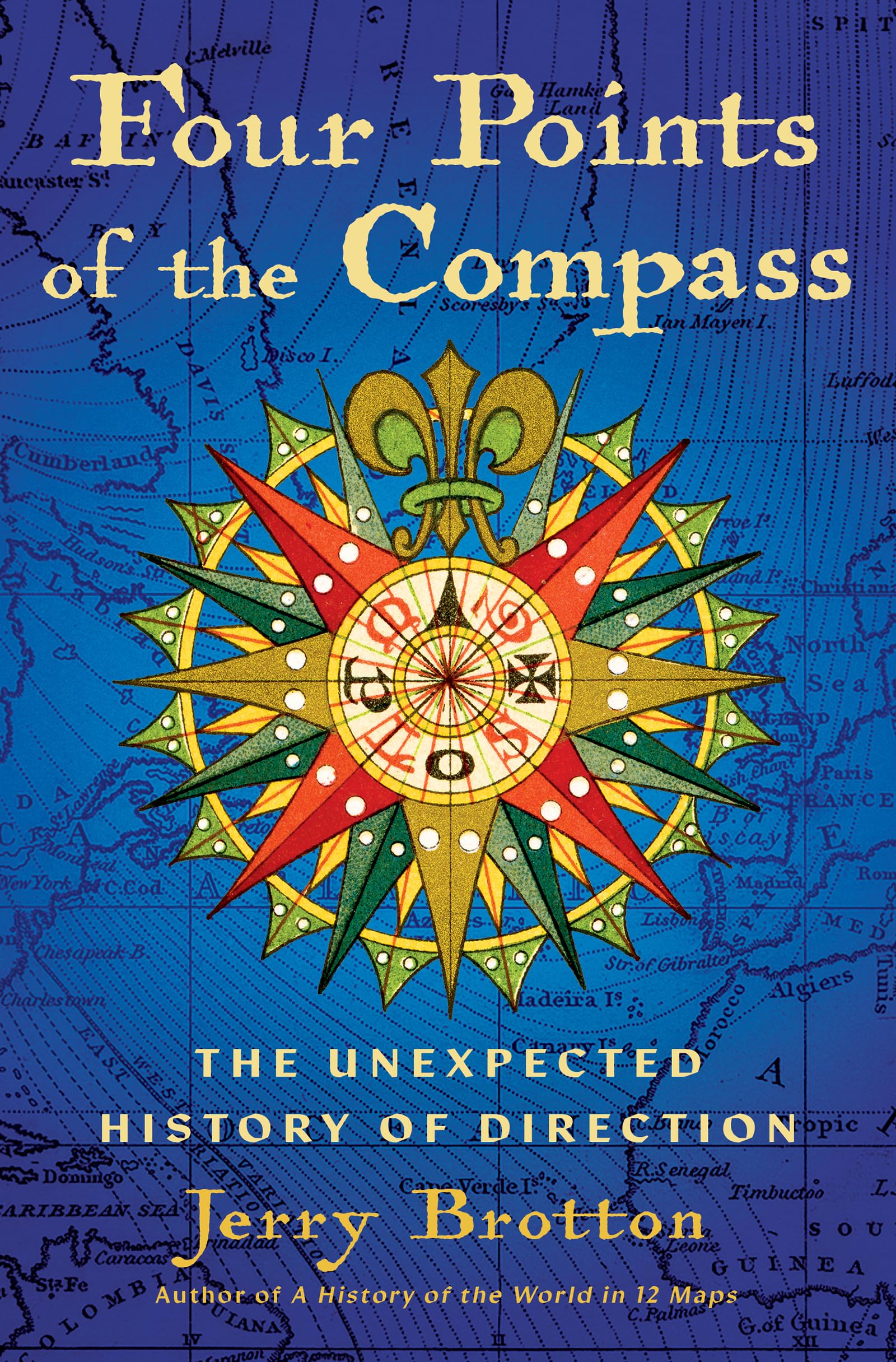



From the New York Times bestselling author of A History of the World in 12 Maps , this is the revelatory history of the four cardinal directions that have oriented and defined our place on the globe for millennia North, south, east, and west: almost all societies use these four cardinal directions to orientate themselves and to understand who they are by projecting where they are. For millennia, these four directions have been foundational to our travel, navigation, and exploration, and are central to the imaginative, moral, and political geography of virtually every culture in the world. Yet they are far more subjective—and sometimes contradictory—than we might realize. Four Points of the Compass leads us on a journey of directional discovery. Societies have understood and defined directions in very different ways based on their locations in time and space. Historian Jerry Brotton reveals why Hebrew culture privileges east; why Renaissance Europeans began drawing north at the top of their maps; why early Islam revered the south; why the Aztecs used five color-coded cardinal directions; and why no societies, primitive or modern, have ever orientated themselves westwards. In doing so, politically-loaded but widely used terms such as the “Middle East,” the “Global South,” the “West Indies,” the “Orient,” and even the “western world” take on new meanings. Who decided on these terms and what do they mean for geopolitics? How have directions like “east” and “west” taken on the status of cultural identities—or more accurately stereotypes? Yet today, because of GPS capability, cardinal points are less relevant. Online, we place ourselves at the center of the map as little blue dots moving across geospatial apps; we have become the most important compass point, though in the process we’ve disconnected ourselves from the natural world. Imagining what future changes technology may impose, Jerry Brotton skillfully reminds us how crucial the four cardinal directions have been to everyone who has ever walked our planet. For anyone interested in history, geography, or surprising new ways to think about the world at large, Four Points of the Compass will be a stimulating experience. Praise for Four Points of the Compass : A Next Big Idea Club Must-Read Book (November 2024) Named a Best Book of the Year by the Washington Independent Review of Books “Mr. Brotton’s evocative book investigates those shifting meanings, drawing from religion, history, literature and geopolitics to argue that north, south, east, and west now function more as loaded ideological terms than as navigational aids . . . He establishes that they remain potent in fascinating and surprising ways.”— Barbara Spindel, Wall Street Journal “Explores the whats and whys of those little arrows that guide our feet and, occasionally, our fate . . . Remarkably informative.”— Ian Volner, New York Times Book Review “Brotton is at his best when he analyzes how directional terms have come to define us”— Anne Cassidy, Washington Independent Review of Books “Brotton’s fascinating global history takes in science, meteorology and cultural perceptions.”— New Statesman “Intriguing . . . Measured and precise . . . A unique and observant history.”— Chris Allnutt, Financial Times “For helping us navigate the history of directions, Brotton’s book is the perfect compass.”— Literary Review “With a compass to show the way, a professor of English and history undertakes an engaging journey of discovery . . . Brotton keeps his complex story moving, knitting technical information and anecdotes into a vivid tapestry.”— Kirkus Reviews “Readers who enjoy history, science, and conceptually innovative nonfiction will adore this title.”— Booklist “Intriguing and enlightening.”— Geographical Magazine “A wide-ranging, well-researched tour.”— Chris Smith, Winnipeg Free Press Praise for The Sultan and the Queen : “Jerry Brotton’s wonderful book reveals this instructive history of Protestant England’s intense interactions with Islam, showing how Muslims shaped English culture, consumerism and literature during the half-millennium between the Crusades and the rise of the British Empire in the Middle East.”— Wall Street Journal “Elegant and entertaining.”— New York Times Book Review “ The Sultan and the Queen evokes an England struggling to find a place for itself in a world that it had not yet learned to dominate, and often making colossal diplomatic blunders in the process. Brotton is a gifted writer who is able to present this history as an exciting series of critical and suspense-filled encounters.”— Washington Post “Both a colorful narrative of that extraordinary time and a reminder that our own fortunes and those of the wider Islamic world have been intertwined for much longer than we might think.”— The Times (UK) “Impressive and highly readable . . . Brotton’s book crackles with an energy that illuminates and vivifies its larger claims.”— Financial Times “Jerry Brotton’