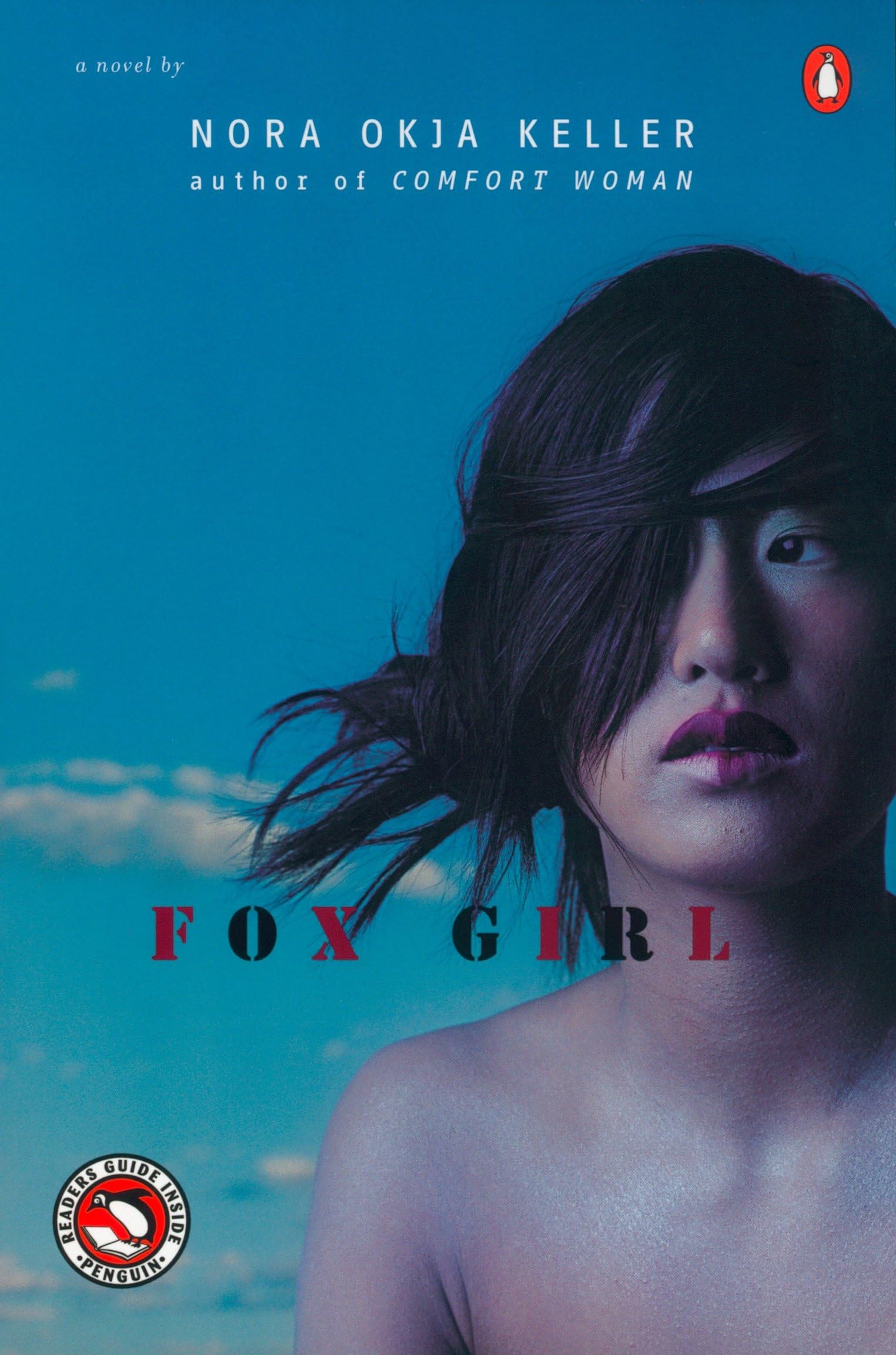



Nora Okja Keller, the acclaimed author of Comfort Woman , tells the shocking story of a group of young people abandoned after the Korean War. At the center of the tale are two teenage girls—Hyun Jin and Sookie, a teenage prostitute kept by an American soldier—who form a makeshift family with Lobetto, a lost boy who scrapes together a living running errands and pimping for neighborhood girls. Both horrifying and moving, Fox Girl at once reveals another layer of war's human detritus and the fierce love between a mother and daughter. "In words that pulse with life, Keller illuminates the lives of children caught between two worlds with a vividness that lightens their dark circumstances." — The Miami Herald "[Keller's] lyricism makes even the most disturbing scenes eerily beautiful, and gives women who continue to suffer the cruelest fates a much-needed voice." — San Francisco Chronicle "A powerful though gently paced story..." -- Kirkus Reviews Nora Okja Keller was born in Seoul, Korea, and now lives in Hawaii with her husband and two daughters. She received the Pushcart Prize in 1995 for "Mother Tongue," a piece from her first novel, Comfort Woman , winner of a 1998 American Book Award. I dream of her still. It's been years since I've seen her, my oldest friend and truest enemy, but she drifts through my sleep almost nightly. Though her face is usually hidden, my heart recognizes her. "Sookie," I call out, voiceless as if underwater. She turns and all I can see are her teeth gleaming white in the blackness. Her mouth stretches wide, smiling, as if she is happy to see me. But even in my dream, it doesn't seem right, her joy doesn't fit. And then I notice how pointy her teeth are, how they are fangs, really, and how through the slightly open mouth, they are glistening, as if about to take a bite. When I wake, I try to envision her face, but her features melt into one another; I see a smudge of black hair, dark eyes, a smear of mouth as if through churning waves. Or as if through several layers of photographic negatives: Sookie at eight when we fought Lobetto in the ditch behind her apartment; at fourteen, peeking out from under the paper bag she had put on her head when we went to Dr. Pak's VD clinic; at seventeen when, with her mother's makeup smeared over her face, she taught me about "honeymooning" in the backbooths of the GI clubs; at twenty when she pushed a wet and wailing Myu Myu into my arms and told me, "She's your daughter now." In every memory I have of her, I can hear her words, see her gestures, but her face remains a fragmented blur. I've written to her-postcards, a line or two on the back of photos of Myu Myu, who wants to be called Maya now. I indulge the child to make up for the beginning of her life, watching her carefully for signs of developmental delays, erratic behavior, eccentricities that could be blamed on me. I am the only mother Maya knows, but for me, in the shadows, there will always be another. These letters are my guilt payment, I suppose, and one day I will send them, these years' worth of notes, to her, care of Club Foxa Hawai'i. One day, when it is safe, I would like to see Sookie again, once more, face-to-face, so that I can reconcile her in my memory and banish her from my dreams. Maybe after enough time has passed, I could see her clearly, without money or love or other people's vision clouding my eyes. i1 When we were children, everyone in Chollak thought Sookie was ugly; this is what I loved most about her. Her ugliness-bulbous eyed and dark skinned-was greater than mine and shielded me to some degree. "Gundong-hi, ssang-dong-i," the neighborhood boys teased as we walked the path from school. "The Butt Twins," they called us. Sookie covered her ears-bony elbows sticking out like a kite-and I tucked the stained side of my face into my shoulder. Reasoning that they couldn't call me ugly if they didn't see the birthmark, I turned my good side toward the taunting and let the teasing fall on my friend. "Blackie, black dog," they shouted at her. Sookie, hands still over her ears, would recite the alphabet. "Your father must be a U.S. darkie!" the boys spat at us. Even Lobetto, whose father was a black GI and whose skin was darker than Sookie's, teased her since at least he had a father. "Eh, chokka!" I screamed, stooping to pick up a broken piece of concrete from the sidewalk. "I'm gonna kick your penis!" Young Sik and Chung Woo swiveled their hips and "oooh-ooohed" us. Lobetto yelled back, "I doubt you'd even know where to find it, you pile-of-shit-face! What did your mama do to make you born so ugly? Eh. Hyung Jin?" He pronounced the first part of my name with a hard "g" at the end, changing its meaning from wise truth to scarred truth. "At least we're pure Korean, not like you, half-half." I jutted out my hip and shook the chunk of concrete at him. Back then, I was the bolder one, secure in my family's station, our relative wealth. I thought we were rich because we