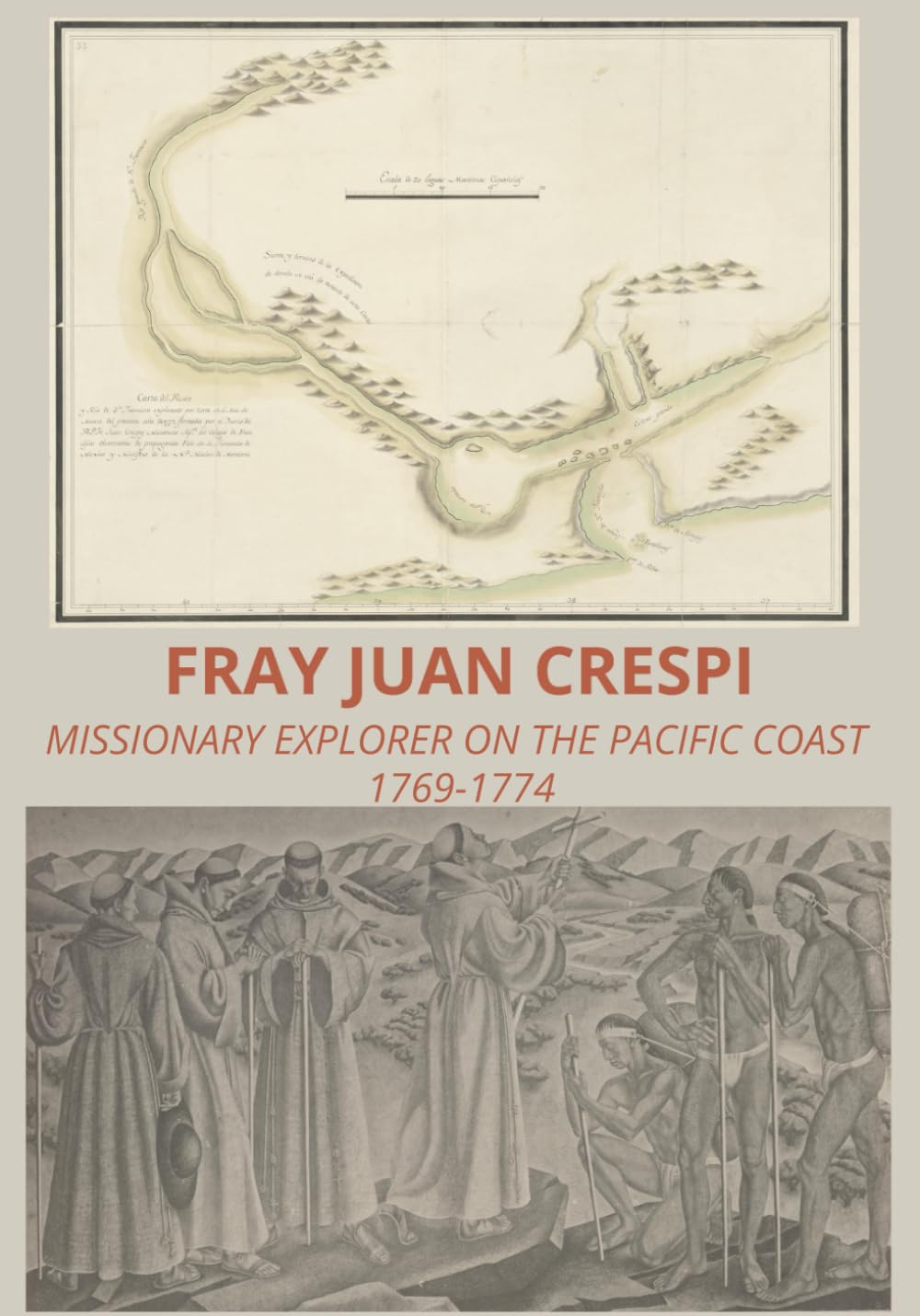
Fray Juan Crespi: Missionary Explorer on the Pacific Coast 1769-1774
$26.95
by Herbert Eugene Bolton



High in the list of early California's "splendid wayfarers" should be placed the name of Fray Juan Crespi. The missionary travels of this gentle Mallorcan friar carried him by sea from Spain to America; by land, on foot or astride a horse or a mule, all the way across Mexico, and the length of Old and New California; and by sea again to the borders of Alaska. To make known to the twentieth-century world the remarkable journeys of Father Crespi is the purpose of this volume. With rapid stroke they are sketched in the Introduction. But this does not suffice. The only way to appreciate his deeds as explorer and diarist is to read his remarkable journals, and follow his itineraries with the map. To make this possible to readers of English, Crespi's diaries are printed here as the primary part of this book. They have never before been assembled in one volume or published as a separate work. They were scattered through the tomes of Palou's New California, and are here reprinted from my English edition of that treatise (Berkeley, 1926), with the addition of several important hitherto unpublished documents, a special Introduction, and Editorial Notes . In addition to this new reprint and edition of Herbert Bolton's original 1926 book is the California maritime historian Bradley Angle's foreword to Bolton's collection. In his words: "I’m not much inclined to be a revisionist after rereading this collection of Crespi’s materials. For five years I shifted through Spanish letters, documents, and shipping logs from the 16th to 19th centuries, in a larger study on the Spanish maritime supply ships on the California Coast. That project spoiled my fascination with both the presidial and mission complexes of Alta California – to say the minimum I can on the subject, as to not distract from the below texts – the Spanish were an evil in Alta California, to the Natives for sure, and to themselves as well. But there is a “but.” Within the mayhem, suffering, dying, murdering and raping, there was still wonder and awe. There was still evidence of the brighter side of humanity, and of the gentleness that can rise above the storm. If I can do my part to emphasize that evidence, this is it – a modern publication of the Crespi Diaries. I hope the reader doesn’t then assume I believe all should be forgiven, or that I assume Crespi was without faults and deserves no blame. Even Crespi obviously falls short of the ripple-free grace of which he is often represented as purporting by 20th century publishers. Nonetheless, I hope this publication sparks useful thoughts on the subject."