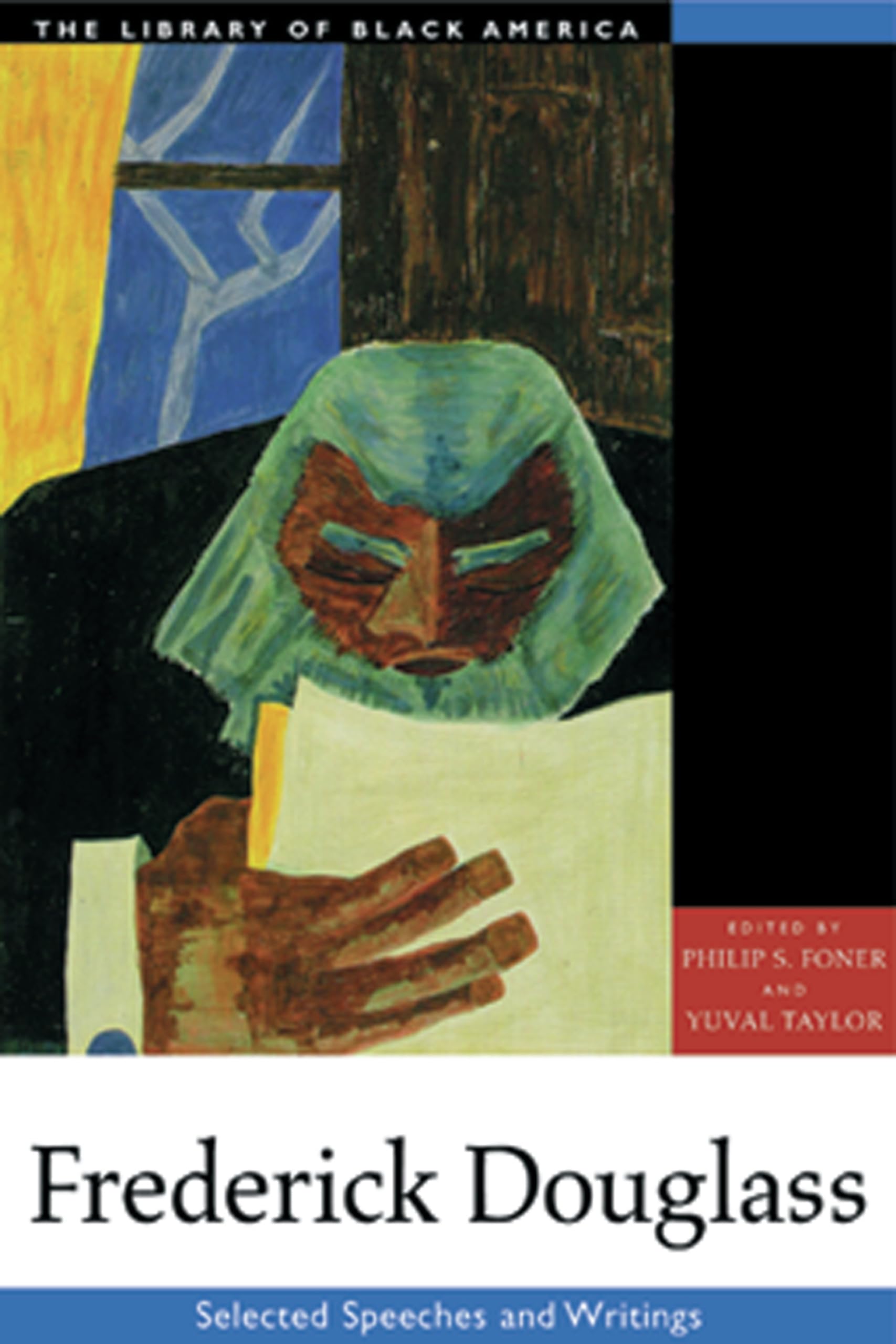
Frederick Douglass: Selected Speeches and Writings (The Library of Black America series)
$35.00
by Philip S. Foner



One of the greatest African American leaders and one of the most brilliant minds of his time, Frederick Douglass spoke and wrote with unsurpassed eloquence on almost all the major issues confronting the American people during his life—from the abolition of slavery to women’s rights, from the Civil War to lynching, from American patriotism to black nationalism. Between 1950 and 1975, Philip S. Foner collected the most important of Douglass’s hundreds of speeches, letters, articles, and editorials into an impressive five-volume set, now long out of print. Abridged and condensed into one volume, and supplemented with several important texts that Foner did not include, this compendium presents the most significant, insightful, and elegant short works of Douglass’s massive oeuvre. Taylor (I Was Born a Slave: An Anthology of Classic Slave Narratives), an editor at Lawrence Hill, serves readers and libraries well by adapting and abridging Foner's acclaimed The Life and Writings of Frederick Douglass, Vols. 1-5 (International Publishers, 1950-1975). As the text shows, Douglass's language, intellect, and humanity create a compelling narrative of 19th-century America. On display here are his ideas about abolitionism, feminism, electoral politics, and peace, as well as family, religion, literature, and economics. Although Taylor does not always provide thorough citations, this much of Douglass's work is not available elsewhere in such an affordable volume. Recommended for public and academic libraries.ASherri Barnes, Ventura, CA Copyright 1999 Reed Business Information, Inc. “[This collection] puts all America under deep obligation. . . . The figure of a great man rises from [this volume].” —W. E. B. Du Bois, author, The Souls of Black Folk “An outstanding contribution to the social history of the Negro in the United States.” —E. Franklin Frazier, author, Black Bourgeoisie “[An] evident outcome of great labor and love, [this book] is a monumental piece of historical scholarship, contributing as much to vital aspects of American history as to the documentary portraiture of the nineteenth century’s greatest American Negro.” —Alain Locke, editor of The New Negro “A veritable treasure house of historical information.” —Benjamin Quarles, author of The Negro in the American Revolution and Frederick Douglass Philip S. Foner wrote and edited more than 100 books, including The Black Panthers Speak , The History of Black Americans , and the 10-volume The History of the Labor Movement in the United States . Yuval Taylor edited I Was Born a Slave: An Anthology of Classic Slave Narratives ; as editor of Lawrence Hill Books, he directs the Library of Black America series. He lives in Chicago. Frederick Douglass Selected Speeches and Writings By Philip S. Foner Chicago Review Press Incorporated Copyright © 1999 Estate of Philip S. Foner and Yuval Taylor All rights reserved. ISBN: 978-1-55652-352-6 Contents INTRODUCTION by Yuval Taylor, PREFACE by Philip S. Foner, Part One: From 1841 to the Founding of The North Star, Part Two: From the Founding of The North Star to the Compromise of 1850, Part Three: From the Compromise of 1850 to the Kansas-Nebraska Act of 1854, Part Four: From the Kansas-Nebraska Act to the Election of Abraham Lincoln, Part Five: From Secession to the Emancipation Proclamation, Part Six: From the Emancipation Proclamation to the Eve of Appomattox, Part Seven: Reconstruction, 1865–1876, Part Eight: The Post-Reconstruction Era, 1877–1895, INDEX, CHAPTER 1 PART ONE From 1841 to the Founding of The North Star From the beginning of his career as a lecturer, Douglass moved beyond the narrow limits prescribed for him by the Garrisonians. He had been hired to tell the story of his slave experiences, and in his first public addresses he discussed nothing else. But within two months, he was discussing the "progress of the cause." ... [In this early speech,] Douglass struck the central theme of his career as an Abolitionist — the twin battle against slavery in the South and prejudice in the North.... Here was no mere copy of other Abolitionist lecturers. Here was a spokesman for his people who experienced their degradation every day of his life, and who could express in vivid burning language the pent-up indignation of the American Negro. [1:48–49] THE CHURCH AND PREJUDICE, speech delivered at the Plymouth Church Anti-Slavery Society, December 23, 1841 At the South I was a member of the Methodist Church. When I came north, I thought one Sunday I would attend communion, at one of the churches of my denomination, in the town I was staying. The white people gathered round the altar, the blacks clustered by the door. After the good minister had served out the bread and wine to one portion of those near him, he said, "These may withdraw, and others come forward"; thus he proceeded till all the white members had been served. Then he drew a long breath,