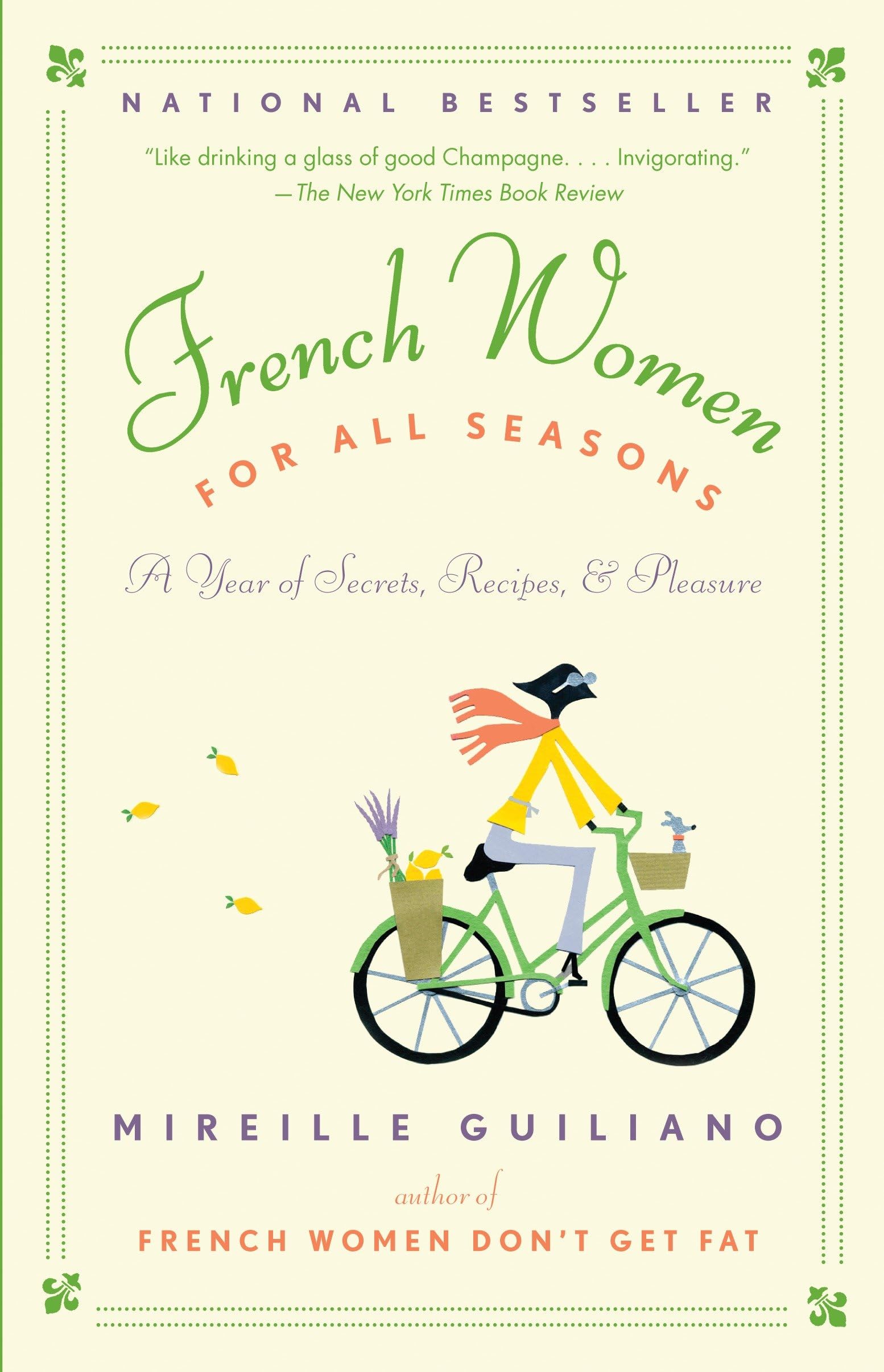
French Women for All Seasons: A Year of Secrets, Recipes, & Pleasure
$13.56
by Mireille Guiliano



NATIONAL BESTSELLER • From the author of the #1 national bestselling French Women Don't Get Fat comes an “invigorating” guide ( The New York Times Book Review ) to the art of joyful living—in moderation, in season, and, above all, with pleasure. Together with a bounty of new dining ideas and menus, Mireille Guiliano offers us fresh, cunning tips on style, grooming, and entertaining. Here are four seasons' worth of strategies for shopping, cooking, and exercising, as well as some pointers for looking effortlessly chic. Taking us from her childhood in Alsace-Lorraine to her summers in Provence and her busy life in New York and Paris, this wise and witty book shows how anyone anywhere can develop a healthy, holistic lifestyle. “Like drinking a glass of good Champagne.... Invigorating.”— The New York Times Book Review “Guiliano is back with more personal stories, recipes and a smorgasbord of advice on all things French.”— USA Today “Romantic and evocative. . . . Better than its predecessor. . . . [Guiliano is] preaching a lifestyle, not a fad diet to try and then abandon. . . . And as lifestyles go, this is a pretty fun and healthy one.”— The San Francisco Chronicle “Guiliano's heartfelt joy in proper eating is an inspiration for those looking to enjoy their meals in a healthy way, rather than count their calories.”— Ladies' Home Journal “Elegant common sense.”— O: The Oprah Magazine MIREILLE GUILIANO is the internationally best-selling author of French Women Don't Get Fat and its companion French Women for All Seasons, which have appeared in thirty-seven and twenty-three languages respectively. She is also a pioneer in business as a longtime senior executive at the world's largest luxury goods company, LVMH Moët-Hennessy—Louis Vuitton, where among other things she brought trendsetting marketing innovation to Champagne Veuve Clicquot. She has written widely on food, wine, travel, and lifestyle for a range of international publications. Pears with Chocolate and Pepper Serves 4 The pear is one of nature's most remarkable inventions; its versatility is second to none. What other fruit could wed so perfectly with chocolate one minute, blue cheese the next? Zest of 1 orange 2/3 cup sugar 4 Bosc pears 2/3 cup heavy cream 4 ounces dark chocolate, coarsely chopped 1 tablespoon unsalted butter, cut in small pieces Freshly ground pepper 1. Bring 1 quart water, the orange zest, and the sugar to a boil. Peel and core the pears, keeping them whole by cutting the core out from the bottom, and put them in the boiling syrup over low heat for 20 minutes. Place each pear on a dessert dish and let cool. 2. Bring the cream to a boil, then pour in the chocolate and stir to melt it. Whisk in the butter piece by piece. Pour the sauce over the pears and season with pepper to taste. Serve immediately. N.B. Pepper is surprising with dessert. It enhances the flavor of fresh fruit. In my first book, I included a pineapple dessert. You can also use pepper with strawberries. Ouverture “It was the best of times, it was the worst of times.” Thus Charles Dickens began his Tale of Two Cities a century and a half ago. The cities he imagined were Paris and London. The countries he was contrasting were revolutionary France and late-eighteenth-century England. Two opposing worlds, two points of view. And two divergent destinies. When I wrote French Women Don’t Get Fat, I had in mind two disparate worlds of eating: the French and the American. Also, to a lesser extent, two cities, Paris and New York. What I did not realize at the time was that I was in fact writing a tale of two global cultures increasingly without borders. For better and worse, where you live no longer dictates how you eat. It’s up to you. Even in our ever more complex world, it is still possible to have our cake and eat it too, to enjoy our days to the fullest in many ways while embracing a time-tested, back-to-basics approach to life–one filled with quality, sensitivity, seasonal foods, and pleasure. I don’t want to live in the past, but I do want to learn from it, and I believe that the culture of moderation, painstaking attention to taste, and healthy eating and living that I absorbed growing up in France can be adapted to today’s world and pursued just about anywhere. This is not to say I don’t understand or appreciate firsthand the challenges women these days face: the pressures of too much to do in too little time, of mega portions and industrially produced food often eaten on the run. For a long time, this clash of cultural and lifestyle perspectives and outcomes took shape in my mind as a contrast between on the one hand fundamental elements of French culture and on the other behaviors I learned in America. But with the appearance of French Women Don’t Get Fat in language after language, I have come to understand that what I thought of as a national divide is really only an emblem for a conflict of two world orders. W